Table of Contents
Togglee-Shram Portal
The e-Shram Portal has completed five years of operation, marking an important milestone in India’s efforts to create a comprehensive social security ecosystem for workers in the unorganised sector.
The portal has evolved from a national database of unorganised workers into an integrated digital platform providing access to welfare schemes, employment opportunities, skill development and pension-related services.
What is the e-Shram Portal?
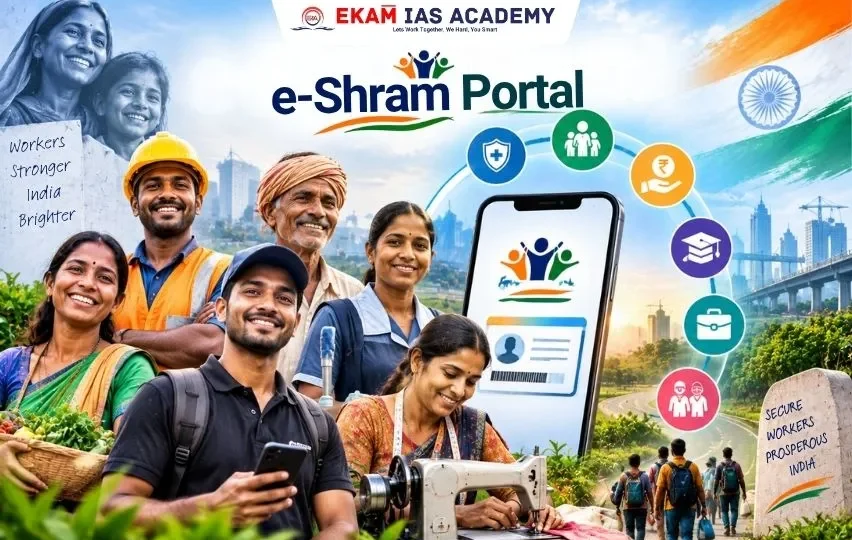
The e-Shram Portal was launched in 2021 by the Ministry of Labour and Employment and developed by the National Informatics Centre (NIC) to create India’s first Aadhaar-authenticated National Database of Unorganised Workers (NDUW).
The portal provides registered workers with a unique 12-digit Universal Account Number (UAN), enabling identification and easier access to government welfare schemes across the country.
The initiative aims to improve social security delivery through:
- Better coordination among different ministries.
- Secure data exchange through digital platforms.
- Evidence-based policy formulation.
- Portability of benefits for migrant workers.
Who are Covered Under e-Shram?
An unorganised worker includes:
- Home-based workers.
- Self-employed workers.
- Wage workers in the unorganised sector.
- Workers in the organised sector who are not covered under EPFO, ESIC or government employment.
Any worker aged 16 years or above can register on the portal, provided they are not an income tax payer and are not members of EPFO or ESIC.
The portal covers diverse categories such as:
- Construction workers.
- Migrant labourers.
- Domestic workers.
- Agricultural workers.
- Street vendors.
- Gig and platform workers.
- Other informal sector workers.
Objectives and Significance of e-Shram
The primary objective of e-Shram is to bring India’s vast unorganised workforce under a structured social security framework.
The portal helps in:
- Creating a national database of informal workers.
- Ensuring targeted welfare delivery.
- Providing portability of benefits across states.
- Supporting migrant workers who frequently change locations.
- Improving government planning through reliable workforce data.
With more than 31.89 crore registrations, e-Shram has become a major platform for strengthening inclusive labour welfare.
Evolution into a One-Stop Solution
In October 2024, e-Shram was expanded into a One-Stop Solution, transforming it from merely a worker database into an integrated service delivery platform.
The platform now connects workers with multiple government programmes related to:
- Social security.
- Employment.
- Skill development.
- Apprenticeships.
- Pension benefits.
It integrates 15 welfare and social security schemes, including:
- Pradhan Mantri Shram Yogi Maan-Dhan Yojana (PM-SYM).
- Pradhan Mantri Suraksha Bima Yojana (PMSBY).
- Pradhan Mantri Jeevan Jyoti Bima Yojana (PMJJBY).
- National Social Assistance Programme (NSAP).
- One Nation One Ration Card (ONORC).
- Pradhan Mantri Awaas Yojana–Gramin (PMAY-G).
Social Security and Employment Benefits
Through e-Shram, workers can access insurance and pension schemes.
Insurance Coverage
- PMSBY provides ₹2 lakh insurance cover for accidental death or permanent disability and ₹1 lakh for partial disability.
- PMJJBY provides ₹2 lakh life insurance coverage.
Pension Support
- PMSBY provides ₹2 lakh insurance cover for accidental death or permanent disability and ₹1 lakh for partial disability.
- PMJJBY provides ₹2 lakh life insurance coverage.
Employment and Skill Development
The portal connects workers with:
- National Career Service (NCS) for employment opportunities.
- Skill India Digital Hub for training and apprenticeship opportunities.
Support for Migrant and Gig Workers
A major advantage of e-Shram is the portability of welfare benefits across states.
The portal captures migrant worker details and enables access to schemes even when workers move for employment.
It also supports registration of gig and platform workers, with around 11.5 lakh platform workers registered on the portal.
For construction workers, e-Shram enables sharing of worker information with States and Union Territories for registration under Building and Other Construction Workers (BOCW) Boards.
Technology and Accessibility Features
To improve accessibility, e-Shram introduced multilingual services through the Bhashini platform, providing support in 22 languages from 2025.
The digital architecture allows workers from different regions and linguistic backgrounds to access welfare services more easily.
Conclusion
The e-Shram Portal represents a major transformation in India’s labour welfare system by bringing millions of unorganised workers into a unified digital framework.
By providing a unique identity through UAN, ensuring portability of benefits and integrating welfare, employment and skill development services, e-Shram strengthens social security for India’s informal workforce.
The initiative reflects the broader vision of technology-driven inclusive growth and Viksit Bharat, ensuring that economic development reaches workers at the grassroots level.


Frequently Asked Questions about e-Shram
What is the e-Shram Portal?
The e-Shram Portal is a national database of unorganised workers launched in 2021 to provide them with easier access to social security, employment and welfare schemes.
Who can register on the e-Shram Portal?
Unorganised workers aged 16 years and above, including migrant workers, construction workers, domestic workers, agricultural workers, street vendors and gig workers, can register subject to eligibility conditions.
What is the Universal Account Number (UAN) in e-Shram?
The Universal Account Number (UAN) is a unique 12-digit number provided to registered workers, helping identify them and access eligible government welfare benefits.
What benefits are available through e-Shram?
The portal connects workers with schemes covering social security, insurance, pensions, employment, skill development and apprenticeships, including PM-SYM, PMSBY and PMJJBY.
How does e-Shram help migrant workers?
e-Shram supports portability of welfare benefits across States, helping migrant and informal workers access eligible government services even when they move to another State for employment.