
Table of Contents
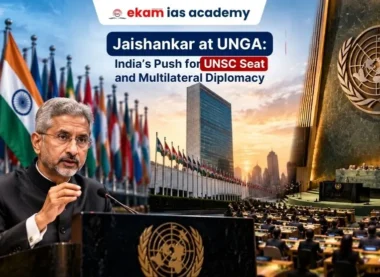
ToggleAt the 81st UNGA in New York, External Affairs Minister S. Jaishankar called for stronger and reformed multilateralism amid rising geopolitical tensions, conflicts and challenges to global cooperation.
He made these remarks while co-chairing the first Partners for Multilateralism, International Law, Peace & Prosperity (P4M) Summit with European Council President Antonio Costa, focusing on strengthening international cooperation and rule-based global governance.
Global Order Under Stress
India highlighted that increasing strategic competition among major powers has created pressure on the existing global order. It emphasised that multilateral institutions must become more effective in addressing common challenges such as:
- International peace and security
- Climate change and climate justice
- Emerging technologies
- Development finance
- Counter-terrorism
- Global supply-chain disruptions
- Disaster resilience and pandemic preparedness
The 4F Crisis: Fuel, Food, Fertiliser and Finance
India drew attention to the vulnerability of global systems through the “4F crisis” — Fuel, Food, Fertiliser and Finance.
The focus was on:
- Diversifying critical supply chains.
- Reducing dependence on strategic chokepoints.
- Creating safeguards for emerging technologies.
- Building resilience against geopolitical and economic shocks.
This approach supports India’s broader objective of maintaining strategic autonomy while strengthening economic security.
Reformed Multilateralism
India advocated reforms in global institutions based on:
- Greater representation of developing countries.
- Transparent and inclusive decision-making.
- Respect for international law and global norms.
India has consistently called for reforms in institutions such as the United Nations Security Council (UNSC) to reflect current geopolitical and economic realities.
India and Visegrad Group Engagement
India participated in the first V4+India Foreign Ministers’ Meeting with the Visegrad Group, comprising:
- Czech Republic
- Hungary
- Poland
- Slovakia
The discussions focused on cooperation in trade, defence, technology, space, connectivity and people-to-people relations, strengthening India’s engagement with Central Europe.
Significance for India
India’s position at the UNGA highlights key priorities:
- Strategic autonomy: Independent decision-making amid global power competition.
- Global South leadership: Promoting greater representation for developing nations.
- Supply-chain resilience: Reducing vulnerabilities from external disruptions.
- Rules-based order: Supporting international law and peaceful cooperation.
Conclusion
India’s advocacy of reformed multilateralism reflects the need for a more inclusive and effective global governance system. By promoting cooperation, representation and resilience, India seeks a multilateral framework capable of addressing challenges such as climate change, technological disruption, pandemics and global insecurity.
FAQs: 81st United Nations General Assembly (UNGA)
What is the significance of the 81st United Nations General Assembly (UNGA)?
The 81st UNGA provided a platform for discussions on global challenges, including geopolitical tensions, climate change, emerging technologies, international security and the need for stronger multilateral cooperation.
What is meant by Reformed Multilateralism?
Reformed multilateralism refers to restructuring global institutions to make them more representative, transparent and inclusive, especially by increasing the participation of developing countries in global decision-making.
What is the 4F Crisis highlighted by India at the UNGA?
The 4F Crisis refers to challenges related to Fuel, Food, Fertiliser and Finance. India highlighted the need to strengthen global resilience by diversifying supply chains and reducing vulnerabilities caused by geopolitical and economic disruptions.
What is the Visegrad Group and why is India engaging with it?
The Visegrad Group (V4) is a regional cooperation group consisting of the Czech Republic, Hungary, Poland and Slovakia. India’s engagement with the group focuses on cooperation in areas such as trade, defence, technology, space, connectivity and people-to-people relations.
Why does India advocate reforms in global institutions like the UNSC?
India supports reforms in global institutions to ensure greater representation of developing countries and make international decision-making structures reflect current geopolitical and economic realities.