Table of Contents
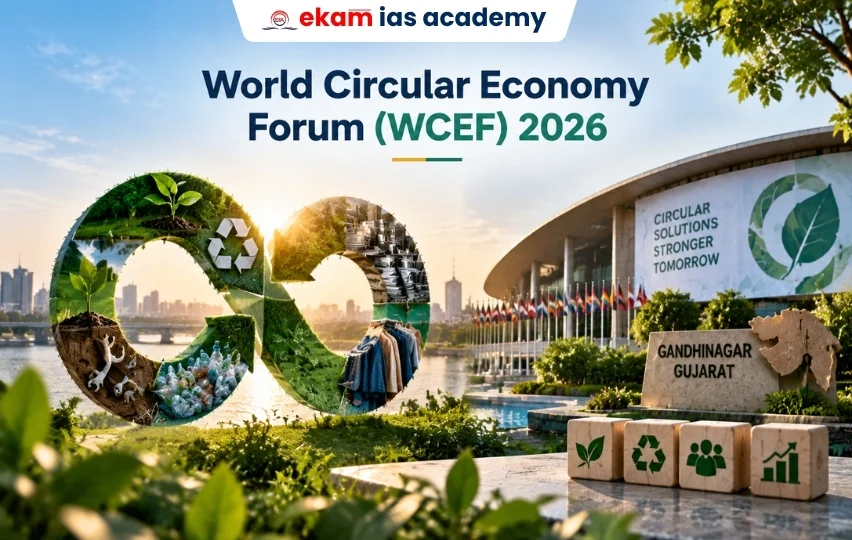
ToggleThe World Circular Economy Forum (WCEF) 2026 was held in Gandhinagar, Gujarat, under the theme “Circular Economy: Transition for People and Prosperity”. This was the first edition of WCEF hosted in South Asia, focusing on practical solutions for promoting sustainable production, consumption and resource management.
The event was jointly organised by the Central Pollution Control Board (CPCB), Ministry of Environment, Forest and Climate Change (MoEF&CC), Government of Gujarat, Gujarat Pollution Control Board (GPCB), and the Finnish Innovation Fund Sitra.
About World Circular Economy Forum (WCEF)
The World Circular Economy Forum (WCEF) is a global platform that brings together governments, industries, researchers, innovators and civil society organisations to discuss strategies for building a circular economy.
WCEF 2026 focused on four major themes:
- People
- Business
- Governance
- Growth
The discussions included plenary sessions, expert meetings, accelerator programmes and exhibitions showcasing innovative circular economy solutions.
What is Circular Economy?
A circular economy is a sustainable model of production and consumption that aims to minimise waste and maximise resource utilisation.
Unlike the traditional linear economy model of “take–make–consume–dispose”, the circular economy focuses on:
- Reusing products
- Repairing and refurbishing materials
- Remanufacturing goods
- Recycling resources
- Extending product life cycles
The objective is to keep materials in circulation for a longer period, reduce resource extraction and create additional economic value.
India’s Circular Economy Approach
India’s circular economy strategy combines traditional practices of reuse, repair and resource conservation with modern technologies and sustainable resource management systems.
The government has introduced several measures, including:
- Strengthening waste management regulations.
- Promoting Extended Producer Responsibility (EPR) frameworks.
- Developing digital monitoring and compliance systems.
- Encouraging recycling and resource recovery industries.
Under various EPR mechanisms, more than 83,000 producers and 4,802 recyclers have been registered, with around 482.24 lakh metric tonnes of regulated waste processed, supporting a shift from waste disposal towards resource recovery.
Link with Mission LiFE
WCEF 2026 also highlighted the importance of Lifestyle for Environment (LiFE), which promotes sustainable choices among individuals and communities.
The approach encourages responsible consumption patterns, efficient use of resources and adoption of environmentally friendly lifestyles.
By integrating circular practices into daily life, Mission LiFE aims to create behavioural changes necessary for long-term sustainability.
International Cooperation
India has been promoting global cooperation on circular economy through initiatives such as the Resource Efficiency and Circular Economy Industry Coalition (RECEIC) launched during India’s G20 Presidency.
The initiative seeks to encourage collaboration among industries, governments and international partners for improving resource efficiency and developing sustainable economic models.
Conclusion
The World Circular Economy Forum 2026 highlights the growing importance of sustainable resource management in addressing environmental challenges. By promoting recycling, resource efficiency, responsible consumption and global cooperation, circular economy principles can support economic growth while reducing pressure on natural resources and contributing to sustainable development.
FAQs: World Circular Economy Forum (WCEF) 2026
What is the World Circular Economy Forum (WCEF)?
The World Circular Economy Forum (WCEF) is a global platform that brings together governments, industries, researchers, innovators and civil society organisations to discuss solutions for building a circular economy.
Where was WCEF 2026 held and what was its theme?
The World Circular Economy Forum 2026 was held in Gandhinagar, Gujarat, under the theme “Circular Economy: Transition for People and Prosperity.” It was the first WCEF edition hosted in South Asia.
What is a circular economy?
A circular economy is a sustainable model of production and consumption that focuses on reducing waste and maximising resource use through reuse, repair, refurbishment, remanufacturing and recycling.
How is India promoting the circular economy?
India is promoting circular economy practices through measures such as Extended Producer Responsibility (EPR), waste management regulations, recycling systems, digital monitoring and resource recovery initiatives.
What is the connection between Mission LiFE and the circular economy?
Mission LiFE (Lifestyle for Environment) promotes sustainable lifestyles by encouraging responsible consumption, efficient resource use and environmentally friendly practices that support circular economy principles.