Table of Contents
ToggleRung Community
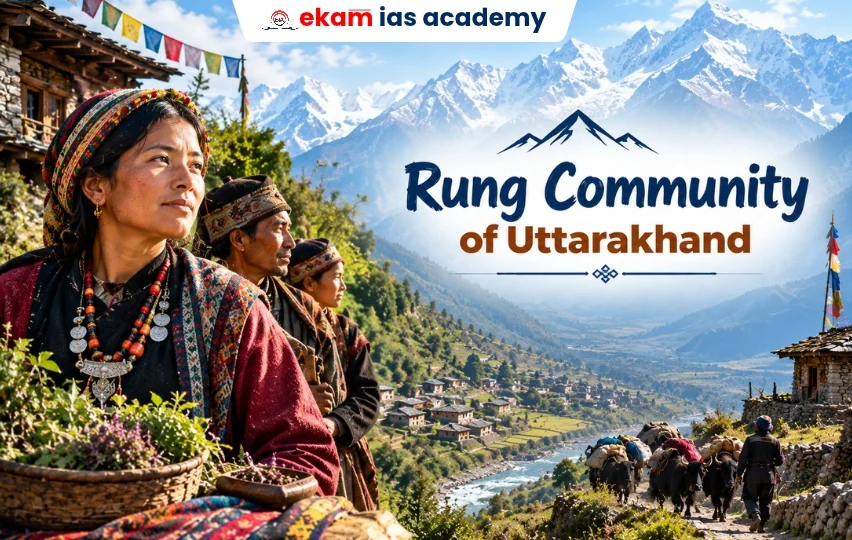
The Rung community, also known as Rang or Shauka, is an indigenous Tibeto-Burman tribal community of the high Himalayan valleys of Pithoragarh, Uttarakhand. Recognised as a Scheduled Tribe, the community has historically been associated with trans-Himalayan trade, seasonal migration, pastoralism and agriculture. Their close relationship with mountains, rivers and forests continues to shape their cultural identity.
Who Are the Rung Community?
The Rung are a distinct Himalayan community with their own linguistic traditions, customs and social institutions. They are generally included within the broader Bhotia classification but retain a separate cultural identity.
They traditionally inhabit the Vyans, Darma, Chaudans and Johar valleys, mainly around Dharchula and Munsiyari. Rung languages and dialects include Byansi, Chaudangsi and Darmiya, collectively associated with Runglo or Rangkas.
Historically, the community depended on trade, farming and pastoralism. Their seasonal movement between high-altitude summer settlements and lower winter settlements is an example of transhumance.
Rung Community History and Origin
The Rung community’s history is closely connected with the ancient trade routes linking the Kumaon Himalayas with Tibet.
For centuries, Rung traders crossed Himalayan passes such as Lipulekh, Darma, Limpiya Dhura, Kungri-Bingri and Untadhura. Indian traders exchanged grains, sugar, spices, textiles and other products for Tibetan goods including salt, wool and borax.
Milam in the Johar Valley emerged as an important trading centre, while markets such as Taklakot (Purang) served as major destinations.
The traditional economy suffered a major setback after China’s control over Tibet and the 1962 India-China War, which effectively disrupted the trans-Himalayan trade network. The community subsequently diversified into education, government employment, medicinal herb collection and tourism.
Limited regulated border trade through Lipulekh resumed in the 1990s but was suspended again in 2020.
Rung Community Culture, Traditions and Festivals
Rung culture reflects a deep connection with nature. The community traditionally worships sacred mountains, rivers and forests and associates these landscapes with Lord Shiva.
The Kandali Festival is among their most important cultural celebrations. It is traditionally associated with the flowering of the Kandali plant and is celebrated periodically in the Chaudans region. The festival combines worship, community gatherings, traditional dress, feasting and rituals.
The community also maintains traditional practices relating to livestock, seasonal migration and collection of medicinal herbs.
Geographical Distribution of the Rung Community in India
The Rung community is concentrated mainly in Pithoragarh district of Uttarakhand, particularly in the Dharchula and Munsiyari regions.
Their traditional settlements extend across the Johar, Darma, Chaudans and Vyans valleys. Places such as Gunji, near the Lipulekh Pass, are important for border connectivity, pilgrimage and traditional trade.
Related Rung groups are also found across the border in Nepal. Their distinctive culture and livelihood practices make them an important part of the social and cultural heritage of India’s Himalayan borderlands.


FAQs: Rung Community of Uttarakhand
Who are the Rung Community of Uttarakhand?
The Rung Community, also known as Rang or Shauka, is an indigenous Himalayan tribal community primarily found in Pithoragarh district, Uttarakhand. They are recognised as a Scheduled Tribe under the broader Bhotia classification.
Where is the Rung Community mainly located?
The Rung Community primarily inhabits the Vyans, Darma, Chaudans and Johar valleys of Uttarakhand, particularly around Dharchula and Munsiyari near the India-Nepal-Tibet border region.
What is the traditional occupation of the Rung Community?
Traditionally, the Rung Community depended on trans-Himalayan trade, pastoralism, agriculture and seasonal migration. They exchanged grains, spices and textiles for Tibetan products such as salt, wool and borax.
What is the Kandali Festival of the Rung Community?
The Kandali Festival is an important traditional celebration associated with the flowering of the Kandali plant. Celebrated periodically in the Chaudans region, it reflects the community’s cultural heritage, nature worship and traditional customs.
Why is the Rung Community important for UPSC preparation?
The Rung Community is relevant to UPSC Geography, Indian Society and Tribal Culture. Important topics include Himalayan tribal communities, transhumance, the India-Tibet trade routes, the Kandali Festival and the cultural heritage of Uttarakhand.