Table of Contents
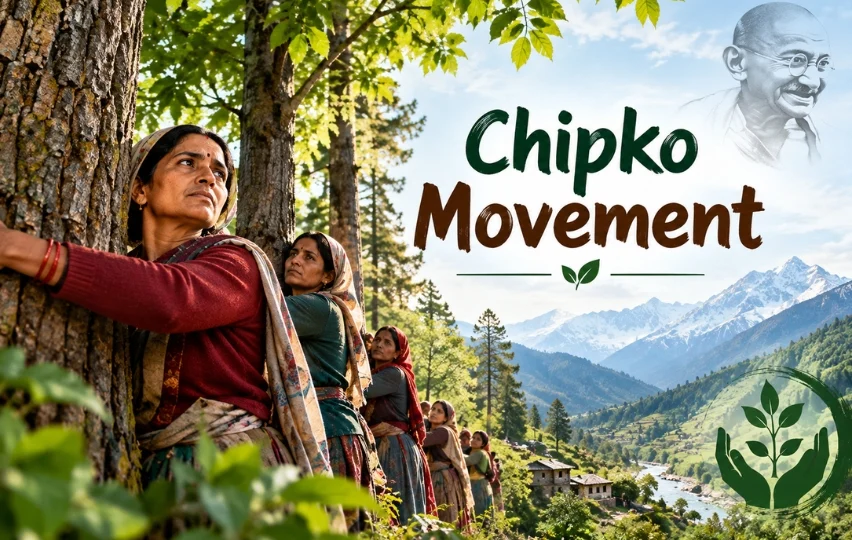
ToggleThe Chipko Movement was a landmark non-violent environmental movement that emerged in the Himalayan region of present-day Uttarakhand in 1973. Villagers, particularly women, embraced trees to prevent commercial logging and protect forests that supported their livelihoods. Inspired by Gandhian principles of non-violence and Satyagraha, the movement connected forest conservation with rural welfare, ecological security and community rights.
What is Chipko Movement?
The Chipko Movement, or Chipko Andolan, was a grassroots campaign against commercial exploitation of Himalayan forests.
- Meaning: “Chipko” means to embrace or cling to.
- Origin: Garhwal Himalayas in 1973.
- Objective: Prevent indiscriminate tree felling and conserve forests.
- Nature: Peaceful, community-led environmental resistance.
- Key feature: Strong participation of local women.
- Approach: Non-violence, Satyagraha and collective action.
Chipko Movement History
The movement developed from growing concerns over forest degradation and the increasing restrictions placed on communities dependent on forest resources.
- 1964: Chandi Prasad Bhatt founded the Dasholi Gram Swarajya Sangh (DGSS) to promote rural industries using local resources.
- 1970: Severe floods in the region intensified concerns about deforestation and ecological degradation.
- 1973: Villagers near Mandal in the Alaknanda valley resisted tree felling permitted for a sports-goods manufacturer.
- 1974: At Reni village, Gaura Devi and local women confronted loggers and protected the forest by embracing trees.
- 1980: Sustained campaigning contributed to a 15-year ban on commercial tree felling in Himalayan forests.
- 1981–83: Sunderlal Bahuguna undertook a long Himalayan march to spread awareness about forest conservation.
Chipko Movement Causes
The movement was driven by several interconnected ecological and socio-economic concerns:
- Commercial logging and forest degradation.
- Limited access of local communities to forest resources.
- Loss of fuel, fodder and livelihood resources.
- Soil erosion and declining agricultural productivity.
- Water scarcity and ecological deterioration.
- Flooding and other environmental risks.
- Failure to adequately address villagers’ demands.
Chipko Movement Methods
Protesters relied on peaceful resistance rather than violence. Villagers hugged trees, organised collective demonstrations and practised Satyagraha. Women played a particularly important role in mobilisation. Activists also used fasting, religious practices and public awareness campaigns to oppose destructive forest policies.
Chipko Movement Leaders
Chandi Prasad Bhatt mobilised villagers through the DGSS and helped organise early protests.
Sunderlal Bahuguna expanded the movement’s message through fasting, campaigns and his extensive Himalayan march.
Gaura Devi became an iconic symbol of women-led forest conservation through the 1974 Reni protest.
Dhoom Singh Negi also participated in grassroots resistance and fasting campaigns against commercial exploitation.
Chipko Movement Impacts
The movement had significant environmental and social consequences. It strengthened public awareness about forest conservation and contributed to restrictions on commercial tree felling in Himalayan forests.
It also demonstrated the importance of women’s participation and community involvement in environmental governance. Chipko influenced subsequent environmental campaigns, including the Appiko Movement in Karnataka, while broadening attention towards mining, dams and Himalayan ecological protection.
Overall, the Chipko Movement remains an important example of how community action, ecological awareness and non-violent resistance can influence environmental policy and resource governance.


FAQs: Chipko Movement
What is the Chipko Movement?
The Chipko Movement was a non-violent environmental movement that began in 1973 in the Garhwal Himalayas of present-day Uttarakhand. Villagers hugged trees to prevent commercial logging and protect forest resources.
Who were the major leaders of the Chipko Movement?
The prominent leaders included Sunderlal Bahuguna, Chandi Prasad Bhatt, Gaura Devi and Dhoom Singh Negi. Gaura Devi became particularly famous for leading women in the 1974 Reni village protest.
What were the main causes of the Chipko Movement?
The movement emerged due to commercial deforestation, loss of forest-based livelihoods, soil erosion, water scarcity, ecological degradation and restrictions on local communities’ access to forest resources.
What were the major achievements of the Chipko Movement?
The movement contributed to a 15-year ban on commercial tree felling in Himalayan forests in 1980, strengthened environmental awareness, encouraged women’s participation and inspired other conservation movements, including the Appiko Movement.
Why is the Chipko Movement important for UPSC?
The Chipko Movement is important for UPSC Prelims and Mains, particularly GS Paper 1 (Social Movements) and GS Paper 3 (Environment and Ecology). It highlights Gandhian Satyagraha, community-based forest conservation, women’s empowerment and sustainable development.