
Table of Contents
ToggleINDIA'S STRATEGIC BALANCING ACT AND MULTI-ALIGNMENT
TOPIC: (GS2) INTERNATIONAL RELATIONS: THE HINDU
India’s diplomatic positions at the 2026 SCO and BRICS summits have sparked debate over its relations with Russia, the United States, China and Iran.
India’s Multi-Alignment Policy
- Multi-alignment means maintaining partnerships with different countries without joining any single power bloc.
- India cooperates with the United States through the Quad while engaging Russia and China through BRICS and the Shanghai Cooperation Organisation (SCO).
- This approach aims to protect national interests, diversify partnerships and preserve independent foreign-policy decisions.
- It reflects India’s transition from traditional non-alignment towards issue-based cooperation.
Developments Highlighted in the Article
- SCO Summit, Bishkek: India reportedly supported a declaration criticising military attacks on Iran and reaffirming its sovereignty.
- BRICS Summit, New Delhi: Members expressed support for Palestinian rights and a negotiated two-state solution.
- Ukraine conflict: Prime Minister Narendra Modi publicly urged Russian President Vladimir Putin to end the prolonged war.
- These developments have raised questions about whether India’s diplomatic messages are consistent across different conflicts.
Importance of India–Russia Relations
- Defence cooperation: Russia remains an important supplier of military equipment, including the S-400 air defence system.
- Energy security: Russian crude oil helps India diversify energy imports.
- Nuclear cooperation: Russia supports the Kudankulam Nuclear Power Project.
- Multilateral coordination: Both countries cooperate through BRICS, SCO and other international platforms.
- Historical ties: The relationship has provided continuity across changing geopolitical conditions.
Challenges
- Russia–China partnership: Moscow’s growing dependence on Beijing complicates India’s strategic calculations.
- Western pressure: Sanctions and geopolitical tensions create difficulties for trade and defence transactions.
- Defence diversification: India’s increasing cooperation with France, Israel and the United States reduces dependence on Russian equipment.
- Diplomatic perceptions: Public criticism of the Ukraine war may be interpreted differently by Moscow and Western capitals.
- Regional instability: Conflicts involving Iran, Israel and the Gulf affect India’s energy supplies and diaspora interests.
India’s Strategic Interests
- Maintain constructive relations with Russia without weakening partnerships with Western democracies.
- Protect energy security, defence preparedness and access to advanced technologies.
- Support sovereignty, territorial integrity and peaceful dispute resolution.
- Strengthen India’s position as an independent voice of the Global South.
- Prevent excessive dependence on any single country for critical resources.
Way Forward
- Consistent diplomacy: Apply principles of international law and peaceful settlement across conflicts.
- Regular dialogue: Address Russian concerns through high-level diplomatic engagement.
- Strategic diversification: Expand defence manufacturing and alternative energy partnerships.
- Economic cooperation: Improve bilateral trade mechanisms and connectivity projects.
- Multilateral engagement: Use BRICS, SCO and the United Nations to encourage dialogue and reduce tensions.
Conclusion
India’s strategic autonomy will remain credible only when its diplomacy combines consistent principles, diversified partnerships and dependable relations with longstanding partners.
INDIA'S NEXT INVESTMENT CYCLE AND BUILDING A LOW-CARBON CLIMATE-RESILIENT ECONOMY
TOPIC: (GS3) ECONOMY: THE HINDU
A recent analysis highlights how India’s upcoming investments in buildings, electricity networks, steel and cement will determine its future carbon emissions.
India’s Infrastructure Opportunity
- UNEP has warned about the growing risk of exceeding the 1.5°C global warming threshold.
- According to NITI Aayog, nearly 86% of India’s projected building stock for 2070 is yet to be constructed.
- Total building floor space may increase from 18 billion square metres in 2020 to 42 billion by 2070.
- India’s steel capacity is targeted to reach 300 million tonnes by 2030–31, while cement production may reach 660 million tonnes by 2030.
- These investments offer an opportunity to adopt clean technologies from the beginning.
Why Early Investment Decisions Matter
- Carbon lock-in: Inefficient infrastructure can create emissions for several decades.
- Stranded assets: High-emission projects may lose economic value because of future regulations or technological changes.
- Avoided retrofitting: Constructing energy-efficient assets initially is often cheaper than upgrading them later.
- Unlike developed economies, India can incorporate modern standards into much of its future infrastructure.
Sector-Wise Challenges and Opportunities
A. Buildings
- Promote energy-efficient construction, natural ventilation and sustainable cooling.
- Implement Energy Conservation and Sustainable Building Code (ECSBC), 2024.
- Apply Eco-Niwas Samhita (ENS), 2024 to residential buildings.
- Link compliance with building approvals and occupancy certificates.
B. Power Sector
- Renewable generation is expanding faster than transmission infrastructure.
- According to the article, grid bottlenecks have affected nearly 60 GW of renewable capacity.
- Invest in transmission networks, battery storage and grid modernisation.
- Reliable electricity supply is essential for electric vehicles and industrial electrification.
C. Steel and Cement
- These industries are difficult to decarbonise because they require substantial energy.
- Green hydrogen and carbon capture remain expensive or commercially uncertain.
- Government procurement can encourage low-carbon steel and cement without mandating particular technologies.
Government Initiatives
- National Green Hydrogen Mission: Supports cleaner industrial energy.
- Carbon Credit Trading Scheme (CCTS): Creates incentives for reducing emissions intensity.
- Green Steel Taxonomy: Provides a framework for identifying lower-emission steel.
- India’s Net-Zero Target: Achieve net-zero emissions by 2070.
Financing and Implementation Challenges
- High capital costs: Renewable projects face expensive financing.
- Technology uncertainty: Premature investments may create financial losses.
- Weak enforcement: Building standards are not uniformly implemented.
- Coordination gaps: Power generation, transmission and storage require integrated planning.
Way Forward
- Enforce energy-efficiency standards across States.
- Use green public procurement to create demand for cleaner materials.
- Offer credit guarantees and concessional finance for proven technologies.
- Encourage competitive bidding and technology-neutral emission standards.
- Prioritise long-term planning to avoid costly future corrections.
Conclusion
India’s next investment cycle must build efficient, flexible and low-carbon infrastructure today to secure sustainable growth and prevent expensive climate-related costs tomorrow.
JOJARI RIVER POLLUTION AND STATE ACCOUNTABILITY
TOPIC: (GS3) ENVIRONMENT: THE HINDU
The Supreme Court criticised the Rajasthan government for failing to control industrial pollution in the Jojari River, threatening public health and the environment.
Jojari River Pollution
- Jojari, Bandi and Luni are seasonal rivers flowing through the arid regions of western Rajasthan.
- Jodhpur, Pali and Balotra are major centres of textile dyeing and industrial activity.
- Untreated industrial wastewater enters rivers, agricultural land and groundwater.
- Approximately 20 lakh people face potential health and livelihood risks.
- The problem has continued despite judicial intervention beginning with a 2011 public interest litigation.
Major Causes of River Pollution
- Industrial effluents: Textile dyes, chemicals and metal-processing waste contaminate water.
- Inadequate sewage treatment: Existing facilities reportedly handle only about half the sewage generated.
- Underutilised CETPs: Common Effluent Treatment Plants operate below capacity despite continuing pollution.
- Illegal sand mining: Riverbed extraction damages ecosystems and natural water flow.
- Weak enforcement: Poor monitoring and suspected regulatory collusion allow violations to continue.
Supreme Court’s Intervention
- The Court initiated suo motu proceedings in 2025.
- It established a High-level Ecosystem Oversight Committee, chaired by Justice Sangeet Lodha, to examine treatment facilities and recommend restoration measures.
- It prohibited construction within 100 metres of riverbanks.
- Hazardous industries were restricted within 500 metres of the river’s course or applicable flood lines.
- The Court raised concerns about administrative negligence and possible collusion.
Constitutional and Legal Framework
- Article 21: The right to life includes access to a clean and healthy environment.
- Article 48A: Directs the State to protect and improve the environment.
- Article 51A(g): Makes environmental protection a fundamental duty of citizens.
- Water Act, 1974: Regulates water pollution through pollution control boards.
- Environment (Protection) Act, 1986: Provides broader powers to prevent environmental damage.
- National Green Tribunal Act, 2010: Enables specialised environmental adjudication.
Environmental Principles and Governance Issues
- Polluter Pays Principle: Polluters must bear the costs of pollution control and environmental restoration.
- Precautionary Principle: Authorities should prevent serious environmental damage even amid scientific uncertainty.
- Public Trust Doctrine: Natural resources must be protected for public benefit.
- Regulatory accountability: Courts should ensure authorities perform their statutory duties rather than permanently replacing regulators.
Way Forward
- Ensure 100% treatment of industrial effluents before discharge.
- Improve CETP connectivity, utilisation and sewage-treatment capacity.
- Introduce real-time effluent monitoring and independent environmental audits.
- Impose environmental compensation on responsible polluters.
- Prevent illegal sand mining through strict inspections and enforcement.
- Prepare a time-bound river restoration plan with community participation and public reporting.
Conclusion
Restoring the Jojari River requires not merely judicial directions but accountable institutions, strict enforcement and sustained ecological rehabilitation.
GENETICALLY MODIFIED CROPS IN INDIA AND BIOSAFETY CONCERNS
TOPIC: (GS3) SCIENCE AND TECHNOLOGY: THE HINDU
Nobel laureate Richard J. Roberts supported the development of genetically modified (GM) crops in Indian laboratories, arguing that domestic innovation can reduce dependence on foreign seed companies.
What Are Genetically Modified Crops?
- GM crops are plants whose genetic material is deliberately changed using modern biotechnology to introduce desirable characteristics.
- These include pest resistance, improved nutrition, herbicide tolerance and climate resilience.
- Example: Bt cotton contains a gene from Bacillus thuringiensis, which helps protect it against certain insect pests.
- CRISPR-Cas9 is a gene-editing technique that allows scientists to make targeted
Status of GM Crops in India
Crop | Approval status |
Bt cotton | Approved for commercial cultivation in 2002 |
Bt brinjal | Under an indefinite moratorium since 2010 |
GM mustard (DMH-11) | Conditional environmental-release approval in 2022; commercial cultivation remains stalled |
Golden Rice | Not approved for commercial cultivation |
Other GM food crops | No commercial cultivation approval |
- Bt cotton remains India’s only commercially approved transgenic GM crop.
- In July 2024, the Supreme Court delivered a split verdict on GM mustard and called for a national GM crop policy.
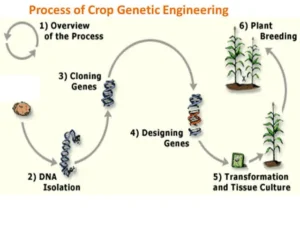
GM Crops Versus Gene-Edited Crops
- Transgenic GM crops may contain genetic material introduced from another organism.
- Gene editing modifies selected DNA sequences and need not introduce foreign DNA.
- In 2025, ICAR announced two genome-edited rice varieties: DRR Rice 100 (Kamala) and Pusa DST Rice 1.
- These were developed under a distinct regulatory framework and should not be confused with conventional transgenic GM crops.
Regulatory Framework
- GEAC: Genetic Engineering Appraisal Committee under the Environment Ministry evaluates environmental release proposals.
- RCGM: Review Committee on Genetic Manipulation oversees biotechnology research-related biosafety.
- Environment (Protection) Act, 1986: Provides the legal foundation for regulating genetically engineered organisms.
- 1989 Rules: Govern research, handling and environmental release of genetically engineered organisms.
Concerns
- Food security: Biotechnology may improve crop productivity and resistance to pests.
- Nutritional security: Golden Rice was developed to produce beta-carotene, a vitamin A precursor.
- Domestic innovation: Indian laboratories can develop locally suitable crop varieties.
- Biosafety concerns: Possible effects on biodiversity, non-target organisms and resistant pests require evaluation.
- Economic concerns: Patents, licensing costs and seed-market concentration may affect farmers.
Way Forward
- Develop a transparent, science-based national biotechnology policy.
- Strengthen independent biosafety testing and long-term ecological monitoring.
- Support public-sector research, affordable seeds and indigenous intellectual property.
- Ensure farmer consultation, field-level assessment and accountability.
- Evaluate each crop individually rather than treating all biotechnology applications alike.
Conclusion
India must combine indigenous biotechnology innovation with rigorous biosafety safeguards to strengthen food security, farmer welfare and agricultural self-reliance.
INFRASTRUCTURE INVESTMENT TRUSTS (INVITS)
TOPIC: (GS3) ECONOMY: THE HINDU
India’s Infrastructure Investment Trusts (InvITs) are attracting more investors, with 6.53 lakh investors and ₹7.3 lakh crore in assets under management in Q1 FY27.
What are InvITs?
- InvITs are investment vehicles that pool money from investors to own and manage income-generating infrastructure assets.
- They function similarly to mutual funds, but invest mainly in infrastructure rather than shares and bonds.
- They are regulated by SEBI under the SEBI (Infrastructure Investment Trusts) Regulations, 2014.
- Investors purchase units and receive periodic distributions from infrastructure
How Do InvITs Work?
- A developer transfers operational assets, such as toll roads or power transmission lines, to an InvIT.
- Investors provide capital by purchasing its units.
- Revenue from these assets supports distributions to unitholders.
- Developers can reinvest the released capital in new infrastructure projects.
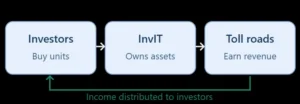
Significance for India’s Economy
- Infrastructure financing: Mobilises domestic savings for long-term investments.
- Asset monetisation: Unlocks capital tied up in completed projects.
- Investor participation: Allows smaller investors to access infrastructure assets.
- Capital recycling: Supports fresh construction without relying entirely on public expenditure.
- Financial market development: Expands alternative investment opportunities.
Challenges
- Revenue risks: Toll collections and other earnings may fluctuate.
- Interest-rate risks: Higher borrowing costs can affect returns.
- Liquidity concerns: Some InvIT units may have limited trading activity.
- Regulatory risks: Changes in tariffs or concession agreements can affect profitability.
Way Forward
- Strengthen transparency, disclosures and investor protection.
- Encourage participation by pension funds, insurers and retail investors.
- Improve asset valuation and risk assessment.
- Promote financially sustainable infrastructure projects.
Conclusion
InvITs can transform India’s domestic savings into productive infrastructure capital, provided investor protection and financial discipline remain strong.