Table of Contents
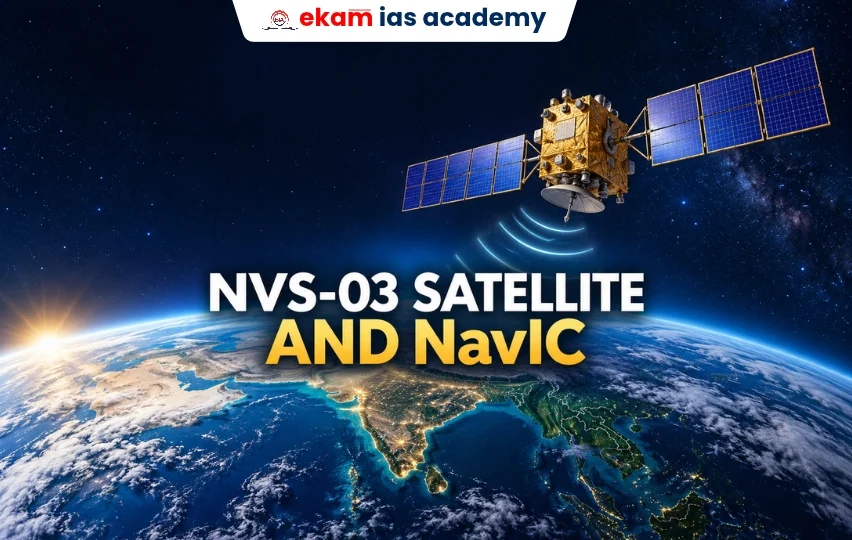
ToggleThe Indian Space Research Organisation (ISRO) is preparing to launch NVS-03 aboard the GSLV-F18 (Mk II) from Sriharikota, Andhra Pradesh. The mission is important for strengthening India’s indigenous navigation system, NavIC, at a time when the operational constellation has faced satellite attrition.
What are the Key Facts About the NVS-03?
NVS-03 is the third satellite of ISRO’s second-generation NVS series, developed to replace ageing first-generation IRNSS satellites. It is designed for a mission life of around 12 years.
A major feature is its indigenous rubidium atomic clock, developed by the Space Applications Centre (SAC), Ahmedabad. Indigenous timing technology is significant because failures of imported atomic clocks affected earlier NavIC satellites.
NVS-03 will also transmit a civilian L1-band signal, alongside L5 and S-band signals. L1 compatibility can make NavIC more suitable for integration into consumer technologies such as smartphones, smartwatches and other navigation-enabled devices.
If successfully commissioned, NVS-03 is expected to strengthen the constellation and improve standalone positioning capability.
What is the NavIC System?
NavIC (Navigation with Indian Constellation) is India’s regional satellite-navigation system developed by ISRO. It provides positioning, navigation and timing services for civilian and strategic users.
The system consists of space, ground and user segments. Its primary service area covers India and extends up to about 1,500 km beyond its borders.
NavIC provides Standard Positioning Service (SPS) for civilian users and an encrypted Restricted Service (RS) for authorised applications, including strategic and defence requirements.
The original IRNSS constellation consisted of seven satellites. The newer NVS series introduces longer mission life, improved reliability and L1-band capability.
What Measures are Needed to Strengthen India’s Regional Navigation System?
India needs sustained launches of the remaining NVS satellites to maintain constellation continuity and redundancy. Wider deployment of indigenous atomic clocks, NavIC-compatible chipsets and receivers can strengthen technological self-reliance.
Greater integration with smartphones, vehicles and other civilian applications would expand domestic adoption. India can also explore interoperability with friendly navigation systems and use NavIC as an instrument of space diplomacy with partner countries.
Conclusion
The NVS-03 mission represents an important step in modernising NavIC. Indigenous timing technology, longer satellite life and civilian L1 signals can improve the system’s reliability and usability. Strengthening the satellite constellation and developing a domestic receiver ecosystem will be crucial for ensuring that NavIC contributes effectively to India’s strategic autonomy, technological self-reliance and digital infrastructure.


FAQs - NVS-03 satellite
What is the NVS-03 satellite?
NVS-03 is the third satellite in ISRO’s second-generation NVS series, designed to replace ageing IRNSS satellites and strengthen India’s NavIC navigation system.
What are the key features of NVS-03?
According to the article, NVS-03 features an indigenous rubidium atomic clock, a planned mission life of around 12 years and navigation signals in the L1, L5 and S bands.
What is NavIC, and what area does it cover?
NavIC stands for Navigation with Indian Constellation. It is India’s regional satellite-navigation system, providing positioning, navigation and timing services across India and approximately 1,500 km beyond its borders.
How can NVS-03 support civilian navigation?
Its civilian L1-band signal can support integration with compatible smartphones, smartwatches, vehicles and other navigation devices, helping expand NavIC’s everyday use.
What challenges does NavIC face?
NavIC faces satellite ageing, limited constellation redundancy, gaps in compatible receiver availability and risks from signal jamming and spoofing. Regular satellite replacement and a stronger domestic chipset ecosystem can help address these challenges.