Table of Contents
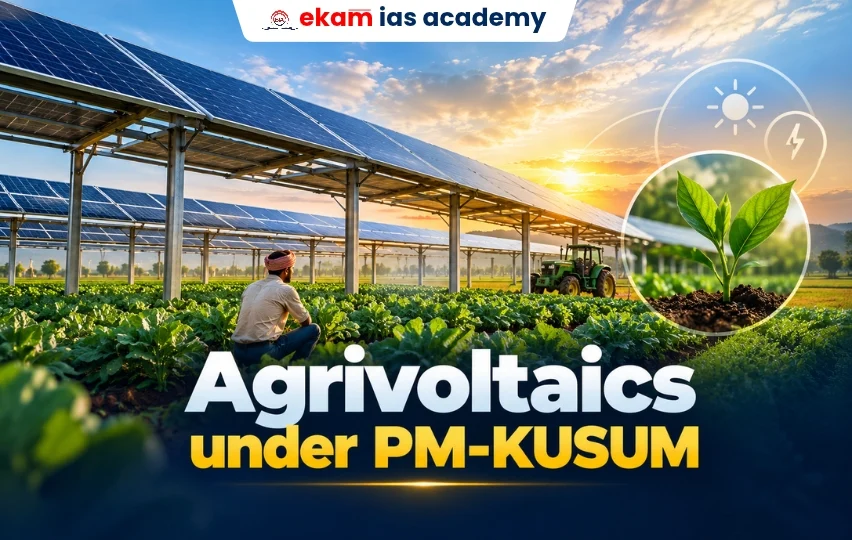
ToggleThe Government is planning to introduce agri-photovoltaics (agrivoltaics) under the second phase of PM-KUSUM (Pradhan Mantri Kisan Urja Suraksha evam Utthaan Mahabhiyan), India’s major programme for promoting solar energy in agriculture. The proposal was highlighted at the Agrivoltaics World Conference 2026 – “Powering the Global South” held in New Delhi on October 25.
The model seeks to combine crop cultivation and solar power generation on the same land, allowing farmers to retain agricultural activity while gaining an additional source of income.
What Is Agrivoltaics?
Agrivoltaics, or agri-PV, involves placing solar panels on elevated structures above agricultural fields. Crops can continue to be cultivated underneath while the panels generate electricity.
The photovoltaic modules are similar to those used in conventional solar projects. The major difference lies in the supporting structures, which raise the panels sufficiently to permit farming operations below.
According to MNRE, the panels may be installed around 3.5–4 metres above ground, allowing agricultural machinery and other routine activities to operate beneath them.
Why the Government Is Pushing This
Agrivoltaics could help address the land requirement for expanding solar energy without necessarily removing agricultural land from cultivation.
Government assessments indicate that nearly 30% of India’s 160 million hectares of cropland could potentially be suitable for agrivoltaic applications. This translates into an estimated technical potential of around 1–2 terawatts (TW) of capacity.
The approach could be particularly useful in states where availability of non-agricultural land for large solar projects is limited.
Not All Crops Are Suitable
Agrivoltaic systems cannot be applied uniformly to every crop. Current government assessments indicate greater suitability for fruits and leafy vegetables.
However, crops such as rice and sugarcane have not been found suitable under the assessed conditions. Therefore, crop-specific research will be essential before widespread deployment.
The Cost Factor
Agrivoltaic installations are estimated to cost around 25–30% more than conventional ground-mounted solar projects. The additional expense mainly arises from the elevated structures and associated civil infrastructure.
This cost difference could pose a significant challenge for adoption, particularly among small and marginal farmers.
Concerns Over Crop Yields and Farmers’ Interests
Most agrivoltaic projects in India remain at the pilot stage, making it important to assess their impact on crop productivity, soil conditions and farm incomes.
With more than 85% of Indian farmers classified as small and marginal, policy design must ensure that farmers retain control over their land and benefit directly from electricity generation.
Conclusion
Agrivoltaics offers India a potential way to expand renewable energy while continuing agricultural production on the same land. Its large estimated capacity makes it relevant to India’s clean-energy transition.
However, successful implementation will depend on crop suitability, affordable project costs, protection of farmer interests and evidence from pilot projects. The ultimate objective should be to ensure that solar development creates an additional income opportunity for farmers without compromising food production or agricultural livelihoods.


FAQs - agrivoltaics
What is agrivoltaics?
Agrivoltaics combines crop cultivation and solar electricity generation on the same land. Elevated solar panels allow farming activities to continue beneath them.
How is agrivoltaics linked to PM-KUSUM?
According to the article, the government plans to introduce agrivoltaics under PM-KUSUM’s second phase to promote solar energy while retaining agricultural production.
How can agrivoltaics benefit farmers?
It can provide an additional income source through solar power generation while allowing continued crop cultivation. It also reduces competition between agriculture and solar projects for land.
Which crops are suitable for agrivoltaics?
The article identifies fruits and leafy vegetables as more suitable under assessed conditions. Suitability varies with crop requirements, shading, local climate and panel design, making field trials essential.
What are the main challenges of agrivoltaics in India?
Challenges include higher installation costs, uncertain effects on crop yields and limited evidence from pilot projects. Protecting farmers’ land rights and ensuring fair income benefits are also important.