Table of Contents
ToggleArticle 34 of the Indian Constitution
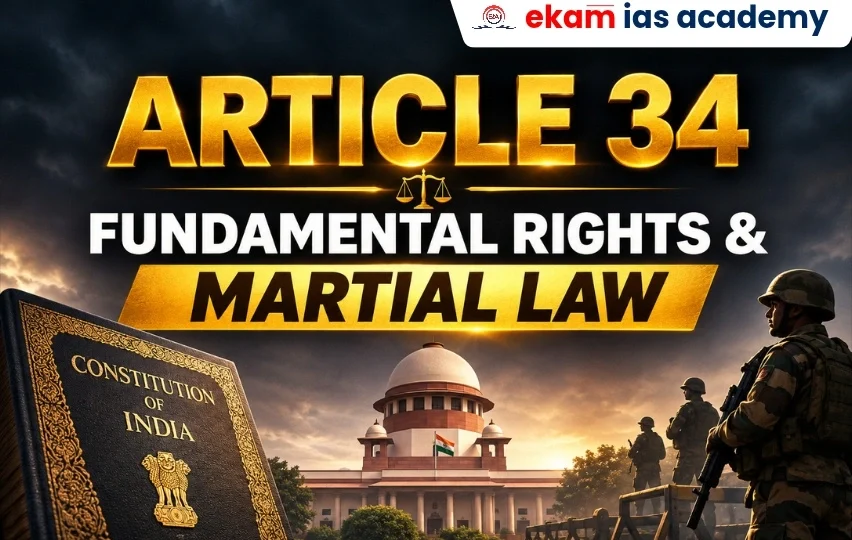
- Article 34 of the Indian Constitution is a critical provision in Part III, governing the operational balance between state security and civil liberties during martial law.
- Mastering Article 34 Fundamental Rights is essential for civil services candidates preparing for Indian Polity UPSC, Fundamental Rights UPSC, and Indian Constitution Articles UPSC modules.
- The article outlines Parliament’s Power Under Article 34 to indemnify government officials for acts committed during the maintenance or restoration of order in areas under martial law.
- Studying Article 34 Explained provides aspirants with comprehensive insights into Constitutional Provisions on Martial Law and its specific impact on Fundamental Rights in India.
Constitutional Provisions of Article 34
- Restcriptive Exception: Functions as a specific exception to Part III, restricting fundamental rights while martial law is in force within any territory of India.
- Act of Indemnity: Empowers Parliament to pass an Act of Indemnity, legalizing acts performed by military or civil authorities during martial law.
- Validation of Sentences: Authorizes Parliament to validate sentences passed, punishments inflicted, or forfeitures ordered under martial law authority.
- Exclusion of Judicial Scrutiny: Shields indemnified acts and sentences from being challenged in courts on the ground of violating fundamental rights.
Meaning and Features of Martial Law
- Military Rule: Refers to a situation where normal civil administration is suspended and the territory is governed directly by military authorities.
- Common Law Concept: Borrowed from English Common Law, the term Martial Law in India is not explicitly defined in the Constitution.
- Extraordinary Situations: Invoked to counter extreme conditions such as insurrection, rebellion, war, or widespread violent breakdown of public order.
- Suspension of Ordinary Courts: Replaces ordinary civil law and judicial machinery with military tribunals and summary procedures.
Article 34 and Fundamental Rights
- Suspension of Liberties: Causes natural suspension or severe restriction of fundamental rights, particularly Article 19 freedoms and procedural guarantees.
- Executive Arbitrariness Guard: Ensures that while rights are curtailed, authorities acting in good faith during martial law are protected post-restoration.
- No Automatic Repeal: Does not permanently void fundamental rights, but temporarily restricts their judicial enforcement during martial rule.
- Proportionality Principle: Requires that martial measures remain strictly proportional to the necessity of restoring public order.
Parliamentary Powers Under Article 34
- Indemnity Legislation: Grants Parliament exclusive authority to enact an Indemnity for Acts During Martial Law to protect officials from civil or criminal liability.
- Statutory Retrospectivity: Allows Parliament to pass indemnity laws retrospectively once civil governance is restored.
- Exclusive Federal Authority: Vests power solely in Parliament, barring State Legislatures from enacting indemnity laws under Article 34.
- Constitutional Protection: Ensures that indemnity statutes passed by Parliament cannot be declared unconstitutional under Article 13.
Article 34 vs Article 33
← Swipe the table to compare Articles 33 and 34 →
| Feature | Article 33 | Article 34 |
|---|---|---|
| Core Subject | Parliament may restrict or abrogate specified personnel’s Fundamental Rights by law. | Parliament may indemnify persons for qualifying acts and validate specified actions under martial law. |
| Who It Covers | Armed Forces, forces maintaining public order, intelligence and counterintelligence personnel, and specified telecommunications personnel serving those bodies. | Persons in Union or State service, or any other person, who acted in connection with maintaining or restoring order in an area under martial law. |
| Operational Timing | Restrictions enacted by Parliament can apply during peacetime and wartime. | Covers acts connected with the period when martial law was in force. Parliament may legislate afterward. |
| Primary Objective | Ensure the proper discharge of duties and maintain discipline among specified personnel. | Provide legal protection for qualifying acts connected with maintaining or restoring order during martial law. |
Article 34 vs National Emergency
Swipe left to see National Emergency →
| Comparison Feature | Martial Law (Article 34) | National Emergency (Article 352) |
|---|---|---|
| Constitutional Basis | Article 34 refers to martial law without defining it or prescribing how it is imposed. | Article 352 permits a proclamation when the security of India or any part of it is threatened by war, external aggression, or armed rebellion. |
| Impact on Government | Military authority may assume functions normally performed by civil authorities in the affected area. Article 34 itself provides no rule automatically closing ordinary courts. | Civil administration and courts continue to function. Under Article 353, the Union gains wider powers to direct States, and Parliament can legislate on State List matters. |
| Territorial Scope | Article 34 applies to acts connected with maintaining or restoring order in an area where martial law was in force. | The proclamation may cover all of India or a specified part of its territory. |
| Fundamental Rights | Article 34 allows Parliament to grant indemnity for qualifying acts and validate specified actions under martial law. It creates no automatic suspension of Fundamental Rights. |
Article 358: Article 19 restrictions on
qualifying laws and executive action are lifted only during
emergencies based on war or external aggression.
Article 359: A presidential order may suspend access to courts to enforce specified Fundamental Rights. Articles 20 and 21 are protected. |
Conclusion
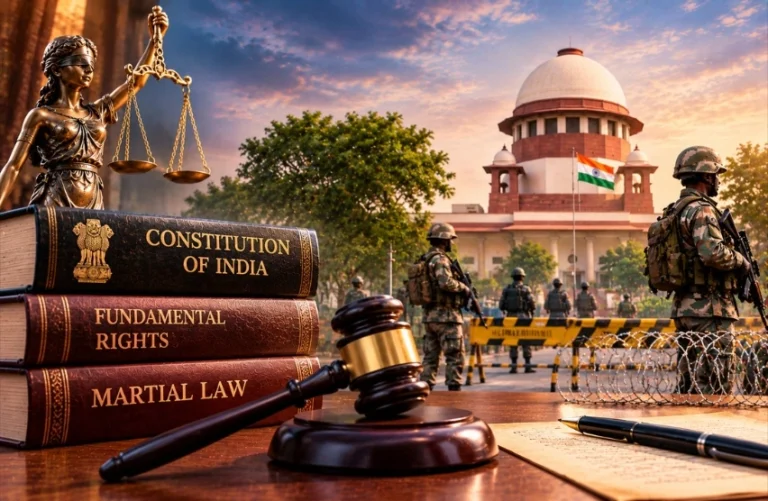
- Article 34 of the Indian Constitution serves as an indispensable emergency mechanism balancing state power and civil liberties.
- Understanding Martial Law and Indian Constitution dynamics clarifies the constitutional boundaries governing state emergency powers.
- Thorough mastery of Article 33 vs Article 34 equips civil services candidates to deliver high-scoring analytical responses in General Studies Paper II.
UPSC Prelims: PYQs & Practice Questions
Previous Year Questions (Prelims)
Q: Which of the following provisions of the Constitution of India provides for restricting Fundamental Rights while Martial Law is in force in any area?
(a) Article 33
(b) Article 34
(c) Article 35
(d) Article 352
Answer: (b) Article 34
Explanation:
Article 34 provides for restrictions on Fundamental Rights while
Martial Law is in force in any area within the territory of India.
It empowers Parliament to indemnify any government servant or person for acts
done in connection with the maintenance or restoration of order in any area
where martial law was in force.
Q: With reference to Martial Law under Article 34 of the Indian Constitution, consider the following statements:
1. The expression 'Martial Law' has been explicitly defined under Article 34 of the Constitution.
2. The concept of Martial Law in India has been borrowed from the English Common Law.
Which of the statements given above is/are correct?
(a) 1 only
(b) 2 only
(c) Both 1 and 2
(d) Neither 1 nor 2
Answer: (b) 2 only
Explanation:
Statement 1 is incorrect: The expression
'Martial Law' is NOT defined anywhere in the Indian Constitution.
It literally means 'military rule'.
Statement 2 is correct: The concept of Martial Law has been borrowed from the English Common Law framework to handle extreme situations like insurrection, war, or armed rebellion.
Practice Questions
Q: With reference to Article 34 of the Indian Constitution, consider the following statements:
1. An Act of Indemnity passed by Parliament under Article 34 cannot be challenged in any court on the ground of contravention of any of the Fundamental Rights.
2. The power to pass an Act of Indemnity under Article 34 lies concurrently with Parliament and State Legislatures.
3. Martial Law leads to the complete suspension of the writ of Habeas Corpus automatically.
Which of the statements given above is/are correct?
(a) 1 only
(b) 1 and 2 only
(c) 2 and 3 only
(d) 1, 2, and 3
Answer: (a) 1 only
Explanation:
Statement 1 is correct: An Act of Indemnity passed by Parliament under Article 34 protects state officials for actions taken to restore order and is shielded from being invalidated on the grounds of violating Part III Fundamental Rights.
Statement 2 is incorrect: Under Article 35 read with Article 34, the power to pass an Act of Indemnity is conferred exclusively on Parliament; State Legislatures have no power to make laws under Article 34.
Statement 3 is incorrect: Martial Law affects fundamental rights, but the writ of Habeas Corpus is not automatically suspended unless specific statutory or constitutional emergency orders explicitly suspend enforcement mechanisms. In A.K. Gopalan and Additional District Magistrate, Jabalpur (1976) context, post-44th Amendment protections (Articles 20 and 21) remain non-suspendable even during emergencies.
Q: How does Martial Law under Article 34 differ from a National Emergency under Article 352?
1. Martial Law affects only Fundamental Rights, whereas National Emergency affects Fundamental Rights, center-state relations, and legislative powers.
2. Martial Law suspends ordinary law courts and civil administration, whereas National Emergency allows ordinary courts and civil government to continue functioning.
3. Martial Law can be declared on grounds of war, external aggression, or armed rebellion, while National Emergency can be declared only during civil breakdown.
Which of the statements given above are correct?
(a) 1 and 2 only
(b) 2 and 3 only
(c) 1 and 3 only
(d) 1, 2, and 3
Answer: (a) 1 and 2 only
Explanation:
Statement 1 is correct: Martial Law strictly impacts Fundamental Rights in the specific area where it is imposed. National Emergency (Article 352) has a broader impact—it alters the federal distribution of powers, center-state financial relations, and tenure of Parliament alongside Fundamental Rights.
Statement 2 is correct: Under Martial Law, civil administration is replaced by military authorities and ordinary courts are suspended/replaced by military tribunals. Under National Emergency, ordinary courts and government machinery continue to function.
Statement 3 is incorrect: National Emergency under Article 352 is declared on grounds of War, External Aggression, or Armed Rebellion. Martial Law is declared to handle local civil breakdown, riots, or insurrections.
UPSC Mains – Previous Year & Practice Questions
Mains Previous Year Questions
Question: Examine the constitutional doctrine of 'Act of Indemnity' under Article 34 of the Indian Constitution and its implications for human rights during military interventions. (Mains 2020 – GS Paper II)
Question: Distinguish between the application of Martial Law under Article 34 and National Emergency under Article 352 of the Indian Constitution. (Mains 2016 – GS Paper II)
Question: While the Constitution provides for Martial Law under Article 34, it nowhere defines the term. Discuss the legal safeguards against potential executive arbitrariness under Martial Law. (Mains 2012 – GS Paper II / Law Paper)
Question: Analyze the scope of Parliament's power to validate sentences and forfeitures through an Act of Indemnity under Article 34. (Mains 2008 – GS Paper II / Law Paper)
Question: Compare and contrast Article 33 and Article 34 of the Constitution of India in terms of their impact on Part III rights. (Mains 2003 – GS Paper II / Law Paper)
Mains Practice Questions
[15 Marks | 250 Words]
Question: Article 34 balances the imperative of restoring public order during extraordinary civil breakdown with post-facto legislative scrutiny. Critically analyze the constitutional boundaries of an Act of Indemnity.
[15 Marks | 250 Words]
Question: The absence of an explicit definition of 'Martial Law' in the Indian Constitution leaves room for executive discretion. Examine the judicial principles that ensure basic human rights protections remain intact under Article 34.
[10 Marks | 150 Words]
Question: Distinguish between Martial Law under Article 34 and extraordinary statutory regimes like the Armed Forces (Special Powers) Act (AFSPA).


Article 34 of the Indian Constitution-FAQs
What is Article 34 of the Indian Constitution?
Article 34 deals with the restriction of Fundamental Rights while martial law is in force in any area of India. It empowers Parliament to provide legal protection for acts performed to maintain or restore order.
What is martial law in India?
Martial law refers to a situation where military authority assumes control of civil administration in an area during an extreme breakdown of law and order. The Constitution does not explicitly define martial law.
What power does Parliament have under Article 34?
Parliament can enact an indemnity law protecting persons for acts done during martial law. It can also validate sentences, punishments or forfeitures imposed under martial-law authority.
Is martial law the same as a National Emergency?
No. Martial law is a localized military-control mechanism, whereas a National Emergency under Article 352 operates within the constitutional framework of emergency governance and does not automatically suspend civil administration.
What is the difference between Article 33 and Article 34?
Article 33 permits Parliament to restrict Fundamental Rights of specified security forces to maintain discipline. Article 34 concerns restrictions and parliamentary indemnity in areas where martial law is in force.