Table of Contents
Toggle73rd and 74th Constitutional Amendments
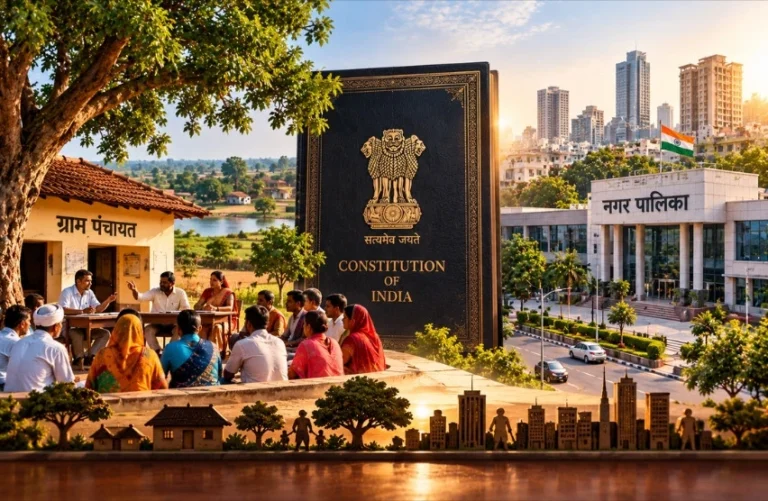
- The 73rd Constitutional Amendment Act and 74th Constitutional Amendment Act represent watershed moments in the decentralization of democratic power in India.
- Mastering the Panchayati Raj Constitutional Provisions and Municipalities Constitutional Provisions is vital for civil services aspirants covering Indian Polity UPSC and Local Self-Government in India UPSC modules.
- Passed in 1992, these twin acts institutionalized grass-roots democracy by according constitutional status to rural and urban local bodies.
- Studying the 73rd and 74th Amendment Acts helps candidates analyze democratic governance, fiscal federalism, and social inclusion at the local level.
Historical Background
- Directive Principles Anchor: Article 40 of the Constitution originally enjoined the State to organize village panchayats as units of self-government.
- Evolutionary Committees: Recommendations from the Balwant Rai Mehta (1957), Ashok Mehta (1977), G.V.K. Rao (1985), and L.M. Singhvi (1986) committees paved the way for constitutional recognition.
- Legislative Enactment: Passed during the Narasimha Rao government, the 73rd Amendment Act 1992 and 74th Amendment Act 1992 came into force in April 1993 and June 1993, respectively.
- Constitutional Insertion: Introduced Part IX Indian Constitution and Part IXA Indian Constitution to provide a statutory framework for local self-governance.
Provisions of the 73rd Constitutional Amendment Act
- Three-Tier Architecture: Mandates a uniform three-tier Panchayati Raj System in India at the village, intermediate (block), and district levels (except states with populations under 20 lakh).
- Gram Sabha Pillar: Establishes the Gram Sabha as the foundational body consisting of all registered voters in a village area.
- Eleventh Schedule of the Constitution: Entrusts 29 functional subjects (such as agriculture, health, sanitation, and primary education) to Panchayats under Article 243G.
- Mandatory Reservations: Reserves at least one-third of total seats and chairperson positions for women, alongside proportionate representation for SCs and STs.
Provisions of the 74th Constitutional Amendment Act
- Three Types of Urban Bodies: Categorizes Urban Local Bodies in India into Nagar Panchayats (transitional areas), Municipal Councils (smaller urban areas), and Municipal Corporations (larger urban areas).
- Twelfth Schedule of the Constitution: Lists 18 functional responsibilities (including urban planning, water supply, public health, and slum improvement) under Article 243W.
- Ward Committees: Mandates the constitution of Wards Committees in urban areas having a population of three lakh or more.
- District & Metropolitan Planning: Provisions under Articles 243ZD and 243ZE for setting up District Planning Committees (DPCs) and Metropolitan Planning Committees (MPCs).
Comparison Between the 73rd and 74th Amendments
| Feature / Criteria | 73rd Constitutional Amendment Act | 74th Constitutional Amendment Act |
| Constitutional Addition | Part IX Indian Constitution (Articles 243 to 243O) | Part IXA Indian Constitution (Articles 243P to 243ZG) |
| Schedule Added | Eleventh Schedule of the Constitution (29 Subjects) | Twelfth Schedule of the Constitution (18 Subjects) |
| Governance Unit | Rural Institutions (Panchayati Raj System in India) | Urban Local Bodies in India (Municipalities/Corporations) |
| Foundational Body | Gram Sabha (Registered Village Voters) | Wards Committees / Ward Sabhas |
Significance of the Amendments
- Democratic Decentralization: Shifted Indian federalism from a two-tier structure to a three-tier democratic model.
- Social Empowerment: Empowered marginalized sections and women by creating over one million elected female grass-roots leaders.
- Institutional Uniformity: Standardized election cycles, tenure (5 years), and dissolution norms for local bodies across states.
- Independent Election and Financial Bodies: Created the State Election Commission (SEC) and State Finance Commission (SFC) under Articles 243K/243I and 243ZA/243Y.
Challenges in Implementation
- 3F Bottlenecks (Funds, Functions, Functionaries): Inadequate devolution of financial autonomy, functional powers, and technical staff by state governments.
- Bureaucratic Overreach: Excessive control exercised by state bureaucracy over elected local representatives.
- Irregular SFC Recommendations: Delays by state governments in constituting State Finance Commissions and implementing their financial recommendations.
- Sarpanch Pati Phenomenon: Gender proxy representation where male relatives exercise de facto power on behalf of elected women representatives.
Reforms and the Way Forward
- Activity Mapping: Clear administrative separation of roles and powers between state departments and local bodies.
- Fiscal Capacity Building: Enhancing local tax collection rights, municipal bond issuance, and timely devolution of grants recommended by the Finance Commission.
- Capacity Enhancement: Conducting regular training and digital literacy drives for elected representatives, especially women and first-time leaders.
- Strengthening Gram Sabhas: Ensuring regular, transparent Gram Sabha meetings with mandatory social audits to curb corruption.
Conclusion
- The 73rd and 74th Amendment Acts form the constitutional backbone of participatory democracy and grass-roots development in India.
- Addressing implementation gaps in funds and functional autonomy is vital to achieving genuine self-governance.
- Comprehensive mastery over Local Self-Government in India UPSC concepts equips civil services candidates to answer high-scoring questions in General Studies Paper II.
UPSC Prelims: PYQs & Practice Questions
Previous Year Questions (Prelims)
Q: Fundamental religious and democratic principles apart, local self-government can be best explained as an exercise in:
(a) Federalism
(b) Democratic decentralization
(c) Administrative delegation
(d) Direct democracy
Answer: (b) Democratic decentralization
Explanation:
The fundamental rationale behind the 73rd Constitutional Amendment Act and 74th Constitutional Amendment Act is democratic decentralization. It transfers decision-making powers, developmental responsibilities, and financial autonomy directly to elected grass-roots representatives, rather than merely delegating administrative duties top-down from central or state authorities.
Q: With reference to the 73rd Constitutional Amendment Act, consider the following statements:
1. The minimum age prescribed for any person to be a member of a Panchayat is 25 years.
2. A Panchayat reconstituted after premature dissolution continues only for the remainder of the period for which the dissolved Panchayat would have continued.
Which of the statements given above is/are correct?
(a) 1 only
(b) 2 only
(c) Both 1 and 2
(d) Neither 1 nor 2
Answer: (b) 2 only
Explanation:
Statement 1 is incorrect: Under Article 243F(1)(a), the minimum age requirement to contest elections for a Panchayat is 21 years.
Statement 2 is correct: Under Article 243E(4), a Panchayat reconstituted following premature dissolution serves only for the remaining period of the original five-year term, unless the remaining period is less than six months.
Practice Questions
Q: With reference to the 74th Constitutional Amendment Act, 1992, consider the following statements:
1. It mandates the constitution of Wards Committees in all municipality areas having a population of three lakh or more.
2. The District Planning Committee (DPC) constituted under Article 243ZD consists of members where at least four-fifths are elected by elected members of the district Panchayat and Municipalities.
3. The Twelfth Schedule of the Constitution lists 29 functional subjects for Municipalities.
Which of the statements given above is/are correct?
(a) 1 and 2 only
(b) 2 only
(c) 1 and 3 only
(d) 1, 2, and 3
Answer: (a) 1 and 2 only
Explanation:
Statement 1 is correct: Article 243S mandates the setting up of Wards Committees for municipal areas having a population of 3 lakh or more.
Statement 2 is correct: Under Article 243ZD(2)(b), at least four-fifths of the total members of a District Planning Committee (DPC) must be elected by and from amongst the elected members of the Zilla Parishad and Municipalities in the district.
Statement 3 is incorrect: The Twelfth Schedule of the Constitution lists 18 subjects for Municipalities. The Eleventh Schedule contains 29 subjects for Panchayats.
Q: Which of the following provisions under Part IX and Part IXA of the Indian Constitution are mandatory (compulsory) on State Governments?
1. Provision of 1/3rd reservation for women in local bodies and chairperson offices.
2. Constitution of a State Finance Commission every five years to review the financial position of local bodies.
3. Granting voting rights to MPs and MLAs in local body meetings.
4. Providing reservations for Backward Classes (OBCs) in local elections.
Select the correct answer using the code given below:
(a) 1 and 2 only
(b) 1, 2, and 4 only
(c) 2, 3, and 4 only
(d) 1, 2, 3, and 4
Answer: (a) 1 and 2 only
Explanation:
Statements 1 & 2 are mandatory provisions: 1/3rd reservation for women (Articles 243D/243T) and establishing a State Finance Commission every 5 years (Articles 243I/243Y) are compulsory constitutional requirements.
Statements 3 & 4 are voluntary provisions: Allowing MPs/MLAs to vote in local bodies and providing reservations for Other Backward Classes (OBCs) are left to the discretion of individual State Legislatures.
UPSC Mains – Previous Year & Practice Questions
Mains Previous Year Questions
Question: The 73rd Constitutional Amendment Act has empowered women in rural India to emerge as political leaders. However, structural and societal barriers continue to hinder genuine empowerment. Critically analyze. (Mains 2023 - GS Paper II)
Question: The 74th Constitutional Amendment Act intended to decentralize municipal governance, but Municipalities in India continue to suffer from financial dependency and functional paralysis. Discuss. (Mains 2020 - GS Paper II)
Question: Assess the importance of the State Finance Commission in strengthening the financial health of Panchayati Raj Institutions in India. (Mains 2018 - GS Paper II)
Question: To what extent has the 73rd Amendment fulfilled the dream of Mahatma Gandhi regarding Gram Swaraj? Highlight the core structural impediments. (Mains 2015 - GS Paper II)
Question: Compare the structural framework and functional responsibilities of the Eleventh and Twelfth Schedules of the Indian Constitution. (Mains 2011 - GS Paper II)
Mains Practice Questions
[15 Marks | 250 Words]
Question: Despite 30+ years of passing the 73rd and 74th Amendment Acts, local self-governments suffer from the '3F Crisis' (Lack of Funds, Functions, and Functionaries). Suggest institutional reforms to achieve true administrative devolution.
[15 Marks | 250 Words]
Question: The 'Sarpanch-Pati' phenomenon undermines constitutional reservations for women in Panchayati Raj Institutions. Evaluate the root causes and outline legislative and administrative measures required to eliminate gender proxying.
[10 Marks | 150 Words]
Question: Examine the role of District Planning Committees (DPCs) under Article 243ZD in integrating rural and urban development plans into a comprehensive district development framework.
73rd and 74th Constitutional Amendments-FAQs
What are the 73rd and 74th Constitutional Amendment Acts?
The 73rd Constitutional Amendment Act, 1992 gave constitutional status to Panchayati Raj Institutions and introduced Part IX and the Eleventh Schedule. The 74th Constitutional Amendment Act, 1992 constitutionalized Urban Local Bodies, introducing Part IXA and the Twelfth Schedule.
What is the difference between the 73rd and 74th Constitutional Amendments?
The 73rd Amendment deals with rural local self-government, including Gram Sabhas and Panchayats, while the 74th Amendment deals with urban local government, including Nagar Panchayats, Municipal Councils and Municipal Corporations.
What is the significance of the Eleventh and Twelfth Schedules?
The Eleventh Schedule contains 29 subjects that may be entrusted to Panchayats, while the Twelfth Schedule contains 18 subjects relating to municipalities, including urban planning, water supply, sanitation and public health.
What are the major challenges in implementing the 73rd and 74th Amendments?
The major challenges include inadequate devolution of Funds, Functions and Functionaries (3Fs), bureaucratic control, delays in State Finance Commission recommendations, and limited administrative capacity of local representatives.
How did the 73rd and 74th Amendments strengthen grassroots democracy?
They provided constitutional status, regular elections, five-year tenure, reservations for SCs, STs and women, State Election Commissions and State Finance Commissions, thereby strengthening participatory democracy and decentralization at the grassroots level.