Table of Contents
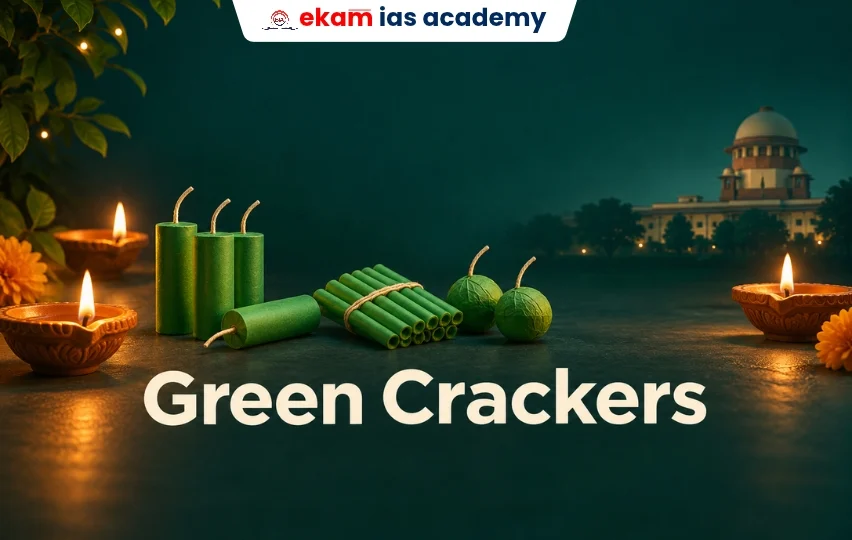
ToggleThe Supreme Court has allowed the conditional use of certified green crackers in Delhi-NCR on November 7 and 8, balancing the cultural significance of Deepavali with the constitutional duty to safeguard public health and the environment.
Supreme Court’s Conditional Permission for Green Crackers
A Bench of Justices M.M. Sundresh and Prasanna B. Varale permitted the use of certified green crackers during specified time slots:
- Morning: 6 a.m. to 7 a.m.
- Evening: 8 p.m. to 10 p.m.
Firecrackers were prohibited within 300 metres of hospitals, healthcare centres, nursing homes, old-age homes, educational institutions and notified silence zones. These locations were to be identified and publicly marked as no-cracker zones.
Religious Practices and Constitutional Limitations
The Court recognised the religious, cultural and emotional importance associated with Deepavali celebrations. However, it reiterated that religious freedom is subject to constitutional limitations, particularly where public health and environmental protection are involved.
Article 25 and Public Health
Article 25(1) guarantees freedom of conscience and the right to profess, practise and propagate religion, subject to public order, morality, health and other Fundamental Rights. Therefore, religious practices cannot override legitimate public-health requirements.
Article 21 and the Right to a Healthy Environment
The Supreme Court has interpreted Article 21’s right to life to encompass protection from serious environmental and health hazards. Firecracker emissions can increase particulate pollution, while excessive noise and waste can create additional risks, particularly for children, senior citizens and vulnerable groups.
Environmental and Public Health Concerns
The Court noted that uncontrolled firecracker use can cause sharp deterioration in Delhi-NCR’s air quality during Deepavali. Fine particulate matter can penetrate the respiratory system, while noise and solid waste add to the overall environmental burden.
Historical Context of Deepavali Celebrations
The Court also considered the evolution of Deepavali traditions, noting references to the use of lamps in ancient Hindu texts. Firecrackers became associated with celebrations later, following the introduction of gunpowder.
Regulation of Green Crackers and Their Sale
Certification and Manufacturing
Only green crackers certified by CSIR-NEERI and PESO were permitted under the directions. Manufacturing was subject to specified conditions, while banned products such as series crackers or ‘ladis’ remained prohibited.
Sale and Identification
Permitted crackers were required to carry product-specific QR codes to facilitate identification and distinguish certified products from unauthorised ones.
Financial Security and Enforcement
Manufacturers and traders were also required to provide monetary security as determined by authorities, strengthening accountability.
Enforcement Challenges and Regulatory Gaps
The Court expressed concern over weak implementation of earlier restrictions. It observed that ineffective enforcement could encourage illegal markets while limiting access to legitimate green crackers.
The case highlights that environmental regulation requires not only judicial directions but also effective monitoring, enforcement and coordination among government agencies, manufacturers, traders and law-enforcement authorities.


FAQs - Green Cracker
Are green crackers allowed in Delhi-NCR during Deepavali?
According to the article, the Supreme Court permitted only certified green crackers on 7 and 8 November, from 6 a.m. to 7 a.m. and 8 p.m. to 10 p.m.
Where are firecrackers prohibited under the Court’s directions?
The article specifies a 300-metre restriction around hospitals, healthcare centres, nursing homes, old-age homes, educational institutions and notified silence zones.
How can buyers identify certified green crackers?
The article says permitted products must be certified by CSIR-NEERI and PESO and carry a product-specific QR code. Series crackers, commonly called ladis, remain prohibited.
How do Articles 21 and 25 apply to firecracker restrictions?
Article 25 protects religious freedom subject to public order, morality, health and other Fundamental Rights. Article 21 protects the right to life, which the Supreme Court has interpreted to include protection from serious environmental hazards.
Why does the Court restrict firecracker use even when green crackers are permitted?
Green crackers still produce emissions and noise. Time limits and designated no-cracker zones aim to reduce exposure, especially for children, older adults and people with respiratory conditions.