Table of Contents
ToggleArticle 39 of the Indian Constitution
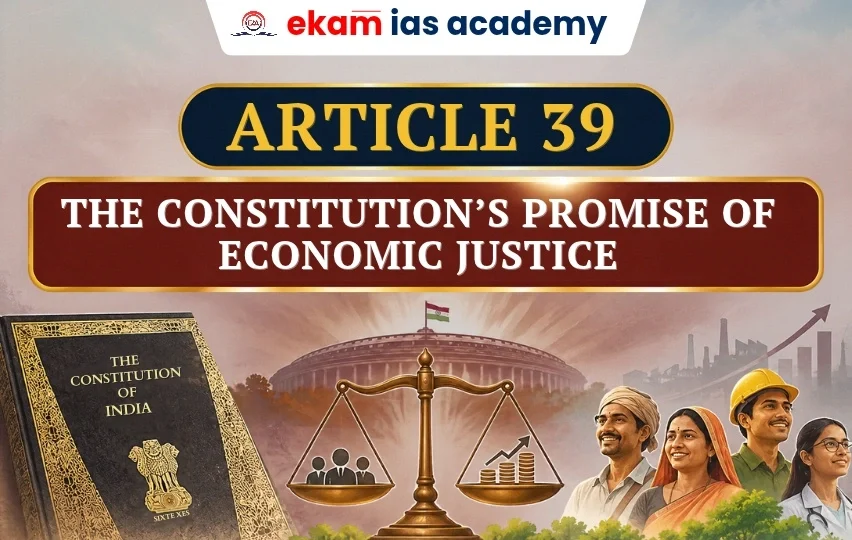
- Article 39 of the Indian Constitution serves as a core pillar of Part IV of Indian Constitution, laying down the socialist principles governing state policy.
- Mastering Article 39 UPSC provisions is essential for civil services aspirants covering Directive Principles of State Policy UPSC, Fundamental Rights and DPSP, and Indian Polity UPSC modules.
- The article sets forth explicit guidelines for achieving economic democracy, distributive justice, and social equity across the nation.
- A detailed analysis of Article 39 Explained provides candidates with structural insights into Article 39 Constitution of India and its role in building an inclusive welfare state.
Constitutional Provisions of Article 39
- Socialist Charter: Outlines specific directives that require the State to direct its policy toward securing economic justice for all citizens.
- Six-Dimensional Directives: Encompasses clauses (a) through (f), covering livelihood, resource distribution, wealth control, equal pay, labor health, and child development.
- Non-Justiciable Mandates: Functions as a non-justiciable directive under Part IV that remains fundamental to the governance and law-making of the country.
- Welfare State Foundation: Transforms abstract constitutional ideals of social justice into concrete socio-economic policy goals.
Article 39(a): Adequate Means of Livelihood
- Economic Security: Directs the State to ensure that citizens, men and women equally, have the right to an adequate means of livelihood.
- Right to Work Orientation: Inspires welfare interventions, public employment guarantee schemes, and rural livelihood programs.
- Gender Neutrality: Explicitly requires equal access to economic opportunities and employment for both male and female citizens.
- Livelihood Protection: Forms the bedrock for national poverty alleviation and socio-economic empowerment policies under Article 39(a) Equal Livelihood.
Article 39(b): Distribution of Material Resources
- Socialist Resource Management: Directs the State to ensure that the ownership and control of the material resources of the community are distributed to best subserve the common good.
- Public Ownership Principles: Provides constitutional backing for land reforms, nationalization of key industries, and public control over natural resources.
- Community Welfare Focus: Prevents private monopolies over essential national assets under Article 39(b) Distribution of Resources.
- Judicial Endorsement: Cited in landmark Supreme Court rulings to validate legislative acts aimed at public resource redistribution.
Article 39(c): Prevention of Concentration of Wealth
- Anti-Monopoly Directive: Mandates that the operation of the economic system does not result in the concentration of wealth and means of production to the common detriment.
- Regulated Capitalism: Provides the constitutional basis for progressive taxation, corporate regulations, and anti-cartel frameworks under Article 39(c) Prevention of Wealth Concentration.
- Economic Balance: Ensures equitable economic growth by checking private wealth accumulation that harms public interest.
- Distributive Harmony: Operates alongside clause (b) to create a balanced socio-economic structure.
Article 39(d): Equal Pay for Equal Work
- Gender Wage Equity: Mandates equal pay for equal work for both men and women across all sectors of employment.
- Statutory Enforcement: Inspired the enactment of the Equal Remuneration Act, 1976 to eliminate gender-based wage discrimination.
- Constitutional Right Realization: Interpreted by the Supreme Court as a constitutional goal enforceable through Article 14 read with Article 39(d).
- Workplace Equality: Forms a cornerstone of labor jurisprudence under Article 39(d) Equal Pay for Equal Work.
Article 39(e): Protection of Workers' Health and Strength
- Labor Welfare Protection: Directs the State to protect the health and strength of workers, men and women, against occupational hazards and exploitation.
- Prevention of Forced Labor: Ensures that citizens are not forced by economic necessity to enter avocations unsuited to their age or strength.
- Humanitarian Conditions: Underpins statutory measures governing factory safety, maximum working hours, and occupational healthcare.
- Human Capital Protection: Safeguards vulnerable workers from economic coercion under Article 39(e) Protection of Workers.
Article 39(f): Protection and Development of Children
- Child Development Focus: Mandates that children are given opportunities and facilities to develop in a healthy manner and in conditions of freedom and dignity.
- Protection from Exploitation: Directs the State to protect childhood and youth against moral and material abandonment and economic exploitation.
- 42nd Amendment Insertion: Clause (f) was modified by the 42nd Constitutional Amendment Act, 1976, to emphasize holistic child welfare.
- Legislative Action: Serves as the guiding light for child labor prohibition acts, national child policies, and Article 39(f) Child Welfare schemes.
Article 39 and Fundamental Rights
- Harmonious Construction: Supreme Court jurisprudence (e.g., Minerva Mills case) established that Part III (Fundamental Rights) and Part IV (DPSP) are built on a mutual balance.
- Constitutional Balance: Directs courts to interpret Fundamental Rights in light of the social goals framed under Article 39 Directive Principles of State Policy.
- Reasonable Restrictions: Serves as a valid constitutional ground for imposing reasonable restrictions on Article 19 rights in the interest of the general public.
- Substantive Equality: Transforms formal legal equality into substantive socio-economic equality across society.
Article 39 and Article 31C
- Constitutional Shield: Article 31C (inserted by 25th Amendment Act, 1971) protects laws giving effect to Article 39(b) and 39(c) from judicial challenge under Articles 14 and 19.
- Primacy over Fundamental Rights: Establishes that laws enacted to redistribute material resources or prevent wealth concentration cannot be declared void for violating equality or freedom guarantees.
- Judicial Review Benchmark: Kesavananda Bharati case (1973) upheld the validity of Article 31C shielding Article 39(b) and 39(c), while keeping judicial review intact.
- Legislative Protection: Grants robust constitutional immunity to agrarian, land reform, and economic nationalization statutes.
Landmark Supreme Court Judgments
← Swipe left or right to view all four columns →
| Case | Year | Key Principle | UPSC Significance |
|---|---|---|---|
| State of Madras v. Champakam Dorairajan | 1951 | Early conflict between Fundamental Rights and DPSPs | Established the primacy of Fundamental Rights over DPSPs in case of conflict; led to the First Constitutional Amendment. |
| Kesavananda Bharati v. State of Kerala | 1973 | Basic Structure Doctrine | Established that Parliament's power to amend the Constitution is subject to the Basic Structure limitation. |
| Minerva Mills v. Union of India | 1980 | Harmony between Fundamental Rights and DPSPs | Held that harmony and balance between Fundamental Rights and DPSPs form part of the Basic Structure. |
| Randhir Singh v. Union of India | 1982 | Equal pay for equal work | Recognised equal pay for equal work as a constitutional goal flowing from Articles 14, 16 and 39(d). |
| Sanjeev Coke Manufacturing Co. v. Bharat Coking Coal Ltd. | 1983 | Distribution of material resources | Examined Article 39(b) in the context of nationalisation and distribution of material resources to serve the common good. |
| D.S. Nakara v. Union of India | 1983 | Social justice and welfare state | Emphasised the welfare-state objectives and the importance of social and economic justice. |
| M.C. Mehta v. State of Tamil Nadu | 1996 | Protection of children from hazardous employment | Issued directions concerning the prohibition and rehabilitation of children employed in hazardous industries, reflecting the objectives of Article 39(e) and 39(f). |
| Property Owners Association v. State of Maharashtra | 2024 | Interpretation of Article 39(b) | Clarified the meaning of “material resources of the community” and held that not all privately owned property automatically qualifies as such resources. |
Significance of Article 39
- Economic Democracy: Translates political democracy guaranteed by Part III into economic democracy under Part IV.
- Legislative Roadmap: Acts as a constant guide for Parliament and State Legislatures when framing social security and labor laws.
- Judicial Interpretation Tool: Used by Indian courts to expand the scope of the Right to Life (Article 21) to include livelihood, health, and dignity.
- UPSC Relevance: Essential for analyzing state intervention, social justice, and constitutional law questions in Indian Polity UPSC.
Conclusion
- Article 39 of the Indian Constitution embodies the core vision of an egalitarian and progressive welfare state.
- Through its comprehensive directives, it balances economic growth with distributive social justice across all sections of society.
- Mastery of Article 39 Directive Principles of State Policy equips civil services candidates to deliver high-scoring, analytical answers in General Studies Paper II.
UPSC Prelims: PYQs & Practice Questions
Previous Year Questions (Prelims)
Q: Other than the Fundamental Rights, which of the following parts of the Constitution of India reflects/reflect the principles and provisions of the Universal Declaration of Human Rights (1948)?
1. Preamble
2. Directive Principles of State Policy
3. Fundamental Duties
Select the correct answer using the code given below:
(a) 1 and 2 only
(b) 2 only
(c) 1 and 3 only
(d) 1, 2 and 3
Answer: (d) 1, 2 and 3
Explanation:
The Universal Declaration of Human Rights (UDHR) encompasses civil, political, social, economic, and cultural rights.
Preamble: Reflects the values of justice, liberty, equality, and fraternity.
Directive Principles of State Policy: Part IV reflects several socio-economic principles of the UDHR. In particular, Article 39 covers adequate means of livelihood, equal pay for equal work, protection of worker health, and child welfare.
Fundamental Duties: Part IVA aligns with the idea of duties to the community reflected in Article 29 of the UDHR.
Q: In India, "Equal Pay for Equal Work" is a:
(a) Fundamental Right
(b) Directive Principle of State Policy
(c) Fundamental Duty
(d) Statutory Right
Answer: (b) Directive Principle of State Policy
Explanation:
Article 39(d) of the Indian Constitution directs the State to secure equal pay for equal work for both men and women.
While the Supreme Court has read the principle of equal pay for equal work in the context of Articles 14 and 21 in appropriate cases, its primary constitutional origin is as a Directive Principle of State Policy under Part IV.
Practice Questions
Q: With reference to Article 31C and Article 39 of the Indian Constitution, consider the following statements:
1. Article 31C was added by the 25th Constitutional Amendment Act, 1971, to protect laws giving effect to Article 39(b) and Article 39(c).
2. A law enacted to give effect to Article 39(b) or 39(c) cannot be declared void on the ground of unconstitutionality under Article 14 or Article 19.
3. The 42nd Constitutional Amendment Act expanded this immunity to laws giving effect to all Directive Principles in Part IV, which was subsequently struck down by the Supreme Court in the Minerva Mills case (1980).
Which of the statements given above are correct?
(a) 1 and 2 only
(b) 2 and 3 only
(c) 1 and 3 only
(d) 1, 2, and 3
Answer: (d) 1, 2, and 3
Explanation:
Statement 1 is correct: The 25th Constitutional Amendment Act (1971) inserted Article 31C, providing constitutional protection to legislation giving effect to Article 39(b) (distribution of material resources) and Article 39(c) (prevention of concentration of wealth).
Statement 2 is correct: Under Article 31C, such laws are shielded from challenge under Article 14 (Equality before law) and Article 19 (Six fundamental freedoms).
Statement 3 is correct: The 42nd Amendment (1976) attempted to extend this immunity to all Directive Principles, but the Supreme Court in Minerva Mills v. Union of India (1980) invalidated this extension, restoring the constitutional shield exclusively for Article 39(b) and 39(c).
Q: Consider the following pairs of Article 39 clauses and their core directives:
1. Article 39(a): Prevention of concentration of wealth and means of production
2. Article 39(b): Distribution of community material resources to subserve common good
3. Article 39(d): Equal pay for equal work for both men and women
4. Article 39(f): Protection of workers' health and strength against forced economic entry
Which of the pairs given above are correctly matched?
(a) 1 and 4 only
(b) 2 and 3 only
(c) 1, 2 and 3 only
(d) 2, 3 and 4 only
Answer: (b) 2 and 3 only
Explanation:
Pair 1 is incorrectly matched: Article 39(a) mandates adequate means of livelihood, whereas Article 39(c) deals with the prevention of concentration of wealth.
Pair 2 is correctly matched: Article 39(b) mandates that material resources of the community are distributed to best subserve the common good.
Pair 3 is correctly matched: Article 39(d) guarantees equal pay for equal work for men and women.
Pair 4 is incorrectly matched: Article 39(e) deals with protecting workers' health and preventing forced labor due to economic necessity, whereas Article 39(f) focuses on child welfare and protection against exploitation (modified by the 42nd Amendment, 1976).
UPSC Mains – Previous Year & Practice Questions
Mains Previous Year Questions
Question: The doctrine of “harmonious construction” has evolved to resolve conflicts between Fundamental Rights and Directive Principles of State Policy. Discuss with special reference to Article 39(b) and Article 39(c). (Mains 2020 – GS Paper II)
Question: Examine how Article 39(d) of the Constitution has been translated into statutory enforcement in India. Has the legal framework succeeded in eliminating gender wage gaps? (Mains 2017 – GS Paper II)
Question: Discuss the constitutional validity of land reforms and nationalization laws enacted under the protective umbrella of Article 31C read with Article 39(b) and Article 39(c). (Mains 2015 – GS Paper II)
Question: Analyze the judicial journey from the Champakam Dorairajan case to the Minerva Mills case regarding the primacy between Part III (Fundamental Rights) and Article 39 of Part IV. (Mains 2011 – GS Paper II / Law Paper)
Question: Evaluate how the Supreme Court of India has expanded the scope of Article 21 (Right to Life) by incorporating the social directives contained under Article 39(a), (e), and (f). (Mains 2006 – GS Paper II / Law Paper)
Mains Practice Questions
[15 Marks | 250 Words]
Question: Article 39 represents the economic core of the Indian Constitution, seeking to establish a socialist welfare state without compromising democratic constitutionalism. Critically analyze.
[15 Marks | 250 Words]
Question: Evaluate the constitutional significance of Article 31C in shielding state actions under Article 39(b) and 39(c) from judicial review under Articles 14 and 19. How has judicial interpretation balanced private property rights with distributive justice?
[10 Marks | 150 Words]
Question: Discuss the significance of Article 39(f) in guiding statutory frameworks for child rights and juvenile justice in India.


Article 39 of the Indian Constitution-FAQs
What is Article 39 of the Indian Constitution?
Article 39 is a Directive Principle of State Policy that guides the State toward economic justice, equitable resource distribution, equal pay, worker protection and child welfare.
What does Article 39(a) provide?
Article 39(a) directs the State to ensure that men and women equally have the right to an adequate means of livelihood.
What is the significance of Article 39(b) and 39(c)?
Article 39(b) focuses on distributing material resources for the common good, while Article 39(c) seeks to prevent the concentration of wealth and means of production.
What does Article 39(d) mean by equal pay for equal work?
Article 39(d) directs the State to secure equal pay for equal work for both men and women, forming an important constitutional basis for workplace equality.
How is Article 39 related to Article 31C?
Article 31C provides constitutional protection to laws giving effect to Article 39(b) and 39(c) against challenges under Articles 14 and 19, subject to the constitutional position established by the Supreme Court.