
Table of Contents
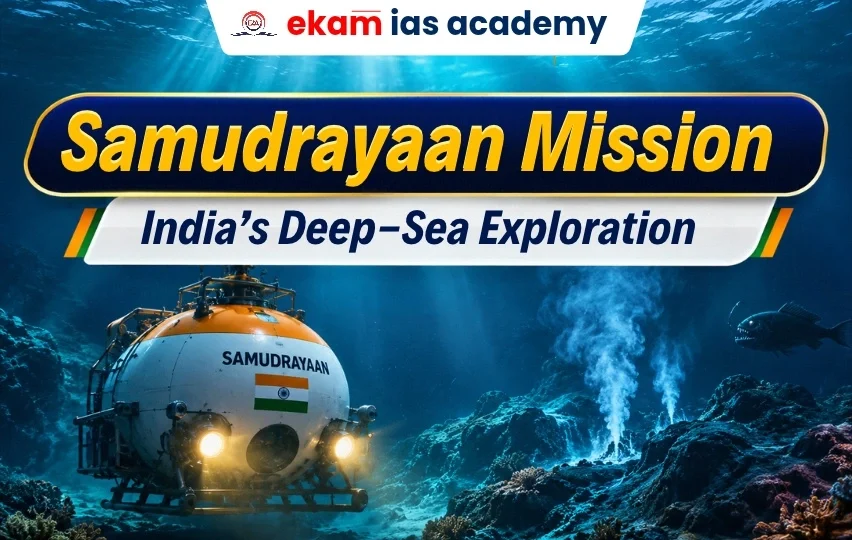
ToggleIndia is targeting its first human deep-sea expedition to a depth of nearly 6,000 metres by 2028 under the Samudrayaan Mission. The initiative, highlighted at the Indo-Pacific Regional Dialogue (IPRD) 2026, reflects India’s efforts to develop advanced underwater technologies and expand scientific cooperation in the Indo-Pacific. The mission is an important development in India’s Deep Sea Exploration and Science and Technology Current Affairs UPSC.
What is the Samudrayaan Mission?
Samudrayaan is India’s human deep-sea exploration programme under the Deep Ocean Mission India, which was approved by the Union Cabinet in 2021 and is implemented by the Ministry of Earth Sciences.
The broader mission focuses on Deep Ocean Mission Objectives, including deep-sea mining technologies, marine biodiversity, seabed exploration, ocean-climate services and the development of ocean-based resources. It forms a major component of India’s Deep Sea Mission and is important for Samudrayaan Mission UPSC preparation.
MATSYA-6000 Submersible
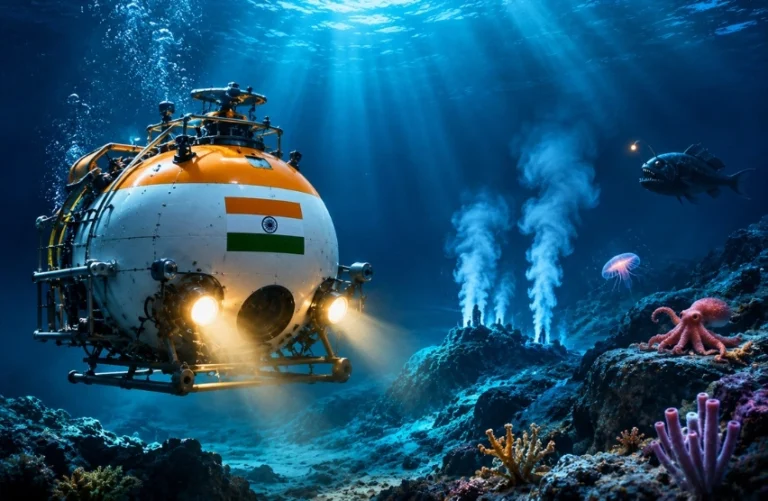
The centrepiece of Samudrayaan is MATSYA-6000, an indigenously designed human-occupied submersible developed by the National Institute of Ocean Technology (NIOT), Chennai. The Matsya 6000 Submersible represents a major advancement in Deep Sea Technology in India.
It is designed to carry three aquanauts to depths of up to 6,000 metres. The battery-powered vehicle is intended to support around 12 hours of normal operations, with emergency life-support provisions for up to 96 hours. Its titanium-alloy personnel sphere is designed to withstand the immense pressure found at extreme depths.
Key Technologies and Applications
The mission will support detailed exploration of the seabed, including hydrothermal sulphide deposits, which can contain strategically important minerals. Such exploration is relevant to Deep Sea Mining in India and broader efforts towards Ocean Exploration Technology.
It will also enable direct research into deep-sea biodiversity, marine geology and extreme underwater ecosystems, strengthening India’s understanding of Deep Sea Biodiversity.
Satellite-derived information on ocean colour, sea-surface temperature and winds can complement deep-sea observations, strengthening ocean monitoring, climate research and assessment of marine renewable-energy potential.
International Cooperation
India has proposed collaborative scientific missions, reciprocal access to research infrastructure and greater sharing of ocean-related data under the principle of “One Ocean, Shared Knowledge and Equitable Prosperity.”
Cooperation will focus on ocean observation, extreme-event forecasting, coastal climate services and sustainable marine-resource management. Such cooperation can also support research related to Polymetallic Nodules Exploration and other deep-ocean resources.
Significance
Samudrayaan can strengthen India’s indigenous deep-sea capabilities, scientific knowledge and strategic resource security. It can also contribute to the development of the Blue Economy in India, sustainable ocean governance and the broader vision of Viksit Bharat 2047.


Samudrayaan Mission-FAQs Answered
What is the Samudrayaan Mission?
Samudrayaan is India’s human deep-sea exploration programme under the Deep Ocean Mission, aimed at exploring ocean resources, biodiversity and the deep seabed.
What is MATSYA-6000?
MATSYA-6000 is an indigenously designed human-occupied submersible developed by NIOT, Chennai. It is designed to carry three aquanauts to depths of up to 6,000 metres.
What are the main objectives of the Deep Ocean Mission?
The mission focuses on deep-sea exploration, seabed resource assessment, marine biodiversity, deep-sea mining technologies and ocean-climate services.
Why is Samudrayaan important for India?
It can strengthen India’s deep-sea technology, scientific capabilities, resource security and Blue Economy, while supporting sustainable ocean exploration and governance.
Which ministry is implementing the Samudrayaan Mission?
The Ministry of Earth Sciences is implementing Samudrayaan as part of the Deep Ocean Mission, approved by the Union Cabinet in 2021.