Table of Contents
ToggleThe Directorate General of Foreign Trade (DGFT) has changed India’s export policy for lithium-ion battery black mass from ‘Free’ to ‘Prohibited’ with immediate effect. The move aims to retain mineral-rich battery waste within the country and strengthen domestic recycling, refining and critical-mineral supply chains.
What is Black Mass?
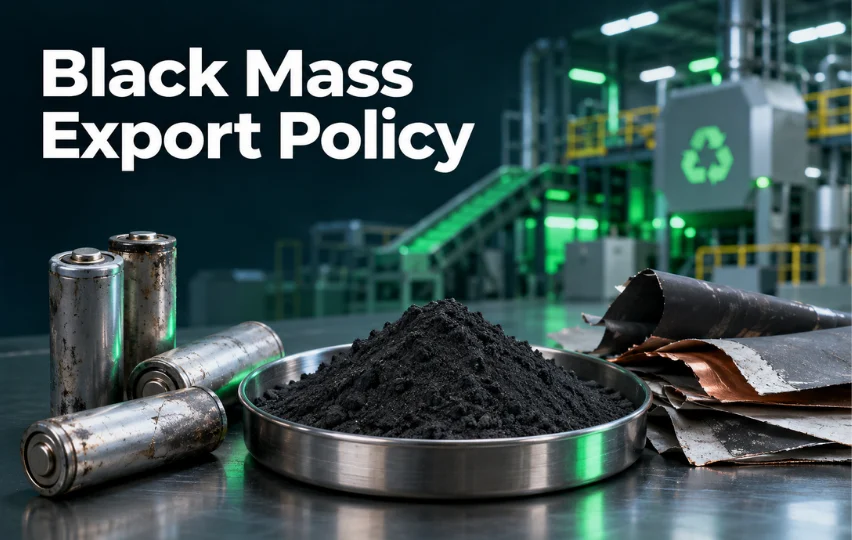
Black mass is a powder-like material produced by shredding and processing discarded lithium-ion batteries and electronic devices. It contains valuable minerals such as lithium, cobalt, nickel, manganese and graphite, making it an important secondary source of critical minerals.
Its economic value varies with battery chemistry. NMC batteries generally contain valuable nickel and cobalt, while LFP batteries contain iron and phosphate and offer different recovery economics.
The recovery of minerals from discarded products is known as urban mining. Pyrometallurgy uses high temperatures to recover metals but can consume significant energy, while hydrometallurgy uses chemical processes such as leaching and solvent extraction to recover battery-grade materials.
Why Has India Restricted Black Mass Exports?
The export restriction is intended to ensure adequate feedstock for Indian recycling and refining facilities. Retaining black mass domestically can increase capacity utilisation, promote value addition and create opportunities in the circular economy.
India remains highly dependent on imports for several critical minerals, while global processing is concentrated in a few countries. Developing domestic recycling capacity can therefore strengthen resource security and reduce exposure to international supply disruptions.
India’s Domestic Recycling Potential
India generates substantial quantities of end-of-life lithium-ion batteries as electric mobility and energy-storage demand expands. The country has also been developing a network of CPCB-registered battery recyclers and processing facilities.
Future battery demand is expected to increase significantly, creating a growing domestic source of recyclable materials and recovered minerals.
Policy Support and Way Forward
The export restriction complements government efforts to expand domestic critical-mineral processing capacity. However, its effectiveness will depend on advanced recycling technologies, adequate refining infrastructure, commercially viable recovery processes and stronger Extended Producer Responsibility mechanisms.
Environmental safeguards will also be essential to ensure that India’s growing battery-recycling industry develops as a sustainable circular-economy ecosystem.


FAQs - Black Mass Export Policy
What is lithium-ion battery black mass?
Black mass is a powder-like material obtained by processing discarded lithium-ion batteries. Depending on battery chemistry, it can contain valuable minerals such as lithium, cobalt, nickel, manganese and graphite.
What change has India made to its Black Mass Export Policy?
According to the article, DGFT has changed the export classification of lithium-ion battery black mass from ‘Free’ to ‘Prohibited’, with immediate effect.
Why has India prohibited black mass exports?
The restriction aims to retain mineral-rich material for domestic recycling and refining, support value addition and strengthen India’s critical-mineral supply chains.
How are valuable minerals recovered from black mass?
Recovery methods include pyrometallurgy, which uses high temperatures, and hydrometallurgy, which uses chemical processes such as leaching and solvent extraction.
What is needed to strengthen India’s battery-recycling industry?
Priorities include advanced recycling technologies, sufficient refining infrastructure, commercially viable recovery processes, stronger Extended Producer Responsibility mechanisms and effective environmental safeguards.