
Table of Contents
ToggleResearchers at IIT Gandhinagar (IITGN) have developed biodegradable, pH-responsive seaweed-based hydrogel microbeads to deliver micronutrients directly to plant roots. The technology adapts the controlled-release approach used in medical applications to improve nutrient-use efficiency in agriculture.
What are Hydrogel Microbeads?
Hydrogels are three-dimensional polymer networks capable of absorbing and retaining substantial quantities of water. They can also encapsulate nutrients and release them gradually under specific environmental conditions.
The IITGN microbeads are approximately 3.5 mm in size and are primarily made using kappa-carrageenan, a gelling substance obtained from red seaweed such as Kappaphycus. Trans-ferulic acid and calcium chloride are also used in the formulation.
How Do the Microbeads Work?
The technology responds to changes in the soil environment around plant roots. When plants experience deficiencies of micronutrients such as iron or zinc, their roots release organic acids into the rhizosphere, lowering local soil pH.
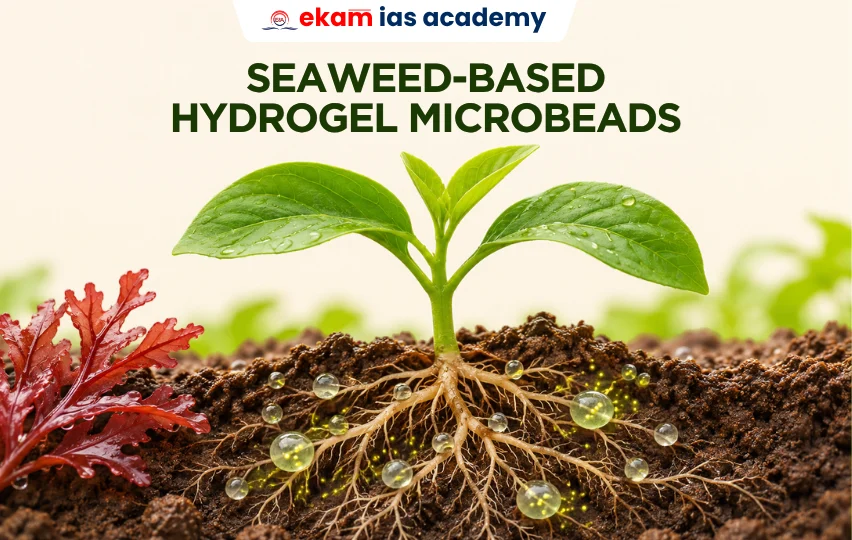
The microbeads respond to this acidic environment by swelling and releasing encapsulated nutrients, including iron, zinc, manganese and copper, close to the root zone.
Key Laboratory Findings
Experiments showed that the beads expanded by nearly 80% at pH 4 over two days. Over 14 days, they released around 68% of encapsulated iron and 66% of zinc under acidic conditions. Release was considerably lower under neutral and alkaline conditions, demonstrating their pH-responsive behaviour.
Advantages Over Conventional Fertilisers
Conventional micronutrient fertilisers can become fixed in soil or be lost through leaching before plants absorb them. Foliar application is difficult over large areas, while chelated micronutrients can be relatively expensive.
The microbeads could offer a targeted and biodegradable alternative by releasing nutrients where plants require them.
Recognition and Future Potential
Supported by IITGN and the Department of Biotechnology, the research was published in ACS Omega and received first prize at the SOMS 2026 Summit. An Indian patent application has been filed, while further field trials are planned to assess crop productivity, nutritional quality and long-term ecological safety.


FAQs seaweed-based hydrogel microbeads
What are seaweed-based hydrogel microbeads?
They are biodegradable beads designed to deliver micronutrients near plant roots. Developed by IIT Gandhinagar researchers, they primarily use kappa-carrageenan, a gelling substance derived from red seaweed.
How do the hydrogel microbeads release nutrients?
The beads respond to acidic conditions around plant roots by swelling and releasing encapsulated nutrients. This enables targeted delivery in response to changes in local soil pH.
Which micronutrients can the microbeads deliver?
The microbeads can encapsulate and release iron, zinc, manganese and copper, supporting essential plant nutritional requirements.
What did laboratory experiments reveal?
According to the article, the beads expanded by nearly 80% at pH 4 over two days. Over 14 days, they released approximately 68% of encapsulated iron and 66% of zinc under acidic conditions.
What advantages could these microbeads offer agriculture?
They could improve nutrient-use efficiency and reduce nutrient losses through targeted, gradual release. Further field trials are needed to establish their effects on crop productivity, nutritional quality and ecological safety.