
Table of Contents
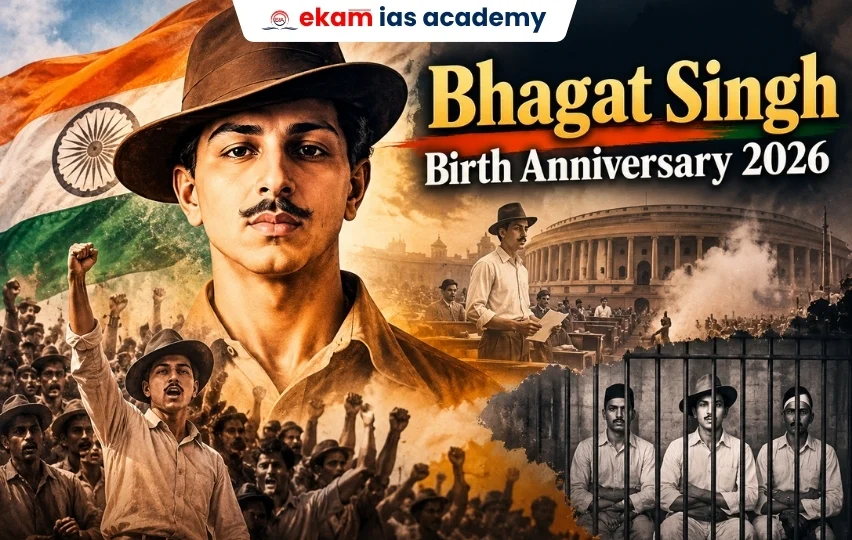
ToggleBhagat Singh Birth Anniversary 2026 will be observed on 28 September, marking his 119th birth anniversary. Bhagat Singh remains one of the most influential young revolutionaries of India’s freedom struggle, remembered for his courage, political writings, revolutionary activities and sacrifice.
Bhagat Singh: Early Life and Background
Bhagat Singh was born on 28 September 1907 at Banga in the Lyallpur district of Punjab Province, British India, now in Pakistan. He belonged to a family associated with nationalist activities. His father, Kishan Singh, and his uncles Ajit Singh and Swaran Singh influenced his early political outlook.
The Jallianwala Bagh massacre of 1919 deeply affected him and strengthened his opposition to colonial rule. He studied at the Dayanand Anglo-Vedic School, Lahore, and later joined National College, Lahore, founded by Lala Lajpat Rai. He developed a strong interest in history, politics, economics, socialism and revolutionary movements.
Bhagat Singh and the Freedom Struggle
Bhagat Singh became associated with revolutionary organisations and later played an important role in the Hindustan Socialist Republican Association (HSRA).
Following the death of Lala Lajpat Rai after injuries sustained during a protest against the Simon Commission, Bhagat Singh and his associates sought to retaliate. In December 1928, Bhagat Singh and Shivaram Rajguru killed John Saunders, a British police officer in Lahore, mistakenly identifying him as the officer they intended to target.
On 8 April 1929, Bhagat Singh and Batukeshwar Dutt threw bombs inside the Central Legislative Assembly in Delhi to protest colonial legislation. The action was intended as a political statement rather than an attempt to cause mass casualties. They remained at the scene and surrendered.
Hunger Strike and Political Thought
During imprisonment, Bhagat Singh participated in a hunger strike demanding better treatment and equal facilities for Indian political prisoners. He also used his trial and writings to communicate his political ideas.
His thinking increasingly reflected socialism, equality, secularism and opposition to economic exploitation. His essay “Why I Am an Atheist” is among his important writings.
Martyrdom and Legacy
Bhagat Singh was executed along with Sukhdev Thapar and Shivaram Rajguru on 23 March 1931 at Lahore Jail. He was only 23 years old.
His association with the slogan “Inquilab Zindabad” made him a lasting symbol of revolutionary nationalism. His life also demonstrated the role of political awareness, intellectual engagement and ideological commitment in the freedom movement.
Significance of Bhagat Singh Birth Anniversary 2026
The birth anniversary provides an opportunity to remember Bhagat Singh’s contribution to India’s independence struggle and examine his ideas beyond his revolutionary activities.
His legacy is associated with:
- Courage and sacrifice in the freedom struggle.
- Youth participation in the nationalist movement.
- Socialism and economic equality.
- Secularism and social justice.
- Political consciousness and intellectual inquiry.
- Resistance to colonial exploitation and injustice.
Conclusion
Bhagat Singh’s contribution to India’s freedom struggle extends beyond his acts of revolution. His writings, political ideas and willingness to sacrifice his life made him an enduring figure in India’s national history. His birth anniversary serves as an occasion to remember both his struggle against colonial rule and his vision of a more equal and socially conscious society.


FAQs: Bhagat Singh Birth Anniversary 2026
When is Bhagat Singh Birth Anniversary observed?
Bhagat Singh’s birth anniversary is observed on 28 September. In 2026, it marks his 119th birth anniversary.
What was Bhagat Singh’s role in India’s freedom struggle?
Bhagat Singh was a prominent revolutionary associated with the Hindustan Socialist Republican Association (HSRA). He used revolutionary action, political writings and his trial to challenge colonial rule.
What happened during the Central Legislative Assembly bombing of 1929?
On 8 April 1929, Bhagat Singh and Batukeshwar Dutt threw bombs inside the Central Legislative Assembly in Delhi as a political protest against colonial legislation. They remained at the scene and surrendered.
What were Bhagat Singh’s major political ideas?
His political thought increasingly reflected socialism, equality, secularism, social justice and opposition to economic exploitation. His essay Why I Am an Atheist is among his notable writings.
When was Bhagat Singh executed?
Bhagat Singh was executed along with Sukhdev Thapar and Shivaram Rajguru on 23 March 1931 at Lahore Jail. He was 23 years old at the time.