
Daily Current Affairs 04-November-2025

Share this Post

INDIA’S IT DREAM AT A CROSSROADS

TOPIC: (GS3) ECONOMY: THE HINDU

India’s IT sector, long considered a major pillar of economic growth and white-collar employment, is facing structural challenges. Recent large-scale layoffs and rapid AI-driven technological disruption have sparked debate on the future of IT jobs and skill demand in India.

Background

  • For nearly 30 years, India’s IT and software services sector has fueled economic growth and middle-class expansion.
  • Though only ~1% of India’s workforce is employed in IT, the industry contributes ~7% to GDP and has been a key employment avenue for engineers.
  • However, large layoffs in major IT firms and slow hiring have raised concerns about the sustainability of India’s traditional IT model.

Current Issue

  • Major companies like TCS and others have initiated significant workforce reductions, including “silent layoffs” through performance exits and delayed promotions.
  • Estimates suggest up to 50,000 IT jobs may be lost in the current financial year.
  • The industry is transitioning towards leaner teams equipped with advanced digital and AI skills.

Reasons for the Transition

AI & Automation

  • Tasks like basic coding, data reporting, and coordination are increasingly automated.
  • Advanced AI models and agent-based systems now execute complex multi-step workflows.
  • Low-skill IT work is declining; specialized digital skills are in demand.

Global Policy Changes

  • Stricter U.S. immigration norms and higher H-1B visa fees push Indian companies to hire locally abroad.
  • Cost pressures prevent firms from relocating mid-level talent abroad.

Economic Slowdown in Key Markets

  • IT spending cuts in the U.S. and Europe have reduced outsourcing momentum.
  • Clients seek faster solutions, cloud adoption, cybersecurity, and AI-based services rather than manpower-heavy projects.

Implications

  • Traditional assembly-line-style coding jobs are shrinking.
  • Mid-career professionals with outdated skills face the highest vulnerability.
  • Young graduates require deep tech skills to remain competitive.
  • Need for better social protection for displaced workers.

Way Forward

Skill Transformation

  • Large-scale reskilling in AI, data science, cybersecurity, and cloud technologies.
  • Engineering curriculum reform to include ML, AI ethics, product design, and soft skills.
  • Continuous learning pathways for mid-career employees.

Industry & Government Role

  • Public-private partnerships for tech upskilling.
  • Support for AI startups and deep-tech innovation hubs.
  • Policy support for visas, data governance, & global tech partnerships.
  • Consider mandatory severance and re-skilling support for laid-off workers.

Conclusion

India’s IT sector is not declining but evolving. The future will emphasize innovation over scale, deep skills over routine coding, and product-driven growth over pure services. With proactive skilling, policy support, and industry adaptation, India can continue to lead in global technology — but complacency is no longer an option.

This article has been updated and published in detail on our new platform. Please visit the link below for the latest version:

👉 Read the full article on ekamiasacademy.in

THE CASE FOR ENERGY EFFICIENCY

TOPIC: (GS3) ENVIRONMENT: THE HINDU

India’s renewable energy capacity has expanded significantly, yet the carbon intensity of grid electricity has increased in recent years. A recent analysis highlights that energy efficiency must become central to India’s clean-energy strategy to ensure real decarbonisation.

Background

  • India has rapidly increased its renewable energy installations; as of June 2025, non-fossil fuel capacity crossed ~50% of total power capacity.
  • However, India’s Grid Emission Factor (GEF) — CO₂ emitted per unit of electricity — rose from 0.703 tCO₂/MWh (2020-21) to 0.727 tCO₂/MWh (2023-24).
  • This contradicts expectations that more renewable power should lead to a cleaner grid.

Why the Grid Is Getting Dirtier

Capacity vs. Actual Electricity Generation

  • Renewables = high installed capacity, but low utilisation (solar & wind ~15–25%).
  • Coal plants operate at much higher utilisation (65–90%).
  • In 2023-24, renewables supplied only ~22% of total electricity; coal met most of the rising demand.

Peak Demand Mismatch

  • Solar power peaks in the afternoon; demand peaks at night.
  • Coal plants fill the gap during evening and night hours — causing more emissions.

Slow Scale-up of Solutions

  • Round-the-Clock renewable power is already cheaper than new coal plant electricity.
  • But land, transmission, and investment constraints slow deployment.

Role of Energy Efficiency

Why It Matters

  • Energy efficiency reduces demand before power needs to be produced.
  • Helps flatten evening peaks, cutting coal-based power usage during high-emission hours.
  • Avoids locking-in old, inefficient appliances and industrial systems.

Way Forward

  • Enable Virtual Power Plants: Allow batteries in homes/offices to support the grid during peak demand.
  • Strengthen Appliance Standards: Push markets toward 4-star & 5-star appliances; gradually raise benchmarks.
  • Support MSMEs: Incentivise efficient pumps, motors, and industrial processes for SMEs.
  • Introduce Time-of-Day Tariffs: Cheaper power during high renewable hours; costly during peak hours.
  • Scrappage Scheme: Remove outdated, inefficient equipment through incentive programmes.
  • Efficiency-Linked Procurement: DISCOMs to buy “clean cooling services” and energy-saving solutions, not just units of electricity.

Conclusion

India’s energy system needs both more renewable supply and smarter energy use. True decarbonisation requires: A balanced strategy of renewables + efficiency + flexibility is essential for India to meet future climate targets and maintain economic growth.

This article has been updated and published in detail on our new platform. Please visit the link below for the latest version:

👉 Read the full article on ekamiasacademy.in

STUDENT INFLOWS INTO TRADITIONAL DESTINATIONS DECLINE

TOPIC: (GS3) ECONOMY: THE HINDU

International student inflows into major education hubs like the U.K., U.S., Canada, and Australia dropped sharply in 2024, reversing the post-COVID boom. Meanwhile, Europe and East Asian countries are emerging as growing study destinations.

Background

  • During the COVID-19 years (2020-21), student mobility declined due to travel restrictions.
  • After reopening (2022-23), these traditional hubs witnessed a surge in admissions.
  • The sudden rise strained housing markets, public services, and job availability for local citizens.
  • As a result, many governments tightened student visa rules in 2024, leading to reduced inflows.

Key Trends

Decline in Traditional Destinations

  • U.K., U.S., Canada, Australia witnessed a clear fall in international admissions in 2024.
  • Reasons: Housing shortages and rising rents, Pressure on labour markets, Policy tightening on student visas and work permits

Rise of New and Alternate Destinations

  • Countries like Germany, France, Spain, Japan, and South Korea saw steady or rising student numbers.
  • Reasons:
    • Affordable education and lower living costs
    • Better post-study work and research opportunities
    • Government support to attract skilled global talent

Indian Students Abroad

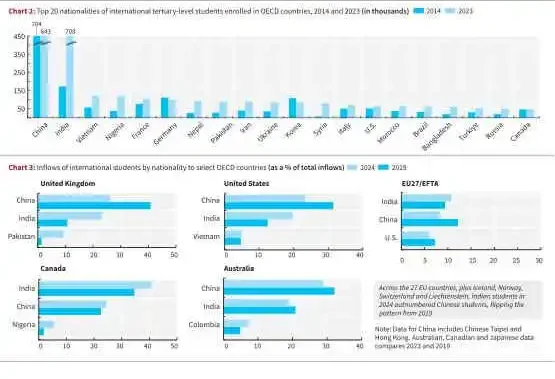
  • Number of Indian students studying overseas rose from 1.72 lakh (2014) to 7.07 lakh (2023) — more than 310% increase.
  • Shows rising aspirations for global exposure and better career prospects.

Comparison with Chinese Students

  • Chinese students increased only 19% during the same period.
  • Shift highlights declining Chinese mobility and rising Indian global presence.

Country-wise Student Distribution Shift

United Kingdom

  • Indian student share increased from 11% (2019) to ~22% (2024).
  • Chinese share fell from 40% to ~25%.

United States

  • Indian share rose from ~12% to ~20%.
  • Chinese share dropped from 30%+ to ~23%.

Canada

  • Indian student dominance continued to grow until recent visa tightening.

Australia

  • Both Indian and Chinese shares declined due to stricter migration rules.

European Union

  • In 2024, Indian students surpassed Chinese students across EU+ countries (27 EU nations + Iceland, Norway, Switzerland, Liechtenstein).

Implications

  • For India: Growing skilled diaspora, Boost to global networks and remittances
  • For host countries: Talent competition, Policy adjustments to balance education and immigration pressures
STUDENT INFLOWS INTO TRADITIONAL DESTINATIONS DECLINE

Conclusion

A strategic global shift in student mobility is taking place. While traditional English-speaking destinations face policy-driven declines, Europe and East Asia are emerging as new education hubs, driven by affordability, work opportunities, and favourable policies. India is now a leading contributor to global student flows, surpassing China in many regions.

This article has been updated and published in detail on our new platform. Please visit the link below for the latest version:

👉 Read the full article on ekamiasacademy.in

HAS CLOUD SEEDING BEEN EFFECTIVE?

TOPIC: (GS3) ENVIRONMENT: THE HINDU

Delhi recently carried out cloud-seeding operations with IIT-Kanpur for the first time in almost 50 years to induce artificial rain and reduce severe smog. However, the trials failed to produce meaningful rain due to unsuitable clouds.

What is Cloud Seeding?

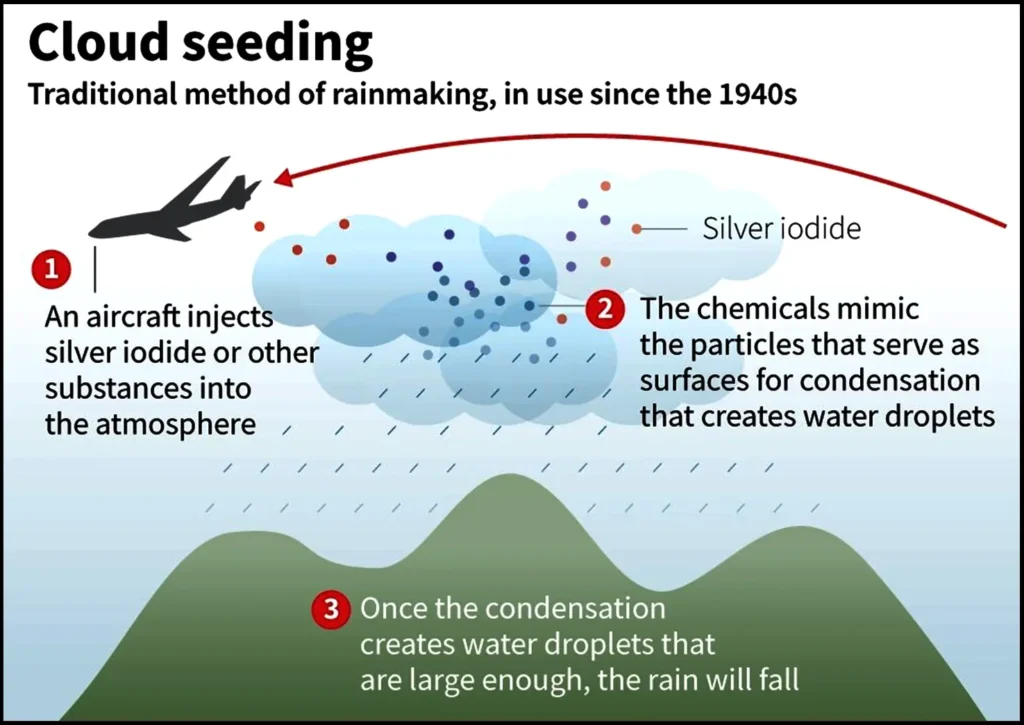
  • Cloud seeding is a weather-modification method to artificially trigger rainfall.
  • It involves dispersing chemicals like salt particles or silver iodide into clouds using aircraft or rockets.
  • These particles act as nuclei that help water vapour or ice crystals combine into larger droplets that may fall as rain.
CLOUD SEEDING

How Does it Help Reduce Smog?

  • Rain brings down dust, smoke, and particulate matter, improving air quality.
  • The idea behind Delhi’s attempt:
    • Wash pollutants from the air column
    • Reduce PM2.5 and PM10 levels
    • Give short-term relief during toxic winter smog episodes

Global History of Cloud Seeding

  • First experiments began in the 1940s in the U.S. by scientists at General Electric.
  • Project Cirrus: tested dry ice to create snowfall.
  • Later, Project Skywater explored large-scale rain enhancement.
  • Soviet Union & China used cloud seeding for weather control during major events (e.g., Beijing Olympics 2008).

India’s Cloud Seeding Journey

  • First trials in 1952 in Kolkata using salt and silver iodide balloons.
  • Attempt in Delhi in 1962, but it failed.
  • From 1970s onwards, aircraft-based seeding began.
  • Several drought-affected States (Maharashtra, Karnataka, Andhra Pradesh, Rajasthan) have tried seeding with mixed results.

CAIPEEX Programme

  • Cloud Aerosol Interaction and Precipitation Enhancement Experiment
  • Launched in 2009 by IITM-Pune.
  • Aim: scientifically evaluate cloud seeding potential in India.
  • Conducted in Solapur (Maharashtra) from 2017-2019.
  • Key Findings:
    • 46% more rainfall in seeded clouds vs. unseeded
    • ~867 million litres additional water
    • 18% more rainfall over a 100 sq km downwind region
  • Proved that seeding works best in moisture-rich monsoon clouds.

Recent Delhi Trials (2024)

  • Conducted by IIT-Kanpur on October 28.
  • Used aircraft and salt-based flares.
  • Result: no significant rain, only light drizzle reported in parts.
  • Reason:
    • Post-monsoon clouds lacked adequate moisture
    • Winter atmosphere in Delhi not suitable for rain-inducing seeding

Conclusion

Cloud seeding has scientific basis but success depends on cloud type, moisture, and timing. It can supplement rainfall in favourable monsoon conditions but is not a reliable tool for winter pollution control. Delhi’s experiment highlights the limitations of artificial rain in dry winter clouds.

This article has been updated and published in detail on our new platform. Please visit the link below for the latest version:

👉 Read the full article on ekamiasacademy.in

GREAT NICOBAR PROJECT

TOPIC: (GS3) ENVIRONMENT: THE HINDU

The Great Nicobar Island mega-infrastructure project has moved a step forward as the A&N administration prepared GIS maps for denotification and renotification of tribal reserve land. This comes amid legal challenges related to Forest Rights Act (FRA), 2006 compliance and tribal protection.

Background

  • Great Nicobar project cost: ₹92,000 crore
  • Key components: International trans-shipment port, Airport, Township, Power plant
  • Implementing agency: ANIIDCO (Andaman & Nicobar Islands Integrated Development Corporation)
  • Tribal group affected: Shompen tribe (Particularly Vulnerable Tribal Group – PVTG)

Latest Developments

Land Denotification Process

  • GIS-based map prepared to denotify and re-notify tribal reserve areas.
  • Consultation ongoing with: Assistant Commissioner, Campbell Bay, Andaman Adim Janjati Vikas Samiti (tribal welfare body)

Forest Rights Clearance

  • Denotification requires settlement of forest rights under FRA, 2006.
  • Claims of settled rights challenged in Calcutta High Court.
  • Court reviewing whether proper consent and rights recognition followed.

Infrastructure Preparation

  • Transit accommodation for project workers completed.
  • Tower locations for communication infrastructure to be finalised soon.
  • Comprehensive Tribal Welfare Plan expected next month.

Key Issues

Environmental Concerns

  • Loss of dense forest, rich biodiversity and coastal ecosystems.
  • Project located in seismically active & tsunami-prone zone.

Tribal Rights

  • Risk of displacement and cultural disruption of the Shompen tribe.
  • Need for meaningful consultation and lawful settlement of rights.

Legal & Policy Challenges

  • Appeals against environmental and forest clearances ongoing.
  • FRA compliance under scrutiny.

Significance

  • Aims to boost India’s maritime and strategic presence in Indian Ocean.
  • Could transform Great Nicobar into a major global shipping & logistics hub.
  • Also tests balance between development, environment, and tribal rights.

This article has been updated and published in detail on our new platform. Please visit the link below for the latest version:

👉 Read the full article on ekamiasacademy.in

HEAVY METALS FOUND IN CAUVERY FISH

TOPIC: (GS3) ENVIRONMENT: THE HINDU

A recent study by Bharathidasan University, Tamil Nadu, reported high levels of heavy metals in sediments and fish from the Cauvery River, warning against frequent fish consumption due to health risks, especially from cadmium and lead.

Key Findings

Heavy Metal Pollution

  • Fish and riverbed sediments showed harmful levels of toxic metals
  • Cadmium & Lead crossed safe limits in several fish species
  • Pollution levels varied across locations

Sources of Pollution

  • Anthropogenic sources (major): Industrial discharge, Agricultural runoff (fertilisers & pesticides), Untreated urban waste
  • Natural sources (minor): Mineral-rich zones upstream contribute trace metals

Health Risk Assessment

  • Long-term fish consumption can lead to: Cancer risks (carcinogenic), Organ damage & metabolic disorders (non-carcinogenic)
  • Higher risk groups: Children, elderly, pregnant women
  • Safe consumption: ~250 g fish, twice a week (as per study estimate)

Bioaccumulation

  • Metals accumulate in fish tissues (especially liver, gills, muscles)
  • Potential biomagnification in food chain

Implications

  • Public Health Concern: Regular exposure may cause: Kidney & liver damage, Neurological issues, Increased cancer risk
  • Environmental Impact: Disturbed river ecology, Threat to aquatic biodiversity

Recommendations:

  • Continuous water & fish monitoring
  • Stronger effluent control & enforcement
  • Public advisories on safe fish intake
  • Better waste-treatment systems in industrial & agricultural areas

Significance

  • Provides fresh data for policymakers & health authorities
  • Highlights urgent need for river protection and pollution management
  • Links urbanisation, industry & agriculture to river ecosystem decline

Conclusion:

Heavy metals in Cauvery fish may harm health if eaten regularly, especially due to cadmium and lead contamination. Experts advise moderate consumption and stronger pollution control to protect people and the river ecosystem.

This article has been updated and published in detail on our new platform. Please visit the link below for the latest version:

👉 Read the full article on ekamiasacademy.in

FOREIGN DEBT INFLOWS FALL SHORT DESPITE RELAXED FAR RULES

TOPIC: (GS3) ECONOMY: THE HINDU

Foreign debt inflows into India in 2025 have remained much lower than expected, even after the relaxation of the Fully Accessible Route (FAR) norms and the inclusion of Indian government bonds in major global indices.
Experts expected much higher foreign investment, but actual numbers are far below projections.

Background

  • India opened its government securities (G-secs) market more widely to foreign investors under FAR.
  • The goal was to attract long-term global funds and strengthen the bond market.
  • However, actual foreign debt inflows have been weaker despite favourable reforms and global index inclusion.

What is the Fully Accessible Route (FAR)?

  • Launched by: RBI & SEBI
  • Purpose: To let foreign investors invest freely in select government bonds
  • Key Features:
    • No investment limit or cap for foreign investors
    • Free repatriation of funds
    • Encourages stable, long-term capital inflows
  • Objective: Deepen the debt market, bring global capital, and make Indian bonds part of global indices.

Expected vs Actual Inflows

  • Analysts predicted $20–25 billion inflows till March 2025 after index inclusion.
  • Actual inflows so far (2024–25): ~$10.7 billion only.
  • This is a big drop compared to 2024, which saw heavy debt inflows.

Why Inflows are Lower

Policy Decision

  • Government excluded 14-year & 30-year bonds from FAR in Aug 2024
  • Aim: Prevent excess speculative inflows & market volatility
  • Result: Limited the securities available under FAR, lowering total inflows

Global Factors

  • Uncertain US interest rate outlook
  • Geopolitical tensions and inflation fears
  • Preference for short-term strategies by foreign investors
  • Rupee fluctuations vs US dollar
  • Higher US treasury yields making US bonds more attractive

India’s Strengths

  • GDP expected to grow ~7% in FY26
  • Inflation near RBI’s target
  • Strong domestic demand and consumption
  • Stable macro fundamentals improving long-term confidence

Importance for India

Foreign debt inflows:

  • Lower government borrowing cost
  • Improve bond market liquidity
  • Strengthen rupee stability
  • Support deeper financial market reforms

Future Outlook

Foreign inflows may rise if:

  • Global interest rates stabilise
  • Bond index inclusion by FTSE & Bloomberg completes
  • India-US trade deal boosts confidence
  • Global monetary policy eases
  • Risk: Fresh inflation surge or sudden US rate hike can slow funds again.

Conclusion

Debt inflows are slower than expected even after reforms. But India’s strong economy and global index inclusion may attract more foreign investment once global conditions stabilise.

This article has been updated and published in detail on our new platform. Please visit the link below for the latest version:

👉 Read the full article on ekamiasacademy.in

RAMNAMI TRIBE

TOPIC: (GS1) INDIAN ART AND CULTURE: THE HINDU

Members of the Ramnami tribe recently became emotional when the Prime Minister accepted their traditional peacock-feather crown, breaking security protocol.
This gesture highlighted the tribe’s unique cultural identity and traditions.

Who are the Ramnami?

  • The Ramnami community belongs to Chhattisgarh, mainly in central and northern regions of the state.
  • They are a devotional sect known for tattooing the word “Ram” across their body and face.
  • Their faith centres on the belief that God (Ram) is everywhere and does not require temples or idols.

RAMNAMI TRIBE

Historical Background

  • Originated in late 19th century as a peaceful social-spiritual movement.
  • Founded by Parsuram Bhardwaj, who belonged to a marginalized caste.
  • Practice began as a silent protest against caste discrimination, especially denial of temple entry.
  • Tattoos were used to assert spiritual equality and claim right to worship without social barriers.

Legal Recognition

  • In 1910, upper-caste groups filed a case against the community’s practice.
  • Court ruled in favour of the Ramnamis, protecting their right to write “Ram” on their bodies, clothing, and homes.

Cultural Features

  • Devotion to Nirgun Ram — God without form or image.
  • Wear white clothing inscribed with “Ram”.
  • Traditional headgear made of peacock feathers.
  • Ghungroo (ankle bells) used during bhajans and community dances.
  • Emphasis on spiritual equality, simplicity, and devotion.
  • Known for gender equality in religious participation.

Present Status

  • Community strength has declined over time: once around 6 lakh, now roughly 1–1.5 lakh, with some estimates as low as 20,000.
  • Younger generations are less inclined toward full-body tattoo traditions.

Conclusion

The Ramnami tribe is a symbol of peaceful resistance to caste oppression and devotion to a formless divine. Their cultural legacy reflects equality, dignity, and faith beyond rituals — and needs continued recognition and preservation.


This article has been updated and published in detail on our new platform. Please visit the link below for the latest version:

👉 Read the full article on ekamiasacademy.in

Write a Review

Your email address will not be published. Required fields are marked *