Table of Contents
Toggle- Meaning:
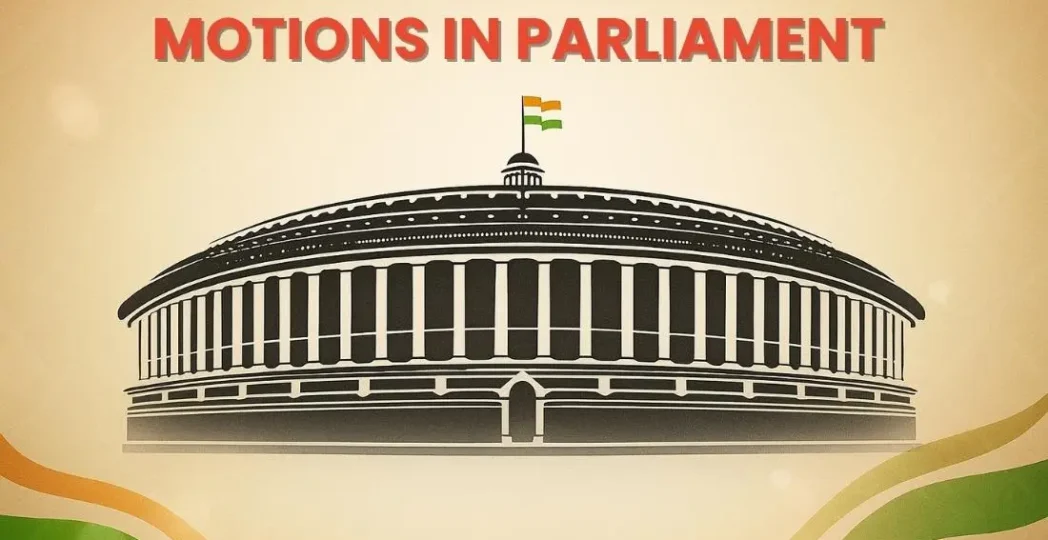
A motion is a formal proposal moved by a Member of Parliament (MP) or minister to initiate discussion, influence the legislative process, or express views on public issues, with prior consent of the.
- Debates are guided by the House’s rules.
- Decision-making can be through voting or discussion.
- Members can propose amendments to modify motions.
- Importance:
- Enables MPs to raise issues of public interest.
- Ensures accountability of the government.
- Facilitates structured debate and decision-making.
Allows expression of opinions and recommendations.
Categories & Types of Motions
1. Substantive Motion
- Independent proposal addressing major issues.
- Examples: Impeachment of the President, removal of Chief Election Commissioner.
2. Substitute Motion
- Alternative to an original motion.
- Replaces the original motion if adopted.
3. Subsidiary Motion
- Depends on another motion; cannot decide House’s action independently.
- Types of Subsidiary Motion:
- Ancillary Motion – routine procedure.
- Superseding Motion – overrides ongoing debate.
- Amendment Motion – alters specific parts of original motion.
Special Motions
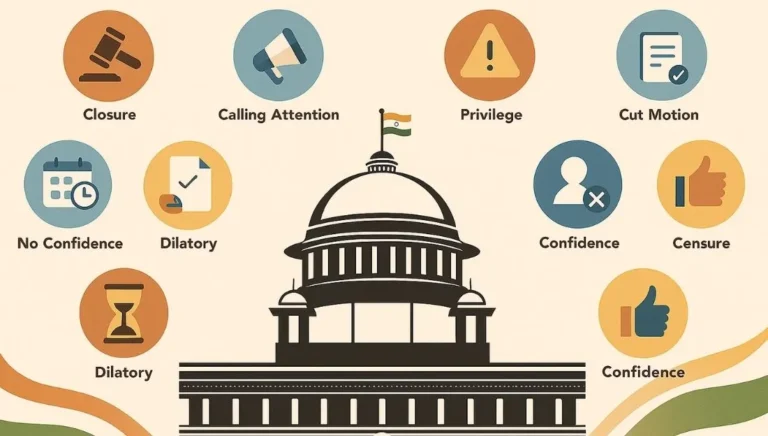
Motion | Purpose / Feature |
Closure Motion | Ends debate and puts matter to vote. Types: Simple, Closure by Compartments, Kangaroo Closure, Guillotine Closure. |
Calling Attention Motion | Draws minister’s attention to urgent public issues. Indian innovation, introduced 1954. |
Privilege Motion | Raised if a minister violates parliamentary privileges; seeks censure. |
Adjournment Motion | Discuss urgent public matters; disrupts normal business; requires 50 MPs’ support; not allowed in Rajya Sabha. |
No-Confidence Motion | Introduced in Lok Sabha to express loss of majority; if passed, government resigns. |
Confidence Motion | Moves by government to prove majority; rejection leads to government downfall. |
Censure Motion | Expresses disapproval of government policies/actions; does not require resignation. |
Motion of Thanks | Debated after President’s Address; government considered defeated if not passed. |
No Day Yet Named Motion | Accepted by Speaker but scheduled for discussion later. |
Dilatory Motion | Delays or adjourns business; checks misuse of House rules. |
Cut Motion | Opposes allocation of funds in Finance Bill; types include Disapproval of Policy, Economic Cut, Token Cut. |
Resolutions in Parliament
- Definition: Independent proposals expressing clear decisions, put to vote in the House.
- Objectives: Express opinion, recommend action, convey approval/disapproval, or highlight issues for government attention.
Types of Resolutions:
- Private Member’s Resolution: Introduced by MPs other than ministers; discussed on alternate Fridays.
- Government Resolution: Moved by ministers; can be discussed any day Monday–Thursday.
- Statutory Resolution: Introduced by either private members or ministers; aligns with Constitution or Acts.
Prelims Practice Questions
Lok Sabha Specific Motions
Q: Which of the following motions can be moved only in Lok Sabha?
a) Adjournment Motion
b) No-Confidence Motion
c) Censure Motion
d) All of the above
Calling Attention Motion
Q: Consider the following statements about Calling Attention Motion:
- It is a formal provision in the Rules of Procedure.
- It is an informal device like Zero Hour.
Which is correct?
a) 1 only
b) 2 only
c) Both 1 and 2
d) Neither 1 nor 2
Closure Motion
Q: Which motion allows skipping certain clauses of a bill for faster voting?
a) Guillotine Closure
b) Kangaroo Closure
c) Closure by Compartments
d) Simple Closure
Cut Motion Types
Q: Token Cut, Economic Cut, and Disapproval of Policy are types of which motion?
a) No-Confidence Motion
b) Cut Motion
c) Adjournment Motion
d) Privilege Motion
Motion of Thanks
Q: Motion of Thanks is related to:
a) President’s Address to Parliament
b) Budget Presentation
c) Confidence Motion
d) Privilege of Members
Mains Practice Questions
Short Answer (50 words)
Question: Explain the significance of No-Confidence Motion and Confidence Motion in the parliamentary system of India.
Medium Answer (150 words)
Question: Discuss the role and importance of Adjournment Motion, Calling Attention Motion, and Privilege Motion in maintaining executive accountability.
Essay / Analytical (250–300 words)
Question: “Motions in Parliament are essential instruments to facilitate debate, decision-making, and accountability.” Critically examine various types of motions and their contribution to democratic governance.
Comparative (150 words)
Question: Compare Censure Motion and No-Confidence Motion in terms of purpose, procedure, and consequences for the government.
Case-Based Question (200 words)
Question: During a session, MPs demand discussion on urgent matters but the House schedule is packed. Which parliamentary motions and resolutions can be used to prioritize these matters? Discuss procedure and implications.
Motions in Parliament - FAQs Answered
What is a Motion in the Indian Parliament?
A motion is a formal proposal made by a Member of Parliament (MP) or a minister to initiate discussion, express an opinion, or decide on a particular issue, with the approval of the Speaker or Chairman.
What are the different types of motions in Parliament?
Motions are broadly classified as Substantive, Substitute, and Subsidiary Motions.
Subsidiary motions include Ancillary, Superseding, and Amendment Motions. Special motions include No-Confidence, Censure, Adjournment, Closure, and Privilege Motions.
What is the difference between a No-Confidence Motion and a Censure Motion?
A No-Confidence Motion expresses lack of majority support and, if passed, requires the government to resign.
A Censure Motion disapproves specific government actions or policies but does not compel resignation.
What is the significance of motions in parliamentary proceedings?
Motions ensure government accountability, encourage structured debate, and allow MPs to raise issues of public importance, thereby strengthening parliamentary democracy.
What is the difference between a Motion and a Resolution in Parliament?
A Motion initiates discussion or decision-making, while a Resolution expresses the definitive opinion or will of the House.
Resolutions are generally voted upon, and once passed, they become the formal decision of the House.