
ESTIMATING INDIA’S POTENTIAL GROWTH RATE
TOPIC: (GS3) ECONOMY: THE HINDU
Economist C. Rangarajan, former RBI Governor, in his article “Estimating India’s Potential Growth Rate,” argued that India’s sustainable long-term growth potential remains around 6.5%, despite short-term fluctuations in GDP growth.
About The Issue
- The debate on India’s potential growth rate — the maximum rate the economy can grow without causing inflation — has gained renewed attention after India reported 7.8% GDP growth in Q1 2025–26.
- The key question: Does this higher quarterly growth signal a lasting rise in India’s growth potential?
Key Economic Findings
GDP and GVA Trends
- The average GDP growth in the first quarters (2022–23 to 2024–25) stood at 9.9%, higher than other quarters.
- Q1 2025–26 growth (7.8%) is lower than that average, suggesting no structural shift upward.
- GVA growth for Q1 2025–26 was 7.6%, driven mainly by manufacturing (7.7%) and key service sectors like trade, transport, finance, and public administration.
Investment Patterns
- The real Gross Fixed Capital Formation Rate (GFCFR) remained steady: 34.5% (2023–24), 34.6% (2024–25), 34.6% (2025–26).
- No visible rise in investment rates, indicating stable but not accelerating capital formation.
Potential Growth Rate and ICOR
- Potential Growth Rate (PGR) depends on two key factors:
- Gross Fixed Capital Formation Rate (GFCFR) — total investment in physical assets.
- Incremental Capital-Output Ratio (ICOR) — the efficiency with which capital converts into output.
- Using a GFCFR of 33.6% and an ICOR of 5.2, the PGR is around 6.5%.
- To push growth above 6.5%, India must either: Raise GFCFR by 2 percentage points (to about 36%), or Lower ICOR (improve efficiency of capital use).
Role of Public and Private Investment
- Public sector’s share in total investment rose from 21.6% (2021–22) to 25.1% (2023–24), mainly through infrastructure projects.
- However, Centre’s capital expenditure growth slowed to 10.8% in 2024–25.
- Private corporate investment declined from 37% to 34.4% of total GFCF.
- Sustained higher growth requires reviving private investment through policy support, ease of doing business, and financing reforms.
Challenges and Future Prospects
- Global headwinds: trade disruptions, tariff barriers, and weak exports (net exports turned negative by –1.4% points in Q1 2025–26).
- Technological changes: AI and automation may boost efficiency but could also increase capital replacement costs.
- Balance of forces: These opposing influences likely keep India’s potential growth near 6.5% in the medium term.
Conclusion
India’s 6.5% potential growth is robust given current global conditions, but employment generation and inclusive growth demand higher rates.
NATIONAL SECURITY AND ECOLOGICAL RESPONSIBILITY
TOPIC: (GS3) ENVIRONMENT: THE HINDU
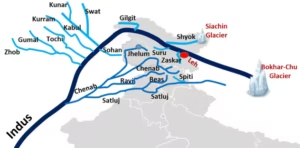
India has given fresh approval to the Sawalkote Hydroelectric Project (1.8 GW) on the Chenab River in Jammu & Kashmir, soon after suspending the Indus Waters Treaty (IWT) following the Pahalgam terror attack.
Background of the Issue
- The Sawalkote Project, planned by NHPC Limited, aims to boost power generation and assert India’s rights over the western rivers under the IWT.
- However, its revival comes with environmental, social, and diplomatic implications that test India’s governance priorities.
Project and Environmental Impact
- Hydropower corridor congestion: The Chenab already has major hydel projects — Dulhasti, Baglihar, and Salal, creating a “bumper-to-bumper” hydropower zone.
- Reservoir and displacement: Though called run-of-the-river, the project’s massive reservoir (over 50,000 crore litres) makes it similar to a storage dam.
- About 1,500 families will be displaced and 847 hectares of forest will be diverted, while rehabilitation costs form only 0.6% of total project cost.
- Cost escalation: Project cost has increased by nearly ₹9,000 crore due to inflation and administrative delays.
Geopolitical and Strategic Dimensions
- The project signals India’s assertion of water rights after the suspension of the Indus Waters Treaty, removing earlier procedural checks.
- While strategically significant, this approach risks hurting India’s global image as a nation supporting treaty-based river governance.
- Pakistan has already questioned the legality of India’s decision, which could invite international scrutiny if future projects lack cooperation mechanisms.
Way Forward
- India must balance national security with ecological sustainability.
- Conduct regional environmental and sediment management studies before project approval.
- Promote data transparency and hydrological sharing through regional platforms to build trust and align strategic autonomy with environmental responsibility.
Indus Waters Treaty (IWT)
Background:
- Signed in 1960 between India and Pakistan, brokered by the World Bank, to share the waters of the Indus River system.
Water Allocation:
- India received rights over the eastern rivers — Ravi, Beas, Sutlej;
Pakistan received rights over the western rivers — Indus, Jhelum, Chenab.
- India received rights over the eastern rivers — Ravi, Beas, Sutlej;
Purpose:
- Aims to ensure peaceful and cooperative water sharing, supporting irrigation, power generation, and agriculture in both nations.
Current Relevance:
- Despite political tensions, the treaty has largely survived wars and disputes, though Pakistan often raises concerns over India’s hydroelectric projects on western rivers.
Conclusion
The Sawalkote project’s true legacy will depend on whether India can prove that security interests and ecological stewardship are complementary, not conflicting, pillars of responsible governance.
THE NEED TO ADDRESS CASTE-BASED ATROCITIES
TOPIC: (GS2) SOCIAL JUSTICE: THE HINDU
The NCRB’s 2023 report shows a rise in caste-based crimes, with 57,789 cases against Scheduled Castes (SCs) and 12,960 against Scheduled Tribes (STs), highlighting persistent social inequalities and the failure of justice delivery mechanisms to protect marginalised groups.
Background of the Issue
- Despite constitutional guarantees of equality and dignity, caste-based discrimination and violence remain entrenched.
- The Scheduled Castes and Scheduled Tribes (Prevention of Atrocities) Act, 1989, was meant to deter such crimes, but weak implementation and social bias have reduced its effectiveness.
Current Trends in Caste-Based Violence
- Rising Cases: NCRB data shows a 0.4% increase in crimes against SCs and a 28.8% rise against STs in 2023 compared to 2022. Offences include physical assaults, humiliation, land disputes, and social boycotts.
- Systemic Discrimination: Dalits and Adivasis face exclusion in education, housing, and employment. In rural areas, defying caste norms often leads to violence, while in urban spaces, discrimination is subtle yet persistent.
Social and Political Dimensions
- Symbolic Inclusion without Structural Change: The current political establishment promotes token gestures — such as Dalit participation in rituals — without addressing structural inequality.
- Failure of Governance: Poor enforcement of laws, delayed investigations, and low conviction rates (over 60% of cases pending under the Atrocities Act) show weak state accountability.
- Cultural Suppression: Restrictions on Dalit-Bahujan cultural expression — such as censorship of films or literature — further marginalise these communities.
Historical Context and Social Movements
- Reformers like Ambedkar, Phule, Periyar, and Gandhi fought to dismantle caste hierarchies.
- Movements such as the Dalit Panthers (1970s) and Bahujan Samaj Party (BSP) empowered marginalised voices politically.
- However, fragmentation and decline of social movements today have weakened collective resistance against caste injustice.
Way Forward:
- Strengthen Law Enforcement: Ensure time-bound investigation and strict prosecution of atrocity cases. Sensitise police and judiciary to prevent caste bias.
- National Campaign for Equality: Launch a nationwide awareness initiative through schools, media, and public platforms to promote fraternity and dismantle caste hierarchies.
- Empower Civil Society: Encourage dialogue between communities through cultural, academic, and religious institutions. Protect and promote Dalit and Adivasi cultural spaces.
- Ensure Effective Affirmative Action: Strengthen reservations and welfare programs with transparency and accountability.
Conclusion
Caste-based atrocities are not merely law-and-order issues but a crisis of equality and humanity. India must reaffirm Ambedkar’s vision of “fraternity and social democracy” through robust policies, political will, and grassroots mobilisation to build a truly inclusive and dignified society.
UTTARAKHAND EASES MARRIAGE REGISTRATION RULES UNDER UCC
TOPIC: (GS2) INDIAN POLITY: THE HINDU
The Uttarakhand government has amended its Uniform Civil Code (UCC) to simplify marriage registration for citizens of Nepal, Bhutan, and Tibet living in the State who do not possess an Aadhaar card.
Background
- Uttarakhand became the first Indian state to implement the Uniform Civil Code (UCC) in February 2024, ensuring uniform personal laws for all communities regarding marriage, divorce, inheritance, and property.
The recent amendment fine-tunes these provisions to make them more inclusive and practical.

Key Features of the Amendment
Inclusion of Foreign Citizens:
- Residents from Nepal, Bhutan, and Tibet can now register their marriages without requiring an Aadhaar card.
- They may use alternative identification such as:
- Citizenship certificate
- Residence certificate
- Passport or other valid identity proof
- Certificate from the Foreign Registration Officer (FRO)
Ease of Online Registration:
- Applicants can upload the approved documents on the official UCC marriage registration portal for quick verification.
Cultural and Regional Context:
- Uttarakhand shares geographical borders and socio-cultural ties with Nepal, Bhutan, and Tibetan communities, leading to intermarriages and shared traditions.
- The change aims to ensure that such families are not excluded from legal rights or government benefits.
- Current Status: Since UCC implementation, over 4 lakh marriages have been registered online, showing rising public acceptance and compliance.
About The Uniform Civil Code (UCC)
- The UCC seeks to provide a common set of laws governing personal matters such as marriage, divorce, inheritance, adoption, and succession for all citizens, irrespective of religion or caste.
- It promotes gender equality, legal uniformity, and secularism as envisioned in Article 44 of the Indian Constitution (Directive Principles of State Policy).
- The UCC ensures:
- Equal rights for women in property and inheritance.
- Mandatory registration of marriages and divorces.
- Regulation of live-in relationships to enhance social accountability.
Significance of the Amendment
- Promotes inclusivity and fairness for cross-border residents.
- Strengthens Uttarakhand’s role as a model for implementing UCC in India.
- Ensures legal protection and recognition of marriages for all residents, regardless of nationality.
NUMBER OF BIRTHS DECLINES; DEATHS RISE SLIGHTLY, CRS REPORT 2023
TOPIC: (GS1) SOCIAL ISSUES: THE HINDU
The Vital Statistics of India 2023 report, released by the Registrar General of India (RGI), shows a decline in registered births and a slight rise in deaths compared to the previous year.
About The Report
- The Civil Registration System (CRS) records vital events such as births and deaths across India every year.
- The 2023 report was compiled by the Office of the Registrar General of India (RGI) under the Ministry of Home Affairs.
- It helps in assessing population growth, mortality, and gender balance in the country.
Key Findings

Birth and Death Statistics
- Registered births (2023): 2.52 crore — a decrease of about 2.32 lakh from 2022.
- Registered deaths (2023): 86.6 lakh — a marginal rise from 86.5 lakh in 2022.
- Pandemic impact: No significant increase in deaths post-2022, though 2021 saw a major surge (over 102 lakh deaths) during the COVID-19 wave.
Sex Ratio at Birth
- Lowest ratios: Jharkhand (899), Bihar (900), Telangana (906), Maharashtra (909), Gujarat (910), Haryana (911).
- Highest ratios: Arunachal Pradesh (1,085), Nagaland (1,007), Goa (973), Ladakh & Tripura (972), Kerala (967).
- Trend: Bihar continues to have the lowest sex ratio since 2020.
Institutional Births
- Share of institutional births: 74.7% of total registered births.
- Overall birth registration rate: 98.4% (excluding Sikkim).
Timely Birth Registration
- Above 90% within 21 days: Gujarat, Puducherry, Chandigarh, Tamil Nadu, Goa, Punjab, and others.
- 50–80% registration: States like UP, Bihar, Kerala, Telangana, and Madhya Pradesh.
Significance
- Reflects post-COVID population stabilization and improved registration efficiency.
- Highlights regional disparities in sex ratio and timely registration.
- Provides crucial data for health planning, gender policies, and population projections.
ACHIEVING CENTRE’S ROOFTOP SOLAR TARGETS TO REMAIN A CHALLENGE
TOPIC: (GS3) ECONOMY: THE HINDU
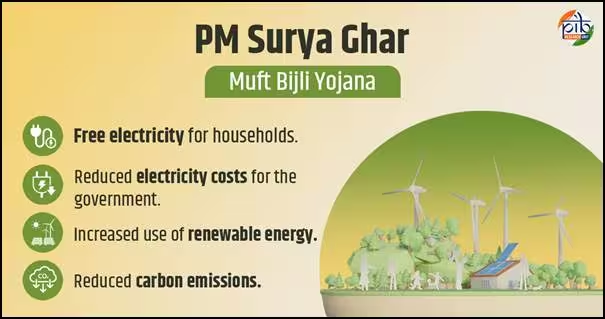
A recent study by the Institute for Energy Economics and Financial Analysis (IEEFA) and JMK Research revealed that the PM Surya Ghar: Muft Bijli Yojana (PMSGY) has achieved only 13.1% of its 1 crore rooftop solar target by July 2025, highlighting serious implementation hurdles.
PM Surya Ghar Yojana (PMSGY)
- A Central Government initiative aimed at promoting rooftop solar installations in residential homes.
- Objective: Install 1 crore rooftop solar systems by FY2027 to promote clean energy and reduce household electricity costs.
- The government provides capital subsidies and loans, encouraging households to shift to solar power.
Key Findings of the Report
- Progress So Far: Till July 2025, about 57.9 lakh applications were received. Only 4,946 MW (4.9 GW) capacity installed across States and UTs.
- 16 lakh households have benefited, with subsidy payouts of ₹9,281 crore (around 14.1% of total ₹65,700 crore).
- Slow Implementation: Approval and connection delays ranging from 45 to 120 days. Caused by meter shortages, poor coordination between consumers, installers, and DISCOMs.
- Economic Challenges: Scheme mandates the use of DCR-compliant (India-made) solar modules. These are ₹12/watt costlier than imported panels, making larger systems less affordable.
- Current Status: The installed 4.9 GW represents about 44.5% of India’s total residential rooftop solar capacity.
Suggestions from the Study
- Set state-wise, time-bound targets to ensure coordinated implementation.
- Simplify approval and metering procedures to cut down delays.
- Encourage cost efficiency through local manufacturing support and better subsidy management.
Significance
- Rooftop solar energy plays a key role in India’s renewable energy goals and carbon neutrality targets.
- Streamlining the PMSGY can accelerate progress toward achieving energy self-reliance and sustainability.
ARCTIC SEALS, BIRDS IN NEW ‘RED LIST’ OF ENDANGERED SPECIES: IUCN
TOPIC: (GS3) ENVIRONMENT: THE HINDU
The International Union for Conservation of Nature (IUCN) has updated its Red List of Threatened Species, warning that Arctic seals and several bird species are increasingly endangered due to climate change, habitat loss, and human activities.
About The Issue
- The update was released during the IUCN World Conservation Congress in Abu Dhabi, which focuses on nature-based recovery, climate action, and biodiversity protection.
- The IUCN emphasized the growing human-induced pressures on ecosystems, particularly in the Arctic and tropical regions.
Key Findings
Threats to Arctic Seals
- Hooded seal status changed from Vulnerable to Endangered.
- Bearded and harp seals moved to the Near Threatened category.
- Causes of decline:
- Rapid global warming melting Arctic sea ice — the habitat essential for these seals.
- Human interference such as shipping, oil drilling, and industrial fishing.
- The Arctic is warming four times faster than the global average, shrinking sea ice drastically.
Decline in Bird Populations
- The IUCN Red List now assesses 11,185 bird species, of which 1,256 (11.5%) are globally threatened.
- 61% of bird species show declining populations, up from 44% in 2016.
- Deforestation and agriculture in tropical regions like Madagascar, West Africa, and Central America have worsened habitat loss.
- Newly listed: 14 species in Madagascar and 5 in West Africa as Near Threatened.
Positive Development
- The Green Turtle has been downgraded from Endangered, thanks to long-term conservation efforts that boosted its population by 28% since the 1970s.

What Is the IUCN Red List?
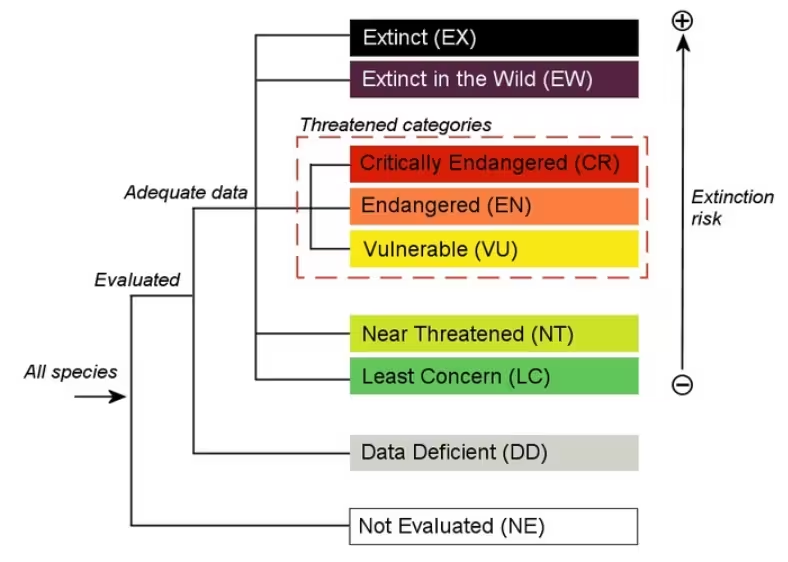
- The IUCN Red List of Threatened Species is the world’s most comprehensive inventory assessing the risk of extinction of plants and animals.
- Categories include: Least Concern, Near Threatened, Vulnerable, Endangered, Critically Endangered, Extinct in the Wild, and Extinct.
- It helps guide global conservation priorities and policies.
Significance
- Highlights the accelerating climate crisis in the Arctic and biodiversity loss globally.
- Urges nations to intensify conservation measures and adopt sustainable resource practices.
GAZA DECLARATION INKED AS HAMAS RELEASES HOSTAGES
TOPIC: (GS2) INTERNATIONAL RELATIONS: THE HINDU
A historic Gaza Declaration was signed by U.S. President Donald Trump and leaders of Egypt, Qatar, and Turkiye to formalise a ceasefire between Israel and Hamas, as both sides exchanged hostages and prisoners, marking a major breakthrough after two years of conflict.
Background of the Issue
- The Israel-Hamas war, which began in October 2023, claimed thousands of lives and devastated Gaza.
- The latest peace initiative — termed the Gaza Declaration — aims to end hostilities, facilitate prisoner exchanges, and establish a roadmap for long-term peace.
- The deal was finalised at Sharm el-Sheikh, Egypt, with the U.S. and regional powers acting as guarantors.
Key Features of the Ceasefire Deal
- Hostage and Prisoner Exchange: Hamas freed the last 20 surviving hostages after two years of captivity. Israel released 1,968 Palestinian prisoners, including about 250 security detainees.
- International Guarantors: The agreement was co-signed by Donald Trump, Abdel Fattah El-Sisi (Egypt), and leaders of Qatar and Turkiye. The declaration includes guidelines for future peace measures and humanitarian coordination.
- Symbolism and Political Impact: The move marks Trump’s major diplomatic success in the Middle East. Egypt played a key mediation role, with President Sisi praised for facilitating the talks.
Challenge
- Hamas’s refusal to disarm and Israel’s lack of commitment to a full troop withdrawal remain unresolved.
- Sporadic violence within Gaza, including clashes between Hamas forces and local clans, indicates internal instability.
- Trust deficit between both sides could undermine long-term peace enforcement.
Significance of the Gaza Declaration
- Ends a two-year-long war, bringing temporary relief to millions in Gaza.
- Reinforces U.S. and regional diplomacy in conflict resolution.
- Opens avenues for post-war reconstruction, humanitarian aid, and regional cooperation.
Conclusion
The Gaza Declaration marks a critical step toward de-escalation in the Middle East. However, sustaining peace will require mutual restraint, disarmament dialogue, and trust-building between Israel and Hamas under continued international oversight.