
Daily Current Affairs 15-October-2025

Share this Post

POWERING UP THE AUSTRALIA–INDIA CLEAN ENERGY PARTNERSHIP

TOPIC: (GS3) ENVIRONMENT: THE HINDU

India and Australia are working to strengthen their Renewable Energy Partnership to reduce reliance on global supply chains. The collaboration aims to boost clean energy cooperation and address challenges in sourcing critical materials.

Climate Urgency in the Indo-Pacific

  • The Indo-Pacific region faces growing climate threats — from frequent floods and cyclones to rising sea levels.
  • Between 1970 and 2022, it recorded nearly 10 climate disasters every month, causing massive human and economic losses.
  • By 2050, nearly 89 million people may be displaced due to climate impacts, with 80% of the population directly affected.

India and Australia’s Clean Energy Goals

India’s Commitments:

  • Target of 500 GW non-fossil fuel power capacity by 2030, including 280 GW from solar energy.
  • As of mid-2025, half of India’s electricity already comes from non-fossil sources.

Australia’s Commitments:

  • Plans to cut emissions by 62–70% below 2005 levels by 2035.
  • Focus on a net-zero economy and developing a skilled workforce under its Net Zero Jobs Plan.

The Challenge: Overdependence on China

  • China currently refines over 90% of rare earths and produces around 80% of global solar modules.
  • This dominance creates supply chain vulnerability for both India and Australia.
  • COVID-19 and recent Chinese export restrictions exposed these weaknesses:
    • India’s EV and wind sectors suffered due to lack of critical components.
    • Australia realized the risks of staying a raw-material exporter without domestic refining.

India–Australia Renewable Energy Partnership (REP)

Key Areas of Cooperation:

  • Solar photovoltaic technology and green hydrogen development.
  • Energy storage systems and solar supply chain diversification.
  • Circular economy practices in renewables.
  • Two-way investments and capacity building.
  • Track 1.5 Dialogue – linking governments, industry, and academia for practical outcomes.

Mutual Strengths and Opportunities

  • Australia: Rich in lithium, cobalt, and rare earths; offers stable policies and investment potential.
  • India: Has a young workforce, strong manufacturing base, and PLI schemes to promote solar and hydrogen sectors.
  • Together, they can co-develop refining capacity, train skilled workers, and diversify global

Renewable Energy Sources in India
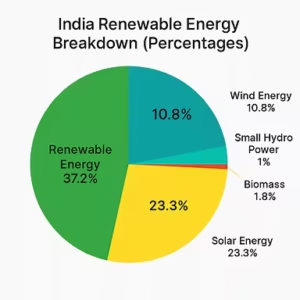
Renewable Energy Sources in India

India aims to generate 50% of its electricity from non-fossil fuel sources by 2030, with renewables playing a central role in achieving this target.

Conclusion

The visit marks a strategic step towards building a resilient, democratic clean energy alliance in the Indo-Pacific. By combining Australia’s resources and India’s talent, both nations can drive a sustainable transition and reduce global dependence on a single country.

MICROPLASTICS POLLUTION THREATENS GOA’S ESTUARINE

TOPIC: (GS3) ENVIRONMENT: THE HINDU

A new study by the CSIR–National Institute of Oceanography (Goa) and AcSIR (Ghaziabad) has revealed alarming levels of microplastic contamination in Goan coastal fish, posing risks to both marine ecosystems and human consumers.
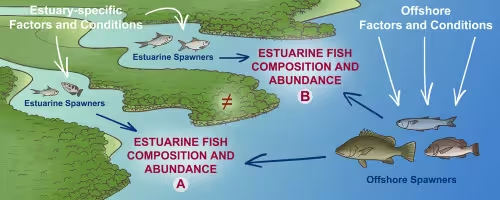
CSIR–National Institute of Oceanography (Goa)        

Background and Context

  • Microplastics are tiny plastic fragments (less than 5 mm) that originate from degraded fishing gear, packaging waste, textiles, and industrial discharge.
  • Goa’s Mandovi estuary, a key fishing hub contributing nearly 97% of the State’s fish output, is witnessing serious microplastic bioaccumulation in commercial fish and shellfish species.
  • The study fills crucial gaps about contamination levels, how fish ingest microplastics, and the potential health implications.

Study Overview

  • Scientists examined 251 fish from nine species of finfish and shellfish such as mackerel, sardine, anchovy, catfish, bamboo shark, clam, and oyster.
  • A total of 4,871 particles were detected, including 3,369 plastic polymers of 19 different types.
  • Higher contamination was found on the sea floor (benthic zone) compared to the open water (pelagic zone).
  • The main pollution sources were discarded fishing materials and wastewater discharge from nearby human settlements.

Key Findings

  • Fish inhabiting areas closer to sediment-rich sea beds ingested more microplastics.
  • Smaller fish like anchovies and catfish accumulated more particles, while larger species like the bamboo shark had fewer.
  • Microplastics were found mainly in the digestive tract, followed by the gills — indicating ingestion during feeding and water intake.
  • The study identified four main shapes of microplastics:
    • Fibres (53%), Fragments (29.9%), Films (13.1%), and Beads (4%).
  • Colours of particles (blue, black, red, transparent) suggested sources such as fishing nets, tyres, packaging, e-waste, and textiles.

Ecological and Human Health Impacts

  • Affected fish showed signs of gene disruption, oxidative stress, poor reproduction, and slower growth.
  • For humans, consuming these fish may lead to immune dysfunction, higher cancer risk, and neurotoxicity.
  • Benthic organisms face greater exposure risks due to sediment contamination.
  • Shellfish showed poor nutritional value, raising concerns for local fisheries and livelihoods.

Broader Implications and Way Forward

  • Though the overall region was marked as low-risk, long-term effects could disrupt Goa’s marine food web and coastal economy.
  • The study stresses the urgent need for:
    • Stricter waste management, especially in coastal zones.
    • Ban on single-use plastics and better disposal of fishing gear.
    • Research into biodegradable materials and public awareness on plastic pollution.

Conclusion:

The Goan coast’s estuarine ecosystems, vital for both fisheries and nutrition, are increasingly threatened by microplastic pollution. Without swift action on waste control and sustainable fishing practices, both marine biodiversity and human health could face long-term consequences.

GAGANYAAN CREW ESCAPE SYSTEM (CES)

TOPIC: (GS3) SCIENCE AND TECHNOLOGY: THE HINDU

ISRO has successfully demonstrated the Crew Escape System (CES) for its upcoming Gaganyaan human spaceflight mission, a key safety feature designed to rescue astronauts in case of a launch emergency.

Background

  • The Gaganyaan mission aims to send Indian astronauts to a low-Earth orbit (around 400 km) and bring them back safely.
  • Human spaceflight requires crew safety at every stage — from launch to landing — making CES a vital system for risk management.
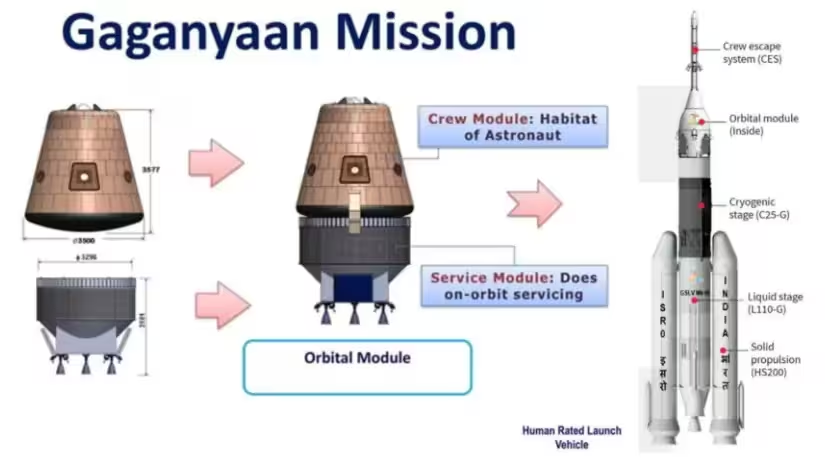
Gaganyaan Mission

What is the Crew Escape System (CES)?

  • CES is a safety mechanism designed to instantly detach the crew module from the launch vehicle if a malfunction occurs.
  • It operates during the initial atmospheric phase, when the rocket faces maximum aerodynamic stress and cannot be shut down quickly.
  • The system uses powerful rocket motors to pull the crew module away from the vehicle with acceleration up to 10 times gravity (10g).
  • Astronauts are seated in a posture that reduces physical stress during this high acceleration phase.

Types of CES

  • Puller Type (used in Gaganyaan): The system pulls the crew module away using solid motors. Chosen for simplicity and reliability.
  • Pusher Type (used in SpaceX Falcon 9): Uses liquid-fuel engines to push the module away from the rocket. Offers better control but adds design complexity.

Functioning after Separation

  • Once safely away, the crew module deploys a multistage parachute system to slow down.
  • The capsule then splashes down in the sea, keeping impact within safe human limits.
  • The Integrated Vehicle Health Management (IVHM) system monitors real-time data and automatically triggers CES if required.

ISRO’s Testing of CES

  • ISRO built a single-stage Test Vehicle using the Vikas engine to validate CES performance.
  • The first successful test in 2023 verified CES operation during transonic conditions (from subsonic to supersonic speed).
  • Further tests are planned to assess CES under varied flight conditions.

Conclusion:

The Crew Escape System is the backbone of astronaut safety in Gaganyaan, ensuring that India’s first human spaceflight mission meets global safety standards through robust engineering and real-world testing.


HOW INNOVATION DRIVES ECONOMIC GROWTH

TOPIC: (GS3) ECONOMY: THE HINDU

ISRO has successfully demonstrated the Crew Escape System (CES) for its upcoming Gaganyaan human spaceflight mission, a key safety feature designed to rescue astronauts in case of a launch emergency.

Background

  • The Gaganyaan mission aims to send Indian astronauts to a low-Earth orbit (around 400 km) and bring them back safely.
  • Human spaceflight requires crew safety at every stage — from launch to landing — making CES a vital system for risk management.

What is the Crew Escape System (CES)?

  • CES is a safety mechanism designed to instantly detach the crew module from the launch vehicle if a malfunction occurs.
  • It operates during the initial atmospheric phase, when the rocket faces maximum aerodynamic stress and cannot be shut down quickly.
  • The system uses powerful rocket motors to pull the crew module away from the vehicle with acceleration up to 10 times gravity (10g).
  • Astronauts are seated in a posture that reduces physical stress during this high acceleration phase.

Types of CES

  • Puller Type (used in Gaganyaan): The system pulls the crew module away using solid motors. Chosen for simplicity and reliability.
  • Pusher Type (used in SpaceX Falcon 9): Uses liquid-fuel engines to push the module away from the rocket. Offers better control but adds design complexity.

Functioning after Separation

  • Once safely away, the crew module deploys a multistage parachute system to slow down.
  • The capsule then splashes down in the sea, keeping impact within safe human limits.
  • The Integrated Vehicle Health Management (IVHM) system monitors real-time data and automatically triggers CES if required.

ISRO’s Testing of CES

  • ISRO built a single-stage Test Vehicle using the Vikas engine to validate CES performance.
  • The first successful test in 2023 verified CES operation during transonic conditions (from subsonic to supersonic speed).
  • Further tests are planned to assess CES under varied flight conditions.

Conclusion:

The Crew Escape System is the backbone of astronaut safety in Gaganyaan, ensuring that India’s first human spaceflight mission meets global safety standards through robust engineering and real-world testing.

A GREEN ADVANTAGE IN TRACTOR EXPORTS

TOPIC: (GS3) ECONOMY: THE HINDU

The government’s recent move to reduce GST on tractors to 5% aims to boost farm mechanisation and manufacturing.

Importance of Tractors in India

  • Tractors are the mainstay of Indian agriculture, used for ploughing, sowing, irrigation, transport, and residue management.
  • India is now a leading global exporter of tractors, exporting $1.15 billion worth to 162 countries in 2024–25.
  • However, rising tractor numbers have also led to increased air pollution, with emissions from agricultural machinery projected to exceed road vehicle emissions by 2030, according to the International Council on Clean Transportation (ICCT).

Shift Towards Cleaner Standards

  • India introduced Bharat Stage (TREM) IV emission norms for tractors in 2023, cutting particulate emissions by up to 94%.
  • By April 2026, TREM V norms will bring Indian standards on par with U.S. Tier 4f and EU Stage V emission rules.
  • These changes not only reduce pollution but also align Indian products with global regulations, lowering export compliance costs and improving competitiveness.

Impact on Exports

  • United States: While total exports dropped, sales of large tractors (75–130 kW) — where norms align — rose sharply.
  • Europe: Exports to Belgium saw a dramatic increase after TREM IV; medium tractors grew 200 times, and large tractor exports reached $28 million in 2024–25.
  • Brazil: After adopting MAR-I norms in 2017, India’s early compliance helped exports grow from $4.5 million (2017–18) to $88 million (2024–25) — a 65% CAGR.
  • Even in non-regulated markets (Bangladesh, South Africa, Thailand), India remains strong due to affordability and reliability.

Policy and Strategic Implications

  • Emission alignment is a strategic trade enabler, not just an environmental goal.
  • The GST cut lowers costs for farmers and manufacturers, encouraging both domestic mechanisation and export readiness.
  • Targeted incentives for electric and low-emission tractors can help India transition from cost-based competition to technology-led exports.
  • Cleaner machines provide lower lifetime costs, better fuel efficiency, and future regulatory resilience.

Conclusion

India stands at a pivotal moment to combine agricultural growth with green technology leadership. By adopting stricter emission standards and incentivising innovation, India can transform tractors into an engine of sustainable exports, strengthening both rural development and global trade presence.

CYBERCRIME CASES OF CHEATING BY PERSONATION SURGE IN KARNATAKA

TOPIC: (GS3) SCIENCE AND TECHNOLOGY: THE HINDU

Recent government data shows a sharp rise in cybercrime cases involving impersonation and online cheating across India, with Karnataka accounting for over 70% of such cases in 2023. However, low charge-sheeting and conviction rates highlight serious gaps in cybercrime investigation and legal handling.

Rise of Cybercrime in India

  • India has witnessed a steady increase in cybercrime cases — from 53,000 (2021) to 86,400 (2023).
  • Karnataka alone contributed over 25% of these cases in 2023, making it a major reporting State.
  • These offences are mainly registered under Section 66D of the Information Technology (IT) Act, 2000, which punishes “cheating by personation using a computer resource” with up to 3 years’ imprisonment and a fine up to ₹1 lakh.

Trends and Statistics

  • In Karnataka, Section 66D cases surged from 8.5% of total cybercrimes (2019) to 83% (2023).
  • Nationally, 66D cases grew from 12% in 2019 to 29% in 2023, showing a nationwide trend of rising impersonation scams.
  • Despite this, only 25% of such cases were charge-sheeted in 2023 — lower than the overall cybercrime rate of 33.9%.
  • Among cases that went to trial, only one in three (33%) resulted in conviction, barely above the 27.6% national conviction average for all cybercrimes.

Types of Cybercrime under Section 66D

  • Fake job offers and online investment frauds.
  • Impersonation scams on social media and messaging apps.
  • Deepfake and identity theft, such as the 2023 fake video of actor Rashmika Mandanna.
  • Phishing and fake government officer calls, e.g., a scam involving a person posing as a TRAI official cheating a State finance officer.
  • Forged recruitment lists, like the National Health Mission job list scam in Kashmir.

Reasons for Karnataka’s High Numbers

  • Karnataka is not necessarily a “cybercrime hotspot.”
  • The State has advanced reporting systems and dedicated cybercrime units, including India’s first city-level cybercrime police station (Bengaluru) established in 2017.
  • Increased awareness and efficient registration contribute to higher case counts.

Challenges and Policy Gaps

  • Poor investigation quality and lack of digital forensics skills among police.
  • Inadequate training for lawyers and judges handling cybercrime trials.
  • Slow legal processes and difficulty in collecting admissible electronic evidence.

CYBERCRIMES

  • Phishing: Tricking users into revealing personal or financial information via fake emails or websites.
  • Hacking: Unauthorized access to or control over computer systems or networks.
  • Identity Theft: Stealing someone’s personal data to impersonate them online.
  • Cyberstalking: Harassing or threatening someone using digital communication tools.
  • Online Fraud: Deceiving people to gain money or data through fake online schemes.
  • Ransomware Attacks: Locking users out of their systems and demanding payment to restore access.
  • Cyberbullying: Using digital platforms to intimidate, embarrass, or harm others.
  • Data Breach: Unauthorized access and exposure of confidential data.

Conclusion

The surge in cyber impersonation crimes signals a growing digital threat to individuals and institutions. To curb it, India must strengthen cyber policing, improve forensic investigation, and enhance judicial capacity to ensure faster charge-sheets and higher conviction rates.

INFLATION LESSONS FOR THE RBI

TOPIC: (GS3) ECONOMY: THE HINDU

India’s retail inflation in September 2025 dropped to 1.54%, the lowest in 99 months, prompting discussions about the Reserve Bank of India’s (RBI) policy stance and accuracy of inflation forecasting.

Current Inflation Trend

  • Retail inflation has been declining steadily throughout FY 2025–26, except in August.
  • The average inflation for the first half of the fiscal year stands at 2.2%, well within the RBI’s comfort range of 2–6%.
  • While inflation once stayed near the upper limit (6%), the current figures are below the RBI’s medium-term target of 4%, raising new policy questions.

Implications of Low Inflation

  • Persistent low inflation suggests that supply exceeds demand in the economy.
  • For instance, clothing and footwear inflation fell to 2.3%, continuing a two-year decline.
  • This situation reflects weak consumer demand, similar to what China faces but without India’s strong export capacity to absorb excess supply.
  • Government measures such as income tax cuts and GST rate reductions gave only temporary boosts to consumption.

Need for Higher Demand and Wage Growth

  • Sustainable demand recovery requires a rise in real wages and stronger private sector participation.
  • Though private investment announcements have increased, actual project implementation remains slow.
  • To stimulate spending and investments, RBI may consider cutting interest rates in the December 2025 MPC meeting.
  • With inflation at historic lows, a more accommodative monetary policy could support economic activity without significant inflation risk.

What is Inflation?

Inflation means the rise in the general prices of goods and services over time.
When prices go up, the value of money goes down — meaning, you can buy less with the same amount of money.

Example:

  • Last year, ₹100 could buy you 5 apples.
  • This year, the same ₹100 buys you only 4 apples.
  • This means prices have increased — that’s inflation.

What is Monetary Policy?

Monetary Policy means the RBI’s actions to control the supply of money and the cost of borrowing (interest rates) in the economy.

How RBI Controls Inflation:

By Changing the Repo Rate: Repo rate = the interest rate at which RBI lends money to commercial banks.

  • If inflation is high, RBI increases repo rate → borrowing becomes costlier → people and businesses borrow less → less money in circulation → prices fall.
  • If inflation is low, RBI reduces repo rate → cheaper loans → more spending → economic growth.

By Changing the Reverse Repo Rate: Reverse repo rate = the interest rate RBI pays banks when they deposit money with it.

  • When inflation is high, RBI increases reverse repo rate so banks keep more money with RBI instead of lending → less money in the market → inflation slows.

By Using Cash Reserve Ratio (CRR): Banks must keep a part of their deposits with the RBI.

  • When RBI raises CRR, banks have less money to lend → less money supply → controls inflation.
  • Lowering CRR increases money supply → boosts growth.

Open Market Operations (OMO): RBI buys or sells government securities (bonds) to control liquidity.

    • Selling bonds → removes money from circulation → lowers inflation.
    • Buying bonds → adds money → boosts spending and growth.

Monetary Policy Committee (MPC): A group of 6 members (including RBI Governor) that meets regularly to decide the repo rate and inflation target.

  • India’s inflation target = 4% (±2%) → means it should stay between 2% and 6%.

Conclusion

The sharp fall in inflation is a double-edged signal — it brings relief to consumers but exposes weak demand in the economy. Going forward, the RBI must refine its forecasting tools and adopt a balanced, growth-supportive policy to ensure sustainable recovery.

LEAPS 2025

TOPIC: (GS3) ECONOMY: PIB

The Commerce and Industry Minister recently launched LEAPS 2025 in New Delhi to promote excellence and innovation in India’s logistics sector.

What is LEAPS 2025?

  • A major initiative by DPIIT under the Ministry of Commerce and Industry.
  • Aims to improve logistics standards and boost India’s global competitiveness.
  • Supports the goals of the National Logistics Policy and PM Gati Shakti.

Objectives

  • Recognize best practices and leadership in logistics.
  • Encourage innovation across logistics services—air, road, rail, sea, warehousing, and multimodal transport.
  • Involve MSMEs, startups, and academic institutions.

Focus Areas

  • Promotes sustainable logistics through Green Logistics and ESG principles.
  • Strengthens cooperation between government, industry, and academia.
  • Improves transparency, efficiency, and resilience in supply chains.

PM Gati Shakti: Infrastructure Integration

  • A national plan to connect transport networks—roads, railways, waterways, and airways.
  • Aims to reduce logistics costs and fill infrastructure gaps.
  • Estimated investment: ₹100 trillion.

Conclusion

LEAPS 2025 is a strategic step to modernize logistics, reduce costs, and support India’s economic growth through sustainable and integrated infrastructure.

Conclusion

The sharp fall in inflation is a double-edged signal — it brings relief to consumers but exposes weak demand in the economy. Going forward, the RBI must refine its forecasting tools and adopt a balanced, growth-supportive policy to ensure sustainable recovery.

Write a Review

Your email address will not be published. Required fields are marked *