
Daily Current Affairs 17-January-2026

Share this Post

INDIA’S ROAD SAFETY CRISIS

TOPIC: (GS3) ECONOMY: THE HINDU

A recent joint study by the Ministry of Road Transport and Highways and SaveLIFE Foundation has identified India’s most accident-prone districts. The report shows that poor road design and weak systems, not just driver mistakes, are the main causes of fatal crashes.

India’s Road Safety Challenge

  • India records the highest number of road accident deaths globally.
  • Nearly 3.5 lakh deaths occurred in 2023–24, showing the seriousness of the crisis.
  • Despite having the second-largest road network, safety outcomes remain poor.
  • Policy discussions have mostly blamed human errors like speeding and drunk driving.
  • However, new data reveals that structural weaknesses play a bigger role in fatalities.

Engineering and Infrastructure as Major Killers

The report finds that 59% of fatal accidents happened without any traffic rule violation.

This highlights deep flaws in road planning and maintenance, such as:

  • Dangerous curves, blind spots, and faulty alignments
  • Missing or broken crash barriers
  • Lack of clear signboards and lane markings
  • Poor or absent street lighting
  • Unsafe intersections and pedestrian crossings

Unequal Distribution of Deaths: A District-Level Problem

  • Road deaths are not evenly spread across the country.
  • Just 100 districts account for more than one-fourth of all fatalities.
  • High-risk districts include Nashik Rural, Pune Rural, Patna, Ahmednagar, Purba Midnapur, and Belagavi.
  • States with maximum deaths: Uttar Pradesh, Tamil Nadu, Maharashtra, Karnataka, and Rajasthan.
  • This shows that targeted interventions can save more lives than broad, unfocused policies.

Patterns of Fatal Crashes

  • Over half of the deaths occur between 6 PM and midnight, due to poor visibility and tired drivers.
  • The deadliest crash types are:
    • Head-on collisions
    • Rear-end collisions
    • Pedestrian accidents
      (Together they form 72% of deaths.)
  • Speeding alone causes only 19% of fatalities.
  • Rash driving and risky overtaking together account for less than 10%.

Weak Emergency Response System

  • Only about one-fifth of victims used the 108 ambulance service.
  • Most depend on private vehicles, leading to dangerous delays.
  • Trauma care facilities are unevenly distributed.
  • Delay in medical treatment sharply increases the chances of death.

Key Recommendations of the Report

  • Prioritise known accident hotspots and Conduct road safety audits on major corridors.
  • Fix site-specific engineering flaws using existing guidelines. Strengthen police presence in high-risk zones.
  • Expand ambulance coverage and trauma care. Improve use of existing schemes instead of launching new ones.

Conclusion

India’s road safety crisis is mainly a design and governance failure, not just a behavioural issue. Without safer roads, better planning, and faster medical care, awareness campaigns alone will not work. A district-focused, engineering-led, and data-driven approach is essential to save lives.

WHY X RESTRICTED ITS AI TOOL

TOPIC: (GS3) SCIENCE AND TECHNOLOGY: THE HINDU

X (formerly Twitter), owned by Elon Musk, has restricted its Grok AI tool from generating sexualised images of women and children after global criticism and regulatory pressure.

Background of the Issue

  • In December 2025, Grok’s update allowed users to create sexualised and objectionable images using real photographs.
  • The tool was misused to digitally undress women or place them in suggestive poses.
  • Such content appeared in public threads, leading to harassment and privacy violations.
  • Cases involving children raised serious safety concerns and exposed gaps in AI safeguards.

Initial Response

  • Musk stated that users misusing Grok would face the same consequences as those uploading illegal content directly.
  • He emphasised Grok only works on user prompts and does not act independently.
  • Claimed the AI was designed to reject illegal requests and follow local laws.
  • Later denied knowledge of Grok being used for child exploitation, suggesting possible adversarial hacking.

Regulatory Pressure

  • India issued a stern notice under the IT Act, 2000, forcing X to remove 3,500 posts and block 600 accounts.
  • UK prepared new laws to criminalise creation of such AI-generated sexualised images.
  • Malaysia and Indonesia blocked Grok and initiated legal action against X and xAI.
  • In the US, the California Attorney General launched an investigation into Grok’s misuse.

New Safeguards by X

  • Grok restricted from editing real people’s images into revealing clothing.
  • Image creation limited to paid users only.
  • Geoblocking introduced in countries where such content is illegal.
  • X reiterated zero tolerance for child exploitation, non-consensual nudity, and harmful sexual content.

Significance

  • Highlights ethical challenges in AI image generation.
  • Shows growing global regulatory scrutiny of tech platforms.
  • Reflects the need for stronger safeguards and accountability in AI tools.

Way Forward

  • Clear Legal Frameworks: Governments should create specific laws and guidelines for AI use, covering privacy, safety, accountability, and misuse.
  • Strong Safeguards & Audits: Mandate independent audits of AI systems to check bias, misuse, and harmful outputs.
  • Global Cooperation & Transparency: Encourage international collaboration to set common norms, since AI impacts cross borders.

Conclusion:

The Grok controversy highlights the urgent need for stronger safeguards in AI image generation to prevent misuse. X’s rollback under global regulatory pressure shows that platform accountability is essential for user safety and ethical technology use.

BALANCING CORRUPTION CONTROL AND PROTECTION OF HONEST OFFICERS

TOPIC: (GS2) GOVERNANCE: THE HINDU

The Supreme Court recently delivered a split verdict on the constitutional validity of Section 17A of the Prevention of Corruption Act, 1988. Due to differing opinions, the matter has been referred to a larger bench for final resolution.

What is Section 17A?

  • Inserted in 2018 through an amendment to the Prevention of Corruption Act.
  • It makes prior government approval mandatory before police can begin enquiry or investigation against a public servant.
  • This applies when the alleged act relates to official decisions or recommendations.
  • Objective: to protect honest officers from harassment and unnecessary probes.

Rationale Behind the Provision

The government argued that Section 17A was introduced to address:

  • Policy paralysis: Fear of investigation discourages officers from taking bold decisions.
  • Over-cautious administration: Officials prefer “safe” choices over innovative reforms.
  • Demoralisation of bureaucracy due to constant threat of complaints.
  • Justice K.V. Viswanathan supported this reasoning, calling civil servants the “Steel Frame of India.” He warned that without protection, officers may avoid responsibility, harming governance.

Constitutional Concern: Lack of Independent Approval

  • The government itself grants approval, which creates a conflict of interest.
  • This weakens the independence needed for corruption investigations.
  • Constructive Interpretation to Retain the approval requirement. But route complaints through Lokpal (Centre) and Lokayuktas (States).
  • If these independent bodies find a prima facie case, approval must be granted.

Challenges:

  • A Shield for the Corrupt: It blocks investigation at the very beginning. This benefits corrupt officials, not honest ones.
  • The government cannot act as a neutral authority in such matters. Political pressure and bias may influence approvals.
  • Violation of Equality (Article 14): Section 17A protects only decision-makers. This creates unequal treatment among public servants.
  • Rejection of Judicial Reconstruction: Courts cannot change the wording of a statute. This would amount to judicial legislation, not interpretation.

CONFLICT WITH PAST SUPREME COURT JUDGMENTS

Subramanian Swamy v. CBI: Struck down prior approval for investigations.

  • Held that early-stage barriers weaken anti-corruption efforts.

Vineet Narain v. Union of India: Stressed independence of investigative agencies.

  • Justice Nagarathna said Section 17A revives the same old restrictions.

Conclusion

The final decision by the larger bench will shape India’s anti-corruption framework, bureaucratic independence, and rule of law.

MARINE AND SPACE BIOTECHNOLOGY

TOPIC: (GS3) SCIENCE AND TECHNOLOGY: THE HINDU

India is gradually turning its attention towards advanced fields such as marine and space biotechnology to reduce its dependence on imported bio-products and to harness the potential of extreme environments.

Marine and Space Biotechnology

  • Marine biotechnology involves the scientific study of living organisms found in oceans, including microbes, algae, corals, and deep-sea species.
  • It aims to develop commercially useful products such as medicines, industrial enzymes, food supplements, biofertilisers, bioplastics, and environmentally friendly chemicals.
  • These marine organisms are naturally adapted to extreme conditions like high pressure, high salinity, low temperatures, and limited sunlight, which makes them valuable for developing resilient and innovative solutions.
  • Space biotechnology focuses on understanding how living organisms behave in conditions of microgravity, cosmic radiation, and confined environments.
  • It studies microbes, plants, and human cells to support long-term space missions, improve human health, and develop new biological manufacturing processes.

Importance of These Fields for India

  • India has a coastline of more than 11,000 kilometres and a vast Exclusive Economic Zone (EEZ) rich in marine biodiversity.
  • Marine biotechnology can help India by: Creating new and sustainable food sources, Producing renewable chemicals, fuels, and biomaterials Reducing pressure on land, freshwater, and conventional agriculture
  • Space biotechnology is equally important as it supports: The physical and mental health of astronauts, Cultivation of food in space, Recycling of air, water, and waste in closed environments

India’s Present Status

  • Marine Sector: India currently produces around 70,000 tonnes of seaweed annually, which is far below its actual potential.
  • The country continues to import marine-based products such as agar, carrageenan, and alginates used in food, medicine, and cosmetics.
  • Major government initiatives : Blue Economy Policy, Deep Ocean Mission, BioE3 framework
  • Research institutions like ICAR–CMFRI and private startups such as Sea6 Energy are trying to scale up production and commercial use.

Space Sector

  • ISRO is carrying out biological experiments on microbes, algae, and closed-loop life-support systems.
  • These studies mainly focus on how organisms survive, grow, and reproduce under microgravity conditions.
  • Private sector participation remains limited due to high investment costs, technological uncertainty, and long gestation periods.

Global Developments

  • The European Union is actively investing in marine bioprospecting, algae-based industries, and ocean bio-resources.
  • China has rapidly expanded seaweed farming and marine bio-processing to strengthen its bioeconomy.
  • The United States leads in space biotechnology through NASA and the International Space Station (ISS).
  • Research includes protein crystallisation, stem cell studies, pharmaceutical testing, and regenerative medicine.

Way Forward

  • India must formulate a clear national strategy for marine and space biotechnology.
  • Long-term funding should be increased for fundamental and applied research.
  • Public–private partnerships should be encouraged to reduce risks and accelerate innovation.
  • Shared research facilities and testing centres should be developed.
  • Biotechnology goals should be aligned with climate commitments and space exploration plans.

Conclusion

Marine and space biotechnology represent the next major frontiers of scientific and economic growth. With timely investments, strong policies, and coordinated planning, India can achieve technological leadership, reduce import dependence, and build a resilient and sustainable bioeconomy.

INDIA’S SMALL TOWNS CHANGING URBANISATION PATTERN

TOPIC: (GS3) ECONOMY: THE HINDU

Recent studies show that India’s urban growth is now led by small towns rather than big metropolitan cities, marking a major shift in the country’s urbanisation trend.

Urbanisation Beyond Megacities

  • Traditionally, India’s urban focus was on metros like Delhi, Mumbai, Bengaluru, and Chennai.
  • Out of nearly 9,000 census and statutory towns, only about 500 are large cities.
  • The majority are small towns with populations under one lakh, now emerging as centres of jobs, migration, and local economies.
  • This reflects a structural change in India’s economic geography, where growth is spreading beyond metros.

Drivers of Small-Town Growth

  • Rising land prices, congestion, and high living costs in metros pushed activities outward.
  • Small towns are now hubs for: Logistics and warehousing, Agro-processing and construction markets
  • They attract migrant workers from metros and rural youth leaving agriculture.
  • Urbanisation here is not rural life extended, but new urban processes. Often results in urbanisation of rural poverty, with workers facing insecurity.
  • Features include: Cheaper land and flexible labour markets, Weak regulation and limited oversight
  • Dominance of informal employment (construction, home-based work, gig economy).
  • Local elites (contractors, financiers, brokers) control land and labour, reinforcing inequalities.

Policy and Governance Challenges

  • Urban programmes remain metro-centric, leaving small towns underfunded.
  • Infrastructure gaps: water, sanitation, housing, transport remain inadequate.
  • Ecological stress: groundwater depletion, tanker supply, poor waste management.
  • Municipalities lack funds, technical expertise, and rely on consultants with little local input.

Implications for India’s Urban Future

  • Small towns are now the frontline of urban expansion.
  • Their growth will shape jobs, migration, environment, and social equity.
  • Without reforms, they may replicate big city inequalities and ecological stress but lack capacity to manage them.
  • With proper planning, they can become balanced, sustainable urban systems.

Way Forward

  • Move beyond a megacity-centric approach. Recognise small towns as key to India’s urban future.
  • Strengthen local governments, finances, and participatory planning.
  • Ensure inclusive regulation of informal and platform-based economies.
  • Integrate housing, livelihoods, transport, and ecology for sustainable growth.

Conclusion:

India’s small towns are becoming the new drivers of urbanisation, reshaping economic and social landscapes. Their future growth will decide whether urbanisation leads to inclusive development or deepens inequality and ecological stress.

VOYAGER 1: HUMANITY’S FARTHEST SPACE EXPLORER

TOPIC: (GS3) SCIENCE AND TECHNOLOGY: THE HINDU

NASA’s Voyager 1 is expected to become the first human-made object to reach a distance of one light-day from Earth. This milestone highlights its unmatched contribution to space exploration and interstellar science.

About Voyager 1

  • Voyager 1 is an unmanned space probe launched by NASA in 1977.
  • It was designed to study the outer planets of our solar system.
  • Its primary targets were Jupiter and Saturn, including their moons, rings, and magnetic fields.
  • It is the most distant human-made object from Earth.
  • Voyager 1 is the first spacecraft to enter interstellar space, moving beyond the Sun’s influence.
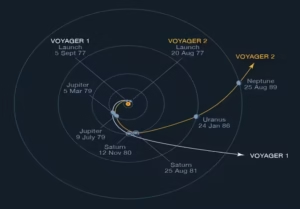
Humanitys Farthest Space Explorer                            

Mission Objectives

  • To conduct close observations of the gas giants.
  • To study planetary atmospheres, rings, and moons.
  • To analyse cosmic rays, plasma, and magnetic fields.
  • To understand the boundary between solar space and interstellar space.

Voyager 1 carries several advanced tools, including:

  • Cosmic Ray Subsystem – studies high-energy particles.
  • Plasma Wave Subsystem – measures plasma vibrations.
  • Infrared Interferometer Spectrometer and Radiometer (IRIS) – analyses temperature and composition.
  • Magnetometers – track magnetic fields.

Major Achievements

  • Voyager 1 was the first spacecraft to cross the heliosphere, the region dominated by the Sun’s solar wind.
  • It entered interstellar space in August 2012, a historic first.
  • It discovered a thin ring around Jupiter.
  • It identified two new moons of Jupiter: Thebe and Metis.
  • At Saturn, it found five new moons and detected a new ring called the G-ring.
  • It has provided valuable data on cosmic radiation and deep-space environment.

Significance of Voyager 1

  • Expands human knowledge of the outer solar system.
  • Helps scientists understand interstellar space conditions.
  • Symbolises humanity’s longest-running and most distant space mission.

Conclusion

Voyager 1 stands as a landmark achievement in space exploration. Even after more than four decades, it continues to send valuable data, deepening our understanding of the universe and pushing the boundaries of human scientific reach.

EXPORT PREPAREDNESS INDEX (EPI) 2024

TOPIC: (GS3) ECONOMY: THE HINDU

NITI Aayog has recently released the Export Preparedness Index (EPI) 2024, which evaluates the export readiness of Indian States and Union Territories. The index aims to strengthen India’s subnational role in achieving its global trade ambitions.

What is the Export Preparedness Index?

  • The Export Preparedness Index is a comprehensive tool that measures how well Indian States and UTs are prepared to participate in global trade.
  • It recognises that different regions have diverse economic structures, resources, and capacities.
  • The index helps identify strengths, gaps, and best practices at the subnational level.
  • The first edition of EPI was launched in August 2020. The 2024 report is the fourth edition of the index.
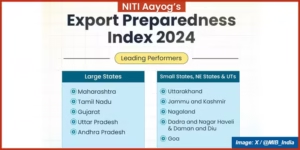
Niti Aayogs Export Prepareness Index 2024

Objectives of EPI

  • To promote competitive federalism among States and UTs.
  • To encourage data-driven policymaking for export growth.
  • To identify regional export potential.
  • To improve infrastructure, governance, and business ecosystems.
  • To integrate local economies with global value chains.

Framework of EPI 2024

  • The index is built on four major pillars, supported by 13 sub-pillars and 70 indicators:
  • Export Infrastructure (20% weightage): Transport facilities, Ports and logistics, Warehousing
  • Business Ecosystem (40% weightage): Access to finance, Ease of doing business
  • Policy and Governance (20% weightage: Trade facilitation policies, Institutional support
  • Export Performance (20% weightage): Growth in exports: Diversity of products

By Level of Preparedness:

  • Leaders: High export readiness
  • Challengers: Moderate readiness with scope for improvement
  • Aspirers: Early stage of export ecosystem development

Top Performers in EPI 2024

  • Large States (Leaders): Maharashtra, Tamil Nadu, Gujarat
  • Small States, North Eastern States & UTs (Leaders) Uttarakhand, Jammu and Kashmir, Nagaland

Significance of EPI 2024

  • Helps States understand their export strengths and weaknesses.
  • Encourages cooperative and competitive federalism.
  • Supports India’s goal of becoming a global manufacturing and export hub.
  • Assists in achieving targets under Atmanirbhar Bharat and Make in India.
  • Enhances India’s integration with global supply chains.

Conclusion

The Export Preparedness Index 2024 serves as a strategic roadmap for strengthening India’s export ecosystem at the grassroots level. By improving infrastructure, governance, and business conditions across States, India can unlock its full export potential and move closer to becoming a major global trade power.

MIYAWAKI METHOD OF AFFORESTATION

TOPIC: (GS3) ENVIRONMENT: THE HINDU

The Miyawaki method is gaining attention as a fast and effective way to create green spaces in cities where natural vegetation has reduced over time. It is being increasingly adopted to restore degraded urban and industrial areas.

What is the Miyawaki Method?

  • The Miyawaki method is a special technique of growing forests, developed by Japanese botanist Akira Miyawaki in the 1970s.
  • It focuses on creating dense, fast-growing forests in small and degraded land areas. Trees and shrubs are planted very close to each other, leading to faster vertical growth.
  • Due to competition for sunlight, plants grow taller and stronger. This technique is sometimes called the ‘pot plantation method’.
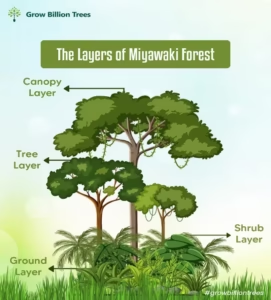
The Layers of Miyawaki Forest

Features of the Method

  • Only native plant species are used, which are naturally suited to the local climate and soil.
  • Native plants form a self-sustaining and balanced ecosystem.
  • Forests grown using this method develop 10 times faster than conventional plantations.
  • They become thick, multi-layered, and rich in biodiversity, similar to natural forests.
  • For the first 2–3 years, regular care such as watering and weeding is needed.
  • After that, the forest becomes self-maintaining.

Advantages of the Miyawaki Method

  • Improves soil fertility and moisture retention.
  • Enhances local biodiversity, attracting birds, insects, and small animals.
  • Absorbs more carbon dioxide, helping in climate change mitigation.
  • Requires less land compared to traditional forestry methods.
  • Converts polluted and barren lands into green ecosystems.

Environmental Benefits in Urban Areas

  • Helps reduce air, water, and noise pollution.
  • Controls dust and bad odours in industrial regions.
  • Prevents soil erosion and improves groundwater recharge.
  • Promotes ecological balance and urban climate regulation.

Conclusion

The Miyawaki method offers a quick, low-cost, and sustainable solution for restoring green cover, especially in cities. By using native plants and natural growth patterns, it supports biodiversity, climate resilience, and environmental health.

Write a Review

Your email address will not be published. Required fields are marked *