Table of Contents
ToggleThe Great Synthesis: A Comprehensive Encyclopedia of Bhakti and Sufi Movements
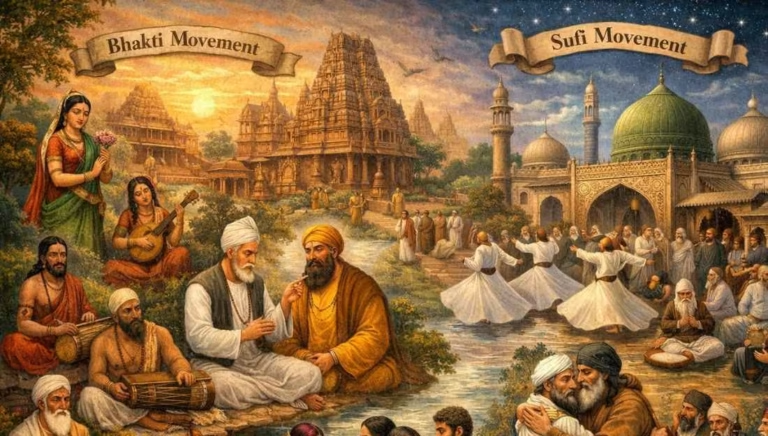
The medieval period in India was marked by a remarkable phenomenon: the simultaneous rise of the Bhakti movement within Hinduism and the Sufi movement within Islam. Both movements emphasized a personal, emotional bond with the Divine, rejecting empty rituals and social hierarchies.
1. The Bhakti Movement: Love as Liberation
The term ‘Bhakti’ is derived from the Sanskrit root Bhaj, meaning “to share” or “to belong to.” It represents a path of intense devotion to a personal god as a means of achieving Moksha (salvation).
A. Origins in South India (7th – 9th Century)
The movement began in the Tamil region with two groups of poet-saints:
- Alvars: Devotees of Vishnu. There were 12 Alvars, including the famous female saint Andal. Their hymns are collected in the Divya Prabandham.
- Nayanars: Devotees of Shiva. There were 63 Nayanars, including Appar, Sambandar, and Sundarar. Their hymns are collected in the Tevaram.
Key Features of Southern Bhakti:
- Opposition to Caste: They ignored caste distinctions and included saints from “untouchable” backgrounds.
- Use of Vernacular: They preached in Tamil rather than Sanskrit, making the divine accessible to the masses.
- Temple Culture: Their songs led to the establishment of great pilgrimage centers and temple architecture in South India.
B. Philosophers of Bhakti (The Acharyas)
The emotional Bhakti of the south was given a solid philosophical foundation by three great scholars:
- Adi Shankaracharya (8th Century): Proposed Advaita Vedanta (Non-dualism). He believed that the Atman (soul) and Brahman (universal soul) are one.
- Ramanujacharya (12th Century): Proposed Vishishtadvaita (Qualified Non-dualism). He argued that while the soul is part of God, it maintains a distinct identity.
- Madhavacharya (13th Century): Proposed Dvaita (Dualism), emphasizing the complete distinction between the soul and God.
C. The Movement Spreads North (14th – 17th Century)
The Bhakti movement moved North primarily through Ramananda, who was the first to use Hindi for preaching.
Classification of Northern Bhakti:
- Nirguna Bhakti: Worship of an abstract, formless God.
- Kabir: A weaver who challenged both Hindu and Muslim orthodoxy. He emphasized Sahaja (simple) union with God.
- Guru Nanak: Founded Sikhism, preaching the oneness of God and the equality of all humans.
- Saguna Bhakti: Worship of God with specific attributes and forms (Avatars).
- Tulsidas: Wrote the Ramcharitmanas, popularizing the cult of Rama.
- Surdas & Mirabai: Famous devotees of Krishna. Mirabai’s Bhajans expressed a “Madhurya Bhava” (conjugal love) for the Lord.
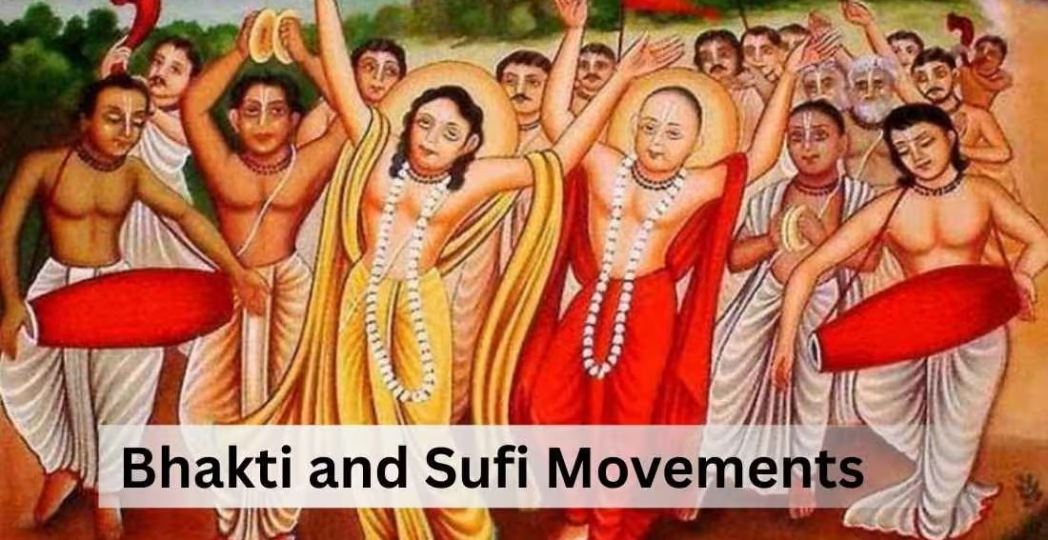
- Chaitanya Mahaprabhu: Introduced Sankirtana (communal chanting and dancing) in Bengal.
2. The Sufi Movement: Mysticism in Islam
Sufism (Tasawwuf) is the mystical dimension of Islam. It emerged as a reaction against the growing materialism of the Caliphate, focusing instead on the inward search for God.
A. Core Concepts
- Pir-Murid Relationship: The importance of a spiritual guide (Pir or Sheikh) to lead the disciple (Murid).
- Khanqah: The hospice or center where Sufi saints lived and taught.
- Sama: Musical congregations aimed at inducing a state of ecstasy and proximity to God.
- Zikr: Remembrance of God through the repetition of His name.
- Fana: The spiritual annihilation of the self in the Divine.
B. Major Sufi Orders (Silsilas) in India
There were 12 major orders, but two were most dominant:
- Chishti Order:
- Founded in India by Moinuddin Chishti (Ajmer).
- Features: They lived simple lives, avoided political power, and integrated Indian musical traditions into their worship.
- Key Saints: Nizamuddin Auliya (Delhi) and Salim Chishti (Fatehpur Sikri).
- Suhrawardi Order:
- Founded by Bahauddin Zakariya.
- Features: Unlike Chishtis, they accepted state patronage and believed that a Sufi should not necessarily live in poverty.
- Naqshbandi Order:
- A more orthodox order that rose during the Mughal era to counter the liberal policies of Akbar.
3. The Impact of the Movements
The Bhakti and Sufi movements acted as the “Social Conscience” of medieval India.
- Linguistic Revolution: They led to the growth of regional languages like Hindi, Bengali, Marathi, Punjabi, and Urdu.
- Social Reform: Both movements attacked the rigidity of the caste system and promoted the idea of the brotherhood of man.
- Religious Syncretism: They bridged the gap between Hinduism and Islam. Figures like Kabir and Guru Nanak were influenced by both traditions.
- Women’s Empowerment: Women like Akka Mahadevi, Mirabai, and Lal Ded broke social norms to become leading spiritual figures.
4. UPSC Summary Table: Saints and their States
Saint | Region | Philosophy/Tradition |
Shankaracharya | Kerala/All India | Advaita (Non-dualism) |
Basavanna | Karnataka | Virashaivism (Lingayats) |
Jnaneshwar / Tukaram | Maharashtra | Varkari Panth |
Shankaradeva | Assam | Ekasarana Dharma |
Narsinh Mehta | Gujarat | Vaishnava Bhakti |
Lal Ded | Kashmir | Kashmiri Shaivism |
UPSC Prelims: PYQs & Practice Questions
Previous Year Questions (PYQs)
Question 1 (2013)
Q: Consider the following Bhakti Saints:
1. Dadu Dayal
2. Guru Nanak
3. Tyagaraja
Who among them was/were preaching when the Lodi dynasty fell and Babur took over?
Options:
(a) 1 and 3 | (b) 2 only | (c) 2 and 3 | (d) 1 and 2
Answer: (b)
Explanation: The Lodi dynasty fell in 1526 (First Battle of Panipat). Guru Nanak (1469–1539) was alive and preaching during Babur’s takeover. Dadu Dayal (1544–1603) and Tyagaraja (1767–1847) belonged to later periods, so they were not contemporaries of the 1526 transition.
Question 2 (2012)
Q: With reference to the religious history of medieval India, the Sufi mystics were known to pursue which of the following practices?
1. Meditation and control of breath
2. Severe ascetic exercises in a lonely place
3. Recitation of holy songs to arouse a state of ecstasy in their audience
Select the correct answer:
Options:
(a) 1 and 2 only | (b) 2 and 3 only | (c) 3 only | (d) 1, 2 and 3
Answer: (d)
Explanation: Sufi traditions included spiritual discipline through meditation and sometimes breath control (influenced by wider yogic/ascetic practices). Many Sufis practiced rigorous asceticism and seclusion as part of spiritual training. They also used Sama (devotional musical recitation) to induce spiritual ecstasy and deepen devotion among listeners.
Question 3 (2019)
Q: Which of the following pair(s) is/are correctly matched?
Movement/Saint : Region
1. Nimbarka : Andhra Pradesh
2. Namdev : Maharashtra
3. Vallabhacharya : Gujarat
Options:
(a) 1 and 2 only | (b) 2 and 3 only | (c) 1 and 3 only | (d) 1, 2 and 3
Answer: (d)
Explanation: Nimbarka is associated with the broader Bhakti stream with strong southern linkages in many exam sources; Namdev is a major saint of the Varkari tradition in Maharashtra; and Vallabhacharya is closely linked with the Pushtimarg tradition and is widely associated with the western region including Gujarat through his institutional and sectarian spread.
Prelims Practice Questions
Question 1
Q: Consider the following statements regarding 'Nirguna' and 'Saguna' Bhakti:
Statements:
1. Nirguna Bhakti focuses on the worship of a formless God without attributes.
2. Saguna Bhakti emphasizes the worship of specific incarnations like Rama and Krishna.
3. Adi Shankaracharya was the pioneer of the Saguna tradition in North India.
Which of the statements given above is/are correct?
Options:
(a) 1 and 2 only | (b) 2 and 3 only | (c) 1 and 3 only | (d) 1, 2 and 3
Answer: (a)
Explanation: Statements 1 and 2 are correct. Statement 3 is incorrect because Adi Shankaracharya propagated Advaita Vedanta (philosophically aligned with Nirguna—formless Brahman). In North India, figures like Ramananda are credited with spreading Bhakti traditions widely.
Question 2
Q: The 'Chishti' Silsila (order) in India was popularized by which of the following saints?
Options:
(a) Sheikh Shihabuddin Suhrawardi
(b) Moinuddin Chishti
(c) Nizamuddin Auliya
(d) Salim Chishti
Answer: (b)
Explanation: The Chishti order was established and popularized in India by Khwaja Moinuddin Chishti of Ajmer. Saints like Nizamuddin Auliya (Delhi) and Salim Chishti (Fatehpur Sikri) were later prominent Chishti figures, but the foundational spread in India is credited to Moinuddin Chishti.
UPSC Mains: Previous Year Questions (PYQs)
Bhakti Movement: Re-orientation with Sri Chaitanya
Question: "The Bhakti movement received a remarkable re-orientation with the advent of Sri Chaitanya Mahaprabhu." Discuss. (2018)
Sufi Movement: Cultural Synthesis in Medieval India
Question: Evaluate the role of the Sufi movement in the cultural synthesis of medieval India. (Generic recurring theme)
Bhakti & Sufi: Growth of Regional Languages
Question: "Bhakti and Sufi movements provided a platform for the growth of regional languages." Elaborate with examples. (2021)
Bhakti Movement: Challenge to Caste & Social Hierarchy
Question: How did the Bhakti movement challenge the existing social hierarchy and caste system in India? (Generic theme)
Sufism: Influence on Akbar’s Liberal Religious Policies
Question: Analyze the influence of Sufism on the liberal religious policies of the Mughal Emperor Akbar. (Generic theme)
Mains Practice Questions
Bhakti Movement: South to North
Question: "The Alvars and Nayanars of South India provided the foundational blueprint for the Bhakti movement in the North." Compare the two phases of the movement. (250 Words)
Women Saints & Social Rebellion
Question: "Women saints of the Bhakti movement were not just spiritual icons but also symbols of social rebellion." Discuss with reference to Mirabai and Akka Mahadevi. (150 Words)
Wahdat-ul-Wajood & Advaita
Question: Evaluate the concept of 'Wahdat-ul-Wajood' (Unity of Being) and its resonance with the 'Advaita' philosophy of Hinduism. (250 Words)
Frequently Asked Questions (FAQs)
What is the difference between 'Be-shara' and 'Ba-shara' Sufis?
- Ba-shara Sufis followed the formal Islamic law (Sharia). Be-shara Sufis were wandering mystics (Malangs) who did not adhere to formal codes and were often outside the organized Silsilas.
Who are the 'Alvars' and 'Nayanars'?
- They were the earliest Bhakti saints from South India. Alvars (12 in number) were devotees of Vishnu; Nayanars (63 in number) were devotees of Shiva.
What is the 'Khanqah'?
- A Khanqah was a building specifically designed for gatherings of a Sufi brotherhood. It served as a hospice, a place for meditation, and a community center for travelers and devotees.
How did the Bhakti movement contribute to literature?
- It led to the decline of Sanskrit’s monopoly and the rise of regional languages. Saints wrote in the language of the people: Tulsidas (Awadhi), Kabir (Sadhukkari/Hindi), Sankaradeva (Assamese), and Chaitanya (Bengali).
What is 'Sankirtana'?
- Introduced by Chaitanya Mahaprabhu in Bengal, it is the practice of communal singing and dancing in praise of God (Krishna), which broke caste barriers by inviting everyone to participate together.