Table of Contents
ToggleThe Sacred Tapestry: A Comprehensive Encyclopedia of Religions in India
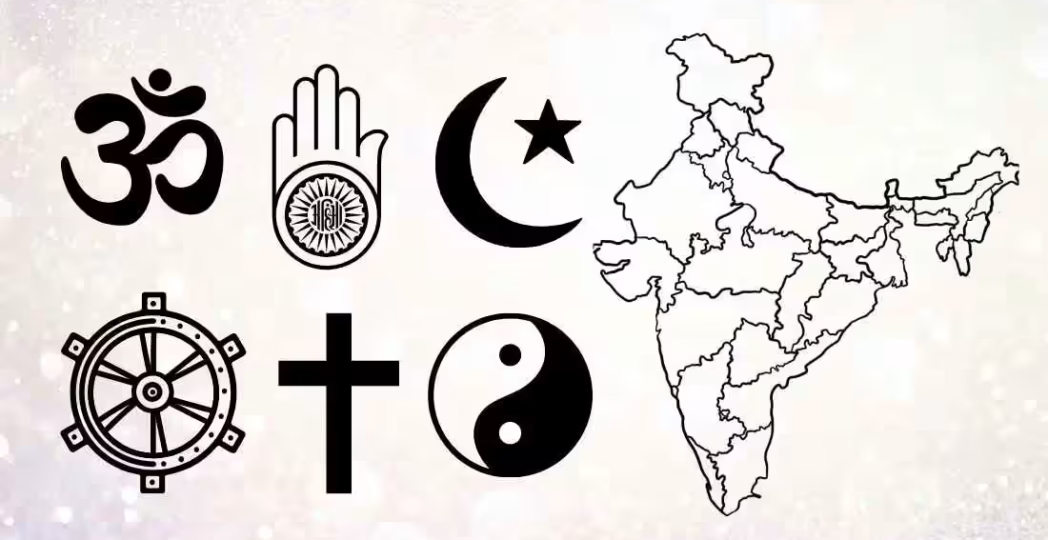
India is the birthplace of four of the world’s major religions—Hinduism, Buddhism, Jainism, and Sikhism—and has served as a sanctuary for many others. Religion in India is not merely a system of belief but the foundational force behind its art, literature, and social structure.
1. Ancient Vedic Religion (Brahmanism)
The Vedic religion, the precursor to modern Hinduism, centers on the Vedas (Rig, Sama, Yajur, and Atharva).
- Early Vedic Period (c. 1500–1000 BCE): Characterized by the worship of nature personified as deities like Indra (Rain/War), Agni (Fire), and Varuna (Cosmic Order). Rituals were simple, and the primary mode of worship was the Yajna (sacrifice).
- Later Vedic Period (c. 1000–600 BCE): Marked by the rise of complex rituals and the dominance of the priestly class (Brahmins). New deities like Prajapati (The Creator) gained prominence.
- Philosophy: The Upanishads introduced profound concepts such as Brahman (Universal Soul), Atman (Individual Soul), Karma (Action), and Moksha (Liberation).
2. The Sramana Tradition: Jainism and Buddhism
The 6th century BCE witnessed a religious revolution known as the Sramana movement, which challenged the ritualistic dominance of Brahmanism.
A. Jainism (The Path of Austerity)
- Tirthankaras: Jainism recognizes 24 spiritual teachers. The first was Rishabhadev, and the last was Vardhamana Mahavira (5th/6th century BCE).
- Core Principles (Pancha Mahavrata):
- Ahimsa (Non-violence) – The highest virtue.
- Satya (Truth).
- Asteya (Non-stealing).
- Aparigraha (Non-attachment).
- Brahmacharya (Chastity) – added by Mahavira.
- Philosophy: Anekantavada (The theory of many-sidedness) and Syadvada (The relativity of truth).
- Sects: Divided into Digambaras (Sky-clad/Naked) and Svetambaras (White-clad).
B. Buddhism (The Middle Path)
- Founder: Gautama Buddha, who attained enlightenment at Bodh Gaya.
- The Four Noble Truths: Dukkha (Suffering), Samudaya (Cause of suffering), Nirodha (Cessation of suffering), and Magga (The Eightfold Path).
- The Three Jewels (Triratna): Buddha, Dhamma (Teachings), and Sangha (Community).
- Major Sects:
- Hinayana: Orthodox; focuses on the self-liberation of the individual.
- Mahayana: Worships Buddha as a deity and believes in Bodhisattvas.
- Vajrayana: Focuses on tantric practices.
- Spread: Under Ashoka, Buddhism became a world religion, spreading to South East Asia and Central Asia.
3. The Puranic Transition: Evolution of Hinduism
Post-Mauryan and Gupta periods saw the transition from Vedic ritualism to Puranic Hinduism.
- Trimurti Concept: The worship of Brahma (Creator), Vishnu (Preserver), and Shiva (Destroyer).
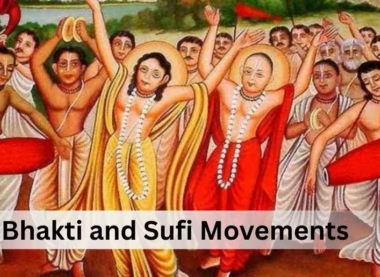
- Bhakti Movement: Emerged in South India (Alvars and Nayanars) emphasizing a personal, emotional bond with God.
- Literature: Compilation of the Puranas, the Ramayana, and the Mahabharata.
- Art Impact: Led to the birth of Temple Architecture (Nagara, Dravida, and Vesara styles) to house the idols of deities.
4. Islam in India: Synthesis and Sufism
Islam arrived in India through traders and later through military conquests, leading to a unique Indo-Islamic culture.
- Sufism: The mystical branch of Islam that emphasized love, tolerance, and direct experience of God.
- Silsilas (Orders): The Chishti (Moinuddin Chishti) and Suhrawardi orders were most influential.
- Impact: Influenced the Bhakti movement, leading to a period of religious syncretism.
5. Sikhism: The Religion of Equality
Founded in the 15th century by Guru Nanak Dev in the Punjab region.
- Guru Nanak’s Vision: “There is no Hindu, there is no Muslim”—emphasizing the oneness of God (Ik Onkar) and the equality of all humans.
- Khalsa: Formed by the 10th Guru, Guru Gobind Singh, creating a community of saint-soldiers to fight oppression.
- Guru Granth Sahib: The holy scripture, which includes the hymns of the Sikh Gurus as well as Hindu and Muslim saints (like Kabir and Namdev).
6. Other Minority Religions
- Christianity: Traditionally believed to have arrived with St. Thomas in 52 CE. Later expanded during the Portuguese and British periods.
- Zoroastrianism (Parsis): Arrived from Persia to escape persecution. They are known for their distinct fire temples (Agiyari).
- Judaism: One of the oldest foreign religions in India, with communities like the Bene Israel and Cochin Jews.
7. Major Schools of Indian Philosophy (Shaddarshana)
Religious thought in India is inseparable from its six orthodox (Astika) philosophical schools:
- Samkhya: Dualism between Purusha (consciousness) and Prakriti (matter).
- Yoga: Practical application of Samkhya through meditation.
- Nyaya: School of Logic.
- Vaisheshika: Atomic theory of the universe.
- Mimamsa: Focus on Vedic rituals.
Vedanta: Focus on the knowledge of the Brahman.
8. UPSC Revision Table: Major Religious Councils
Council | Religion | Patron | Key Outcome |
First Buddhist | Buddhism | Ajatashatru | Compilation of Sutta and Vinaya Pitaka |
Fourth Buddhist | Buddhism | Kanishka | Split into Hinayana and Mahayana |
First Jain | Jainism | Chandragupta Maurya | Compilation of 12 Angas |
Second Jain | Jainism | Devardhi Kshamasramana | Final compilation of Jain scriptures at Vallabhi |
UPSC Prelims: PYQs & Practice Questions
Previous Year Questions (PYQs)
Question 1 (2020)
Q: With reference to the religious history of India, consider the following statements:
1. Sthaviravadins belong to Mahayana Buddhism.
2. Lokottaravadin sect was an offshoot of the Mahasanghika sect of Buddhism.
3. The deification of Buddha by Mahasanghikas fostered Mahayana Buddhism.
Which of the statements given above are correct?
Options:
(a) 1 and 2 only | (b) 2 and 3 only | (c) 3 only | (d) 1, 2 and 3
Answer: (b)
Explanation: Sthaviravadins were associated with Theravada/Hinayana, not Mahayana (so Statement 1 is incorrect). Lokottaravadins emerged as an offshoot of the Mahasanghika tradition (Statement 2 correct). The Mahasanghikas were among the earliest to emphasize the divine/superhuman nature (deification) of the Buddha, which contributed to the ideological climate that fostered Mahayana (Statement 3 correct).
Question 2 (2017)
Q: With reference to the religious history of India, consider the following pairs:
1. Sautrantika and Sammitiya : Sects of Jainism
2. Sarvastivadin : Held that the constituents of phenomena were not wholly momentary, but existed forever in a latent form.
Which of the statements given above is/are correct?
Options:
(a) 1 only | (b) 2 only | (c) Both 1 and 2 | (d) Neither 1 nor 2
Answer: (b)
Explanation: Sautrantika and Sammitiya are schools/sects of Buddhism, not Jainism (so Pair 1 is incorrect). Sarvastivadin is a major Buddhist school associated with the idea that dharmas (elements of existence) exist across time in some form—hence they were not seen as purely momentary only (Pair 2 correct).
Question 3 (2017)
Q: Which one of the following was a very important seaport in the Kakatiya kingdom?
Options:
(a) Kakinada | (b) Motupalli | (c) Machilipatnam | (d) Nellore
Answer: (b)
Explanation: Motupalli was a famous and strategically important port under the Kakatiyas. It gained prominence for overseas trade and is often referenced in the context of coastal commerce and cultural/religious interactions through maritime networks.
Prelims Practice Questions
Question 1
Q: Consider the following statements regarding 'Anekantavada':
Statements:
1. It is a core philosophical theory of Buddhism.
2. It suggests that truth and reality are perceived differently from diverse points of view.
3. It is closely related to the theory of 'Syadvada'.
Which of the statements given above is/are correct?
Options:
(a) 1 and 2 only | (b) 2 and 3 only | (c) 1 and 3 only | (d) 1, 2 and 3
Answer: (b)
Explanation: Anekantavada is a Jain philosophical doctrine (not Buddhist). It emphasizes that reality/truth can be understood from multiple viewpoints. It is closely linked with Syadvada (the doctrine of conditioned predication: “in some ways, it is”).
Question 2
Q: The 'Chishti' and 'Suhrawardi' orders are associated with which religious movement in India?
Options:
(a) Bhakti Movement
(b) Sufi Movement
(c) Sramana Movement
(d) Arya Samaj
Answer: (b)
Explanation: Chishti and Suhrawardi are major Sufi silsilas (orders) that spread Sufism in India and contributed significantly to the cultural and religious synthesis of the medieval period.
UPSC Mains: Previous Year Questions (PYQs) – Ancient & Medieval Indian Socio-Religious Thought
6th Century BCE: Rise of Buddhism & Jainism
Question: "The 6th century BCE was a period of great religious and intellectual ferment in India." Discuss the factors that led to the rise of Buddhism and Jainism. (2016)
Bhakti Movement: Regional Languages & Literature
Question: Examine the contribution of the Bhakti movement to the development of regional languages and literature in India. (Generic theme)
Sikhism: Bridge Across Traditions in North India
Question: Discuss the main tenets of Sikhism and how it acted as a bridge between various socio-religious traditions of North India. (Generic theme)
Sufism: Social Harmony & Cultural Synthesis
Question: "Sufism in India was not just a religious movement but a tool for social harmony." Elaborate. (Generic theme)
Upanishads: Influence on Later Hindu Thought
Question: Analyze the impact of the Upanishadic philosophy on the evolution of later Hindu religious thought. (Generic theme)
Mains Practice Questions
Indian Secularism: Philosophical Roots
Question: "Indian secularism is rooted in the ancient philosophy of 'Sarva Dharma Sambhava'." Discuss this in the context of Ashoka’s Dhamma and Akbar’s Sulh-i-kul. (250 Words)
Bodhisattvas & Popularization of Buddhism
Question: Evaluate the role of 'Bodhisattvas' in the transition of Buddhism from an individualistic path to a mass religion. (150 Words)
Shaddarshana: Samkhya & Vedanta
Question: "The Shaddarshana (Six Schools of Philosophy) represent the peak of intellectual inquiry in ancient India." Briefly explain the core tenets of Samkhya and Vedanta. (250 Words)
Frequently Asked Questions (FAQs)
What is the difference between 'Digambara' and 'Svetambara' in Jainism?
- Digambaras (sky-clad) believe in absolute nudity and that women cannot achieve liberation in their current birth. Svetambaras (white-clad) wear white robes and believe women can achieve liberation.
What are the 'Three Jewels' (Triratna) of Buddhism?
- Buddha (The Enlightened One), Dhamma (The Teachings), and Sangha (The Monastic Order).
What is the 'Agiyari' in Zoroastrianism?
- It is the Fire Temple, the place of worship for Parsis. Fire is considered a supreme symbol of purity and the light of God (Ahura Mazda).
Who were the Alvars and Nayanars?
- They were poet-saints of South India (6th-9th centuries). Alvars were devotees of Vishnu, and Nayanars were devotees of Shiva. They laid the foundation for the Bhakti movement.
What is 'Ik Onkar' in Sikhism?
- It is the fundamental symbol of Sikhism, representing the Oneness of God. It is the opening phrase of the Mul Mantar in the Guru Granth Sahib.