
Table of Contents
ToggleFolk Arts of Chhattisgarh
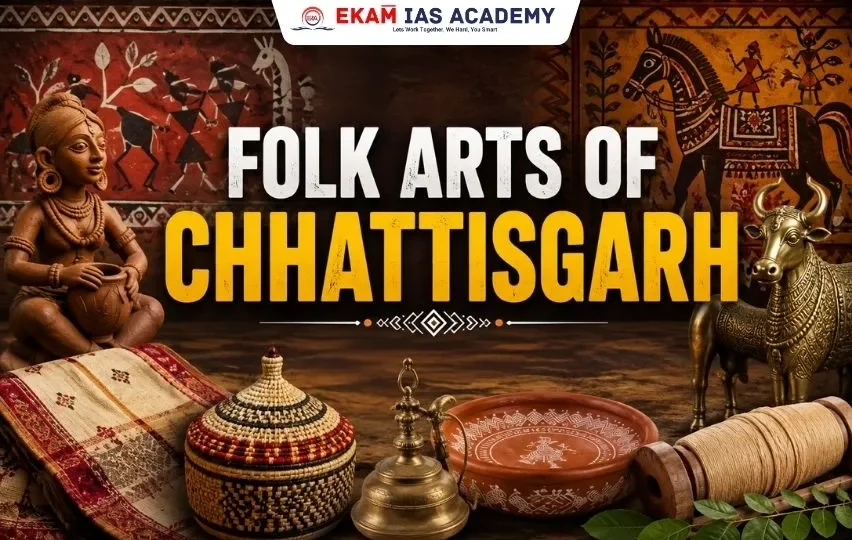
The folk arts of Chhattisgarh represent the State’s deep connection with tribal culture, nature, traditional knowledge and community life. From paintings such as Gond, Godna, Muria and Pithora to crafts such as Dhokra, Kosa silk, terracotta and Bastar woodcraft, these traditions preserve indigenous skills that have been passed from one generation to another.
Apart from their cultural importance, these art forms provide livelihoods to local artisans and strengthen Chhattisgarh’s handicraft economy and cultural tourism.
Major Folk Arts of Chhattisgarh
Terracotta Art
Terracotta is a prominent clay craft practised particularly in Bastar, Raigarh and Ambikapur. Artisans use locally available clay, often obtained from riverbanks, to make figurines and decorative objects.
The creations commonly depict tribal customs, celebrations, human emotions and different aspects of community life, making terracotta an important visual expression of local culture.
Godna Art
Godna originated as a traditional tattooing practice among several tribal communities, particularly the Baiga community.
Its designs include geometric patterns, plants, animals, deities and tribal myths. Over time, Godna also developed into a painting tradition. Devar Godna of Rajnandgaon and Godi Godna of Surguja are notable regional expressions.
Muria Art
Muria painting is associated with the Muria tribe of Bastar. Traditionally, Muria communities decorated the walls of houses and Ghotuls using locally available materials.
Red and white clay are frequently used, while subjects include tribal dances, customs and scenes from everyday life. The paintings are generally simple and spontaneous, reflecting community traditions.
Gond Art
Gond painting reflects the close relationship between tribal life and the natural environment.
Animals, trees, deities and everyday tribal activities are common subjects. A distinctive feature is the use of dots, lines, circles and repeated patterns to create texture within figures. Artists traditionally complete the eyes at the end, symbolically giving life to the artwork.
Pithora Art
Pithora is a ritual wall-painting tradition associated with the worship of Baba Pithora, considered a protective deity.
Traditionally painted on mud-plastered walls, Pithora paintings depict deities, animals, agriculture, trade and daily activities. Colours such as red, yellow, ochre and black give the paintings their distinctive character.
Traditional Crafts of Chhattisgarh
Kosa Silk
Kosa silk is a celebrated textile tradition, especially associated with Korba and Champa.
It is produced from cocoons of the silkworm Antheraea mylitta, associated with trees such as Arjun, Saja and Sal. Kosa silk is valued for its durability, natural appearance and traditional designs.
Dhokra Craft
Dhokra is one of Bastar’s best-known metal crafts. Artisans use the ancient lost-wax casting technique to produce objects from brass and other non-ferrous metals.
Common designs depict animals, folk deities, gods and scenes from everyday life. The famous Bastar Dhokra bull is a notable example.
Bastar Woodcraft
Bastar woodcraft developed from the traditional dependence of tribal communities on forest resources.
Artisans carve teak, sal, shisham and other woods into doors, decorative objects, ceilings and figures of gods and goddesses. Most work is produced manually, preserving indigenous carving techniques.
Tuma Craft
Tuma craft uses dried wild bottle gourds to create both functional and decorative objects.
After being hollowed and dried, the gourds are transformed into lamps, toys, jewellery and containers. Their surfaces are often engraved with traditional patterns, folklore and tribal symbols.
Stone Carving
Bastar is also known for traditional stone craftsmanship. Local artisans use stones such as Sudapaal stone and shape them manually with chisels and cutting tools.
Religious idols, sculptures, pillars and vessels are common products, with Shiva, Parvati and Ganesha among frequently represented figures.
Sisal Art
Sisal craft uses strong natural fibres obtained from locally available sisal plants.
The durable and water-resistant fibre is used to create mats, baskets, ropes and wall hangings, making it an environmentally sustainable craft tradition.
Cultural Significance of Chhattisgarh’s Folk Arts
Folk arts act as repositories of tribal identity and traditional knowledge. Paintings and crafts preserve customs, beliefs, myths and community experiences across generations.
Nature is central to these traditions, with artisans using clay, wood, stone, silk, fibres and gourds sourced from their surroundings. Art forms such as Gond and Muria also function as visual records of tribal life.
Economically, crafts such as Dhokra, Kosa silk, terracotta and Bastar woodcraft generate livelihood opportunities for rural artisans and support handicraft-based enterprises.
They also contribute significantly to cultural tourism, attracting visitors interested in tribal traditions and handmade products.
Conclusion
The folk arts of Chhattisgarh represent a unique combination of tribal heritage, environmental knowledge and artistic creativity. From ritual paintings to metalwork and textiles, each tradition tells the story of communities deeply connected with nature and their cultural roots.
Protecting these art forms through skill transmission, better market access and promotion can strengthen artisan livelihoods while preserving Chhattisgarh’s rich cultural heritage for future generations.


Folk Arts of Chhattisgarh-FAQs Answered
What are the major folk arts of Chhattisgarh?
Major folk arts include Gond, Godna, Muria and Pithora paintings, along with traditional crafts such as Dhokra, Kosa silk, terracotta and Bastar woodcraft.
What is Godna art of Chhattisgarh?
Godna originated as a traditional tattooing practice, particularly among the Baiga community. Its motifs include geometric patterns, plants, animals, deities and tribal myths.
What is Bastar Dhokra craft?
Bastar Dhokra is a traditional metal craft made using the lost-wax casting technique. Artisans commonly create animals, folk deities and scenes from everyday tribal life.
What is Kosa silk famous for?
Kosa silk is a traditional textile associated especially with Korba and Champa. It is valued for its durability, natural appearance and traditional designs.
Why are Chhattisgarh’s folk arts important?
They preserve tribal identity, traditional knowledge, customs and beliefs, while also providing livelihoods to artisans and supporting cultural tourism.