Table of Contents
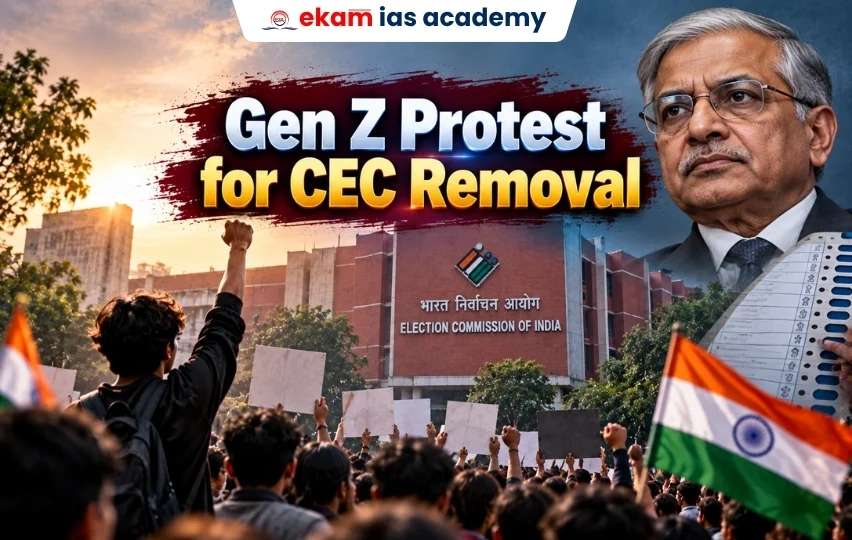
ToggleProtests demanding the resignation of Chief Election Commissioner (CEC) Gyanesh Kumar intensified on 2 October 2026 in Mumbai and Delhi, with the demonstrations also drawing attention as part of the emerging “Gen Z Protest” movement. The protests were linked primarily to concerns over the Special Intensive Revision (SIR) of electoral rolls and demands for greater transparency in the functioning of the Election Commission of India (ECI). The Cockroach Janta Party (CJP) organised a major gathering at Mumbai’s Shivaji Park, while Gen Z protesters, student groups, opposition parties and civil-society organisations demonstrated in Delhi.
Gen Z Protest Background
The protests have emerged amid allegations concerning voter-list revisions and reported disagreements within the ECI over aspects of the SIR process. Protesters have questioned the deletion and restoration of voter names and certain changes associated with voter-registration procedures. The ECI, however, has maintained that its processes follow the law and has described internal differences as part of institutional functioning.
The CJP has made the CEC’s resignation a central demand and announced further mobilisation if the demand is not addressed.
Who is the Chief Election Commissioner?
The CEC heads the three-member Election Commission of India, alongside two Election Commissioners. The Commission exercises constitutional responsibility over electoral rolls and elections under Article 324.
Under the present framework, decisions are expected to be taken unanimously as far as possible; where members differ, the majority view applies.
Process of Removal of CEC
The Constitution provides the CEC with strong security of tenure. Under Article 324(5), the CEC can be removed only in the same manner and on the same grounds as a Supreme Court judge.
The process involves:
- Allegations of proved misbehaviour or incapacity.
- A removal motion being initiated in Parliament.
- Investigation of the allegations through the prescribed procedure.
- Approval by the required special majority in both Houses.
- Issuance of the removal order by the President.
The high constitutional threshold is intended to protect the independence of the electoral institution.
Who are Gen Z?
Generation Z generally refers to people born from the late 1990s onwards, although definitions vary. In India, young people form a significant share of the electorate and increasingly participate in public debates through both digital platforms and conventional civic mobilisation.
Gen Z Protests in India: Background
Youth mobilisation in India has evolved from traditional student movements to campaigns involving employment, examination reforms, social justice, governance and institutional accountability. Recent movements have demonstrated how social media can rapidly connect dispersed groups and translate online mobilisation into street-level participation.
Gen Z Protests: Impact
The recent demonstrations highlight several broader trends:
- Issue-based mobilisation rather than permanent political affiliation.
- Greater use of digital platforms for organising campaigns.
- Increased youth engagement with constitutional and institutional questions.
- Greater public attention to electoral processes and accountability.
- Emergence of new protest methods involving satire, memes and popular culture.
Gen Z Protests Across the World
Youth-led movements have also emerged internationally around employment, taxation, governance and political accountability. Examples include Bangladesh’s 2024 student protests, Kenya’s 2024 anti-tax mobilisation and Nepal’s 2025 youth protests, although their causes and outcomes differed significantly.
Conclusion
The 2026 Gen Z protests place electoral transparency, institutional accountability and youth participation at the centre of public debate. Their longer-term significance will depend on how concerns surrounding SIR, voter registration and ECI decision-making are addressed through constitutional institutions, legal processes and transparent public scrutiny.


FAQs: Gen Z Protest for CEC Removal
Why are Gen Z protests demanding the CEC’s resignation?
The protests are linked to concerns over the Special Intensive Revision (SIR) of electoral rolls, voter-list changes and demands for greater transparency in the functioning of the Election Commission of India.
Who is the Chief Election Commissioner (CEC)?
The CEC heads the three-member Election Commission of India (ECI) along with two Election Commissioners. The Commission has constitutional responsibility over electoral rolls and elections under Article 324.
How can the Chief Election Commissioner be removed?
Under Article 324(5), the CEC can be removed only in the same manner and on the same grounds as a Supreme Court judge, involving proved misbehaviour or incapacity and the required special majority in both Houses of Parliament.
What is the role of Gen Z in recent protests?
The article highlights growing youth participation in public issues through digital platforms, social media campaigns and street-level mobilisation, with concerns involving governance, institutional accountability and electoral processes.
Why are these protests significant for Indian democracy?
The protests highlight broader questions concerning electoral transparency, institutional accountability, constitutional processes and youth participation in democratic affairs.