Table of Contents
ToggleGlaw Lake
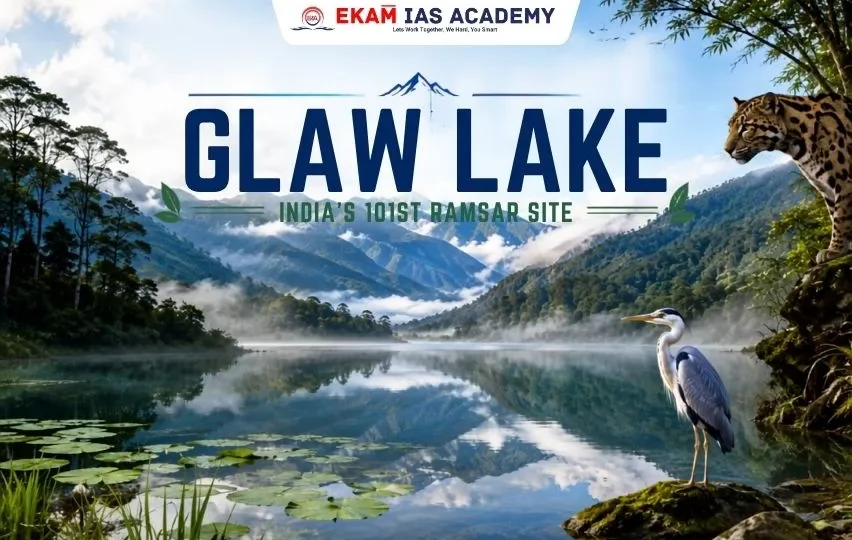
Glaw Lake, located in Lohit district of Arunachal Pradesh, has been designated as India’s 101st Ramsar Site under the Ramsar Convention on Wetlands.
The announcement was made by the Union Environment Minister on 3 August 2026, marking an important achievement for Arunachal Pradesh as it became the first Ramsar Site from the state.
The recognition highlights India’s efforts towards wetland conservation, biodiversity protection, climate resilience and sustainable management of freshwater ecosystems.
About Glaw Lake
Glaw Lake is a high-altitude freshwater ecosystem located in the Eastern Himalayas of Arunachal Pradesh.
Location and Features
- The lake is situated in Lohit district, Arunachal Pradesh.
- It is located within the Kamlang Tiger Reserve and Wildlife Sanctuary.
- The lake lies at an elevation of approximately 1,168 metres above sea level.
- It represents a unique Himalayan wetland ecosystem with rich biodiversity.
Water Source and Ecological Importance
- Glaw Lake is sustained by perennial mountain streams, ensuring a continuous supply of freshwater.
- The surrounding landscape consists of dense vegetation that supports diverse plant and animal species.
- The wetland plays an important role in maintaining ecological balance in the Eastern Himalayan region.
Biodiversity of Glaw Lake
Glaw Lake and its surrounding catchment area support a wide range of flora and fauna.
Floral Diversity
- The region has recorded more than 150 species of trees.
- Around 49 orchid species have been identified within the site and its catchment area.
Faunal Diversity
The wetland supports high-altitude aquatic and terrestrial biodiversity, including threatened species such as:
- White-bellied Heron
- Clouded Leopard
The ecosystem contributes to the conservation of rare Himalayan species and their habitats.
Significance of Ramsar Recognition
The designation of Glaw Lake as a Ramsar Site will:
- Strengthen conservation efforts for Himalayan freshwater ecosystems.
- Promote scientific management and sustainable use of wetlands.
- Support biodiversity conservation and climate resilience.
- Increase global recognition of Arunachal Pradesh’s ecological importance.
About Ramsar Convention on Wetlands
The Ramsar Convention is an international treaty that provides a framework for the conservation and wise use of wetlands and their resources.
Key Facts
- It was adopted in 1971 at Ramsar, Iran.
- It came into force in 1975.
- It was the first international agreement focused specifically on the conservation of a particular ecosystem — wetlands.
The convention encourages countries to protect wetlands that have international ecological importance.
Three Pillars of Ramsar Convention
Conservation of Wetlands of International Importance
- Countries identify and protect wetlands that hold significant ecological value.
- These sites are designated as Ramsar Sites for global recognition and conservation.
Wise Use of Wetlands
- Promotes sustainable utilisation of wetlands while maintaining their ecological functions.
- Encourages balance between human needs and ecosystem protection.
International Cooperation
- Encourages cooperation among countries for conserving:
- Shared wetland ecosystems
- Migratory species
- Transboundary environmental resources
Conclusion
The inclusion of Glaw Lake as India’s 101st Ramsar Site represents a significant step towards protecting the fragile ecosystems of the Eastern Himalayas.
The recognition not only strengthens wetland conservation in Arunachal Pradesh but also highlights the importance of preserving freshwater ecosystems for biodiversity, climate resilience and sustainable development.



FAQ: Glaw Lake – India’s 101st Ramsar Site
Why is Glaw Lake in the news?
Glaw Lake in Arunachal Pradesh has been designated as India’s 101st Ramsar Site, recognising its importance as a Himalayan freshwater wetland ecosystem.
Where is Glaw Lake located?
Glaw Lake is located in Lohit district of Arunachal Pradesh within the Kamlang Tiger Reserve and Wildlife Sanctuary at an elevation of around 1,168 metres.
What is the ecological significance of Glaw Lake?
The lake supports rich Himalayan biodiversity, including several plant species, orchids, and threatened species like the White-bellied Heron and Clouded Leopard.
What is the Ramsar Convention on Wetlands?
The Ramsar Convention is an international treaty adopted in 1971 at Ramsar, Iran, aimed at conserving wetlands and promoting their wise use.
How will Ramsar recognition benefit Glaw Lake?
The Ramsar status will strengthen wetland conservation, promote scientific management, protect biodiversity, and enhance climate resilience in the Eastern Himalayan region.