Table of Contents
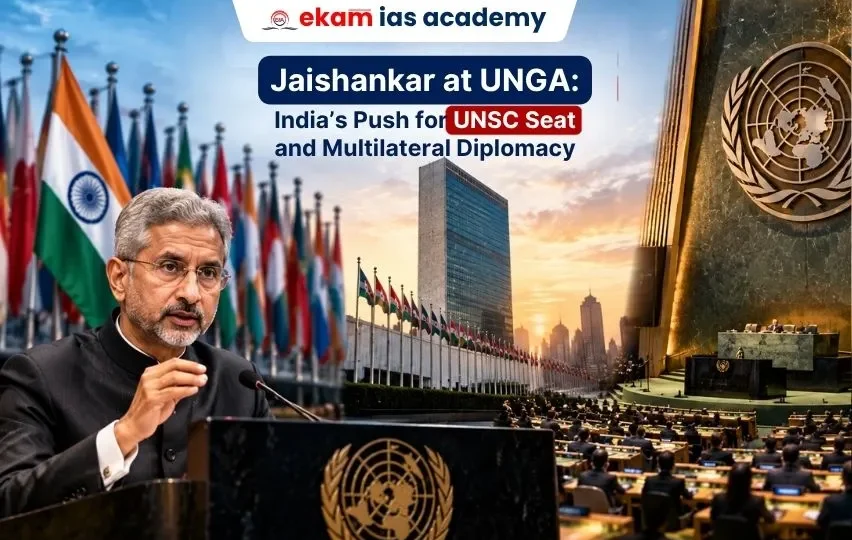
ToggleExternal Affairs Minister S. Jaishankar’s visit to the United Nations General Assembly (UNGA) 2026 has gained importance as India intensifies diplomatic efforts to secure support for its candidature for the United Nations Security Council (UNSC) non-permanent membership for the 2028–2029 term.
India is engaging with multiple countries, regional groups and multilateral platforms to strengthen its position and promote its vision of reformed multilateralism and greater representation for developing nations.
India’s UNSC Candidature and Diplomatic Outreach
A major focus of Jaishankar’s UNGA engagements is building international support for India’s UNSC bid. India has previously been elected to the Security Council eight times and has often represented the Asia-Pacific region. However, the current election scenario has become more competitive with Tajikistan also announcing its candidature for the Asian seat.
India’s diplomatic outreach includes meetings with countries from Europe, Central Asia, Latin America, the Caribbean and other members of the Global South. Discussions are aimed at strengthening partnerships and seeking support for India’s candidature.
Strengthening Multilateralism Through P4M Initiative
During the UNGA week, India joined the Partnership for Multilateralism (P4M) initiative, a grouping aimed at strengthening support for the United Nations and global cooperation.
India’s participation reflects its broader foreign policy objective of promoting:
- Reformed global governance institutions
- Inclusive multilateralism
- Greater voice for developing countries
- Rules-based international cooperation
Key Bilateral Meetings and Global Issues
Jaishankar’s meetings with several foreign ministers, including representatives from Europe, Central Asia and the Global South, focused on strengthening bilateral ties and addressing global challenges.
His expected meeting with the United States Secretary of State is significant amid discussions related to energy security, trade issues and geopolitical developments. India’s energy imports and external economic relations remain important factors in India-US discussions.
The meeting with Bangladesh’s Foreign Minister is also expected to focus on bilateral relations, regional cooperation and the broader UN agenda.
India’s Role in Global Diplomacy
India continues to emphasise issues such as UN reforms, counter-terrorism, climate action, maritime security and development cooperation. Through platforms such as the Quad, SCO and UN mechanisms, India aims to strengthen its role in shaping global decision-making.
The UNGA platform provides India an opportunity to engage with major powers, developing countries and regional organisations on issues affecting international peace and security.
Conclusion
S. Jaishankar’s UNGA engagements highlight India’s active diplomatic campaign for the UN Security Council 2028–2029 seat and its broader push for a more representative global order. Through strategic partnerships, multilateral engagement and Global South cooperation, India seeks to strengthen its position in international governance.


FAQs: Jaishankar at UNGA – India’s UNSC Bid and Multilateral Diplomacy
Why is S. Jaishankar’s UNGA 2026 visit significant?
S. Jaishankar’s UNGA 2026 visit is significant as India is intensifying diplomatic efforts to secure support for its United Nations Security Council (UNSC) non-permanent membership candidature for the 2028–2029 term.
How many times has India been elected to the UN Security Council?
India has previously been elected to the UN Security Council eight times as a non-permanent member and has represented the Asia-Pacific region in earlier terms.
What is India’s vision of reformed multilateralism?
India’s vision of reformed multilateralism focuses on making global institutions more representative, inclusive and reflective of the interests of developing countries and the Global South.
What is the Partnership for Multilateralism (P4M) initiative?
The Partnership for Multilateralism (P4M) is an initiative aimed at strengthening support for the United Nations, global cooperation and rules-based international engagement.
What are the key issues discussed by India at the UNGA?
India highlights issues such as UN reforms, counter-terrorism, climate action, maritime security, development cooperation and greater representation of developing nations in global decision-making bodies.