
Table of Contents
ToggleShaheed Udham Singh: Life, Jallianwala Bagh Revenge & Freedom Struggle Contribution
India remembers Shaheed Udham Singh on his death anniversary, honouring the revolutionary freedom fighter who became a symbol of resistance against British colonial rule.
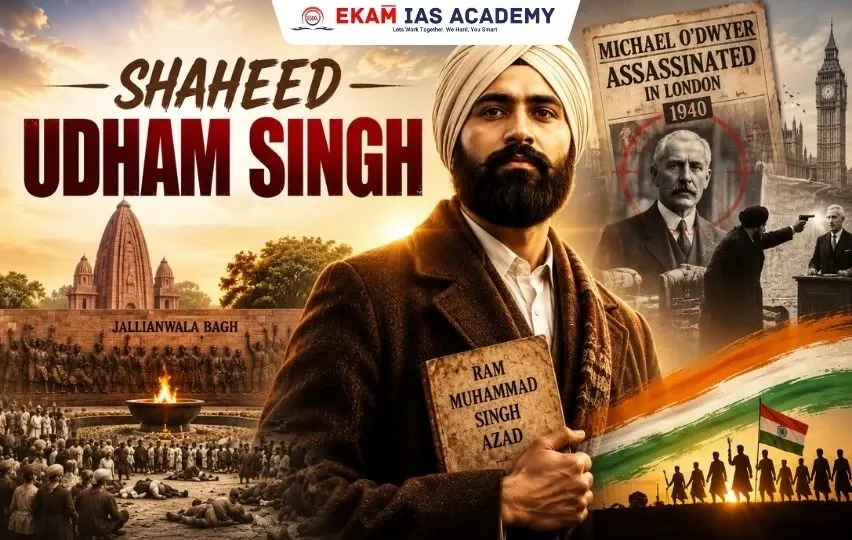
Udham Singh is remembered for assassinating Michael O’Dwyer, the former Lieutenant Governor of Punjab, in 1940 in London as an act of revenge for the Jallianwala Bagh massacre of 1919, one of the darkest episodes of British rule in India.
His courage, sacrifice and commitment to the freedom struggle continue to inspire generations.
Early Life of Shaheed Udham Singh
- Birth: 26 December 1899
- Birthplace: Sunam, Sangrur district, Punjab
Udham Singh was born as Sher Singh to Tehal Singh and Narain Kaur. His father worked as a low-paid labourer.
He lost both his parents at an early age and was brought up at the Central Khalsa Orphanage in Amritsar, where he was renamed Udham Singh.
Growing up in difficult circumstances, he witnessed poverty and social inequalities, which shaped his revolutionary outlook.
Early Influences and Revolutionary Journey
Udham Singh travelled widely during his early years and worked in different regions to earn a livelihood.
- During World War I, he worked as a labourer in Mesopotamia.
- Later, he travelled to Africa, where he worked in railway services in Uganda.
- During this period, he came in contact with members of the Ghadar Party, which influenced his anti-colonial ideas.
He later travelled to the United States, where he supported Indian migrants and became associated with revolutionary activities.
He also established the Azad Party in Chicago as part of the wider Ghadar movement.
Udham Singh and the Jallianwala Bagh Massacre
The turning point in Udham Singh’s life came on 13 April 1919, when he witnessed the Jallianwala Bagh massacre in Amritsar.
On the orders of General Reginald Edward Harry Dyer, British troops opened fire on a peaceful gathering of unarmed Indians, killing and injuring hundreds.
The incident deeply affected Udham Singh, and he took a personal vow to seek justice for the victims of the massacre.
The role of Michael O’Dwyer, who was the Lieutenant Governor of Punjab at the time and supported the harsh colonial response, became a central focus of Udham Singh’s revolutionary mission.
Association with Revolutionary Organisations
- In 1924, Udham Singh joined the Ghadar Party, which aimed to overthrow British colonial rule.
- He was also associated with the Hindustan Socialist Republican Association (HSRA).
- He was deeply inspired by revolutionary leaders like Bhagat Singh and admired his commitment to India’s freedom struggle.
In 1927, Udham Singh was arrested for possessing illegal firearms and was sentenced to five years of imprisonment.
Assassination of Michael O’Dwyer
After two decades of planning, Udham Singh carried out his act of revenge on:
Date: 14 March 1940
Location: Caxton Hall, London
During a meeting at Caxton Hall, he shot Michael O’Dwyer, who had played a major role in the Punjab administration during the Jallianwala Bagh tragedy.
The assassination attracted global attention and became a powerful symbolic act against British imperialism.
Trial and Martyrdom
During his trial, Udham Singh adopted the name:
“Ram Muhammad Singh Azad”
The name represented his vision of religious unity and a free India beyond communal divisions.
He was convicted and sentenced to death.
On 31 July 1940, Udham Singh was hanged at Pentonville Prison, London.
His remains were brought back to India in 1974 and preserved at the Jallianwala Bagh Memorial.
Common Problems Faced Without Mentorship
Many aspirants preparing without guidance often:
- Follow too many resources
- Lack consistency
- Ignore revision
- Avoid answer writing practice
Therefore, proper Personalized Mentorship helps aspirants avoid these mistakes and improve efficiency.
Legacy of Shaheed Udham Singh
- Udham Singh is remembered as “Shaheed-i-Azam” (Great Martyr) for his sacrifice and dedication to India’s freedom struggle.
- His life represents the determination of revolutionaries who challenged colonial injustice.
- The district Udham Singh Nagar in Uttarakhand, created in 1995, was named in his honour.
His actions remain closely associated with the demand for justice for the victims of the Jallianwala Bagh massacre and the larger struggle against British colonial rule.



FAQ: Shaheed Udham Singh – Revolutionary Freedom Fighter
Who was Shaheed Udham Singh?
Shaheed Udham Singh was an Indian revolutionary freedom fighter known for assassinating Michael O’Dwyer in London in 1940 as revenge for the Jallianwala Bagh massacre of 1919.
Why did Udham Singh assassinate Michael O’Dwyer?
Udham Singh considered Michael O’Dwyer responsible for supporting the harsh colonial policies of Punjab during the time of the Jallianwala Bagh massacre, where British forces killed and injured hundreds of unarmed Indians.
What was Udham Singh’s role in the Indian freedom struggle?
Udham Singh was associated with revolutionary organisations such as the Ghadar Party and the Hindustan Socialist Republican Association (HSRA). He worked to oppose British colonial rule and inspire nationalist resistance.
What was the significance of the name “Ram Muhammad Singh Azad” adopted by Udham Singh?
During his trial, Udham Singh used the name Ram Muhammad Singh Azad, symbolising his belief in religious unity and a free India beyond communal divisions.
When and where was Shaheed Udham Singh executed?
Udham Singh was executed on 31 July 1940 at Pentonville Prison, London, after being convicted for the assassination of Michael O’Dwyer. His remains were later brought back to India in 1974.