Table of Contents
ToggleIntroduction: What are Geomorphic Processes?
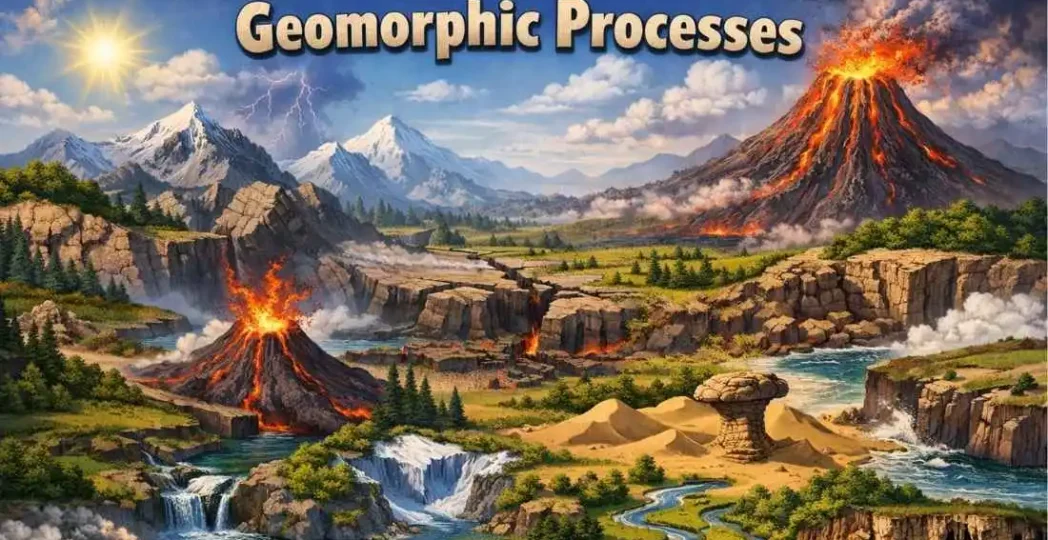
The Earth’s surface is not static; it is constantly being modified. Geomorphic processes are the physical and chemical actions that result from the application of forces on Earth materials, leading to changes in the configuration of the Earth’s surface.
These processes are driven by two primary forces:
- Endogenic Forces: Internal forces originating from within the Earth.
- Exogenic Forces: External forces originating from the atmosphere and solar energy.
Endogenic Processes: The Builders
Endogenic forces are mainly land-building forces that work from the Earth’s interior towards the surface. They are driven by thermal gradients, radioactivity, and rotational friction within the Earth.
Diastrophism
Diastrophism refers to the slow, large-scale movements of the Earth’s crust that elevate or build up portions of the surface.
- Orogenic Processes: These are mountain-building processes involving severe folding and faulting of the crust.
- Epeirogenic Processes: These involve the uplift or subsidence of large parts of the continental crust without significant folding.
- Earthquakes and Plate Tectonics: These involve minor and major movements of crustal plates.
Volcanism (Vulcanism)
Volcanism includes the movement of molten rock (magma) onto or toward the Earth’s surface.
- Intrusive Landforms: Formed when magma cools inside the crust (e.g., Sills, Dykes, Batholiths).
- Extrusive Landforms: Formed when lava reaches the surface (e.g., Volcanoes, Lava Plateaus).
Exogenic Processes: The Sculptors
Exogenic processes derive their energy from the atmosphere (determined by solar energy) and the tectonic factors. These are primarily land-wearing processes.
The term Denudation encompasses all exogenic processes, including weathering, mass wasting, erosion, and transportation.
A. Weathering: The In-Situ Breakdown
Weathering is the mechanical disintegration and chemical decomposition of rocks through the actions of various elements of weather and climate. Crucially, it is an in-situ (on-site) process with little or no movement of material.
1. Physical (Mechanical) Weathering
This involves the breakdown of rocks into smaller fragments without chemical change.
- Exfoliation (Onion Peeling): Caused by differential heating and cooling, leading to the peeling of outer layers.
- Frost Wedging: Water enters cracks, freezes, expands, and exerts pressure to break the rock.
- Thermal Expansion: Repeated expansion and contraction due to temperature changes.
2. Chemical Weathering
This involves the transformation of rock minerals into new chemical combinations.
- Oxidation: Reaction with oxygen (rusting of iron-rich rocks).
- Carbonation: Reaction of rainwater with CO2 to form a weak acid that dissolves carbonates (common in Karst Topography).
- Hydration: Absorption of water by minerals, causing them to expand.
B. Mass Wasting (Mass Movement)
Mass movements involve the transfer of weathered debris down a slope under the direct influence of gravity. Water acts as a lubricant but is not the primary carrier.
- Slow Movements: Such as Soil Creep and Solifluction.
- Rapid Movements: Such as Earthflows, Mudflows, and Landslides.
C. Erosion and Deposition
Erosion is the acquisition and transportation of rock debris by geomorphic agents like running water, groundwater, glaciers, waves, and winds.
- Deposition occurs when the energy of the erosional agent decreases, leading to the settling of sediments. It is the final “constructive” phase of exogenic processes.
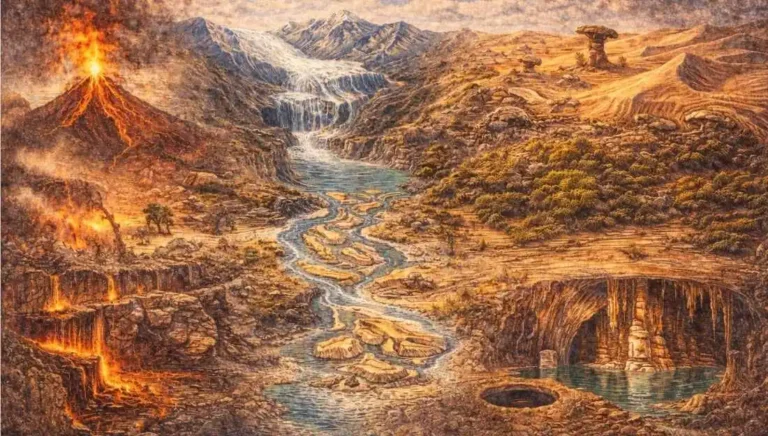
Geomorphic Agents and Resultant Landforms
| Agent | Erosional Landforms | Depositional Landforms |
| Running Water | V-shaped Valleys, Gorges, Potholes | Deltas, Alluvial Fans, Levees |
| Glaciers | U-shaped Valleys, Cirques, Aretes | Moraines, Eskers, Drumlins |
| Wind (Arid) | Pediments, Mushroom Rocks | Sand Dunes, Loess |
| Groundwater | Stalactites, Stalagmites, Sinkholes | Tufa, Travertine |
UPSC Prelims: PYQs & Practice Questions
Previous Year Questions (Prelims)
Question 1 (2021)
Q: Consider the following statements:
1. Weathering is a prerequisite for mass movement.
2. Mass movements are aided by gravity, and no geomorphic agent like running water or glaciers participates in the process.
Select the correct answer:
(a) 1 only
(b) 2 only
(c) Both 1 and 2
(d) Neither 1 nor 2
Answer: (b)
Explanation: Weathering is not a prerequisite for mass movement, although it significantly aids the process by loosening materials. The defining characteristic of mass movement is that materials move downslope under the direct influence of gravity without being transported by an external geomorphic agent like running water or glaciers.
Question 2 (2020)
Q: Which of the following processes are associated with diastrophism?
1. Orogenic processes (mountain building)
2. Epeirogenic processes (continental building)
3. Earthquakes
4. Plate Tectonics
Select the correct answer:
(a) 1 and 2 only
(b) 1, 2, and 4 only
(c) 1, 2, and 3 only
(d) 1, 2, 3, and 4
Answer: (d)
Explanation: All four are part of diastrophism, which includes all processes that move, deform, elevate, or build up portions of the Earth's crust. Orogeny involves intense folding and faulting associated with mountain building. Epeirogeny refers to broad, gentle uplift or subsidence of large landmasses. Earthquakes and plate tectonics are also manifestations of crustal movements and structural deformation.
practice Questions
Question
Q: Consider the following statements regarding Exfoliation:
1. It is a result of physical weathering caused by thermal expansion and contraction.
2. It can also occur due to unloading or pressure release as overlying rock is eroded.
Which of the statements is/are correct?
(a) 1 only
(b) 2 only
(c) Both 1 and 2
(d) Neither 1 nor 2
Answer: (c)
Explanation: Exfoliation (often called onion-peeling) occurs when outer rock layers peel off in sheets. This process may result from repeated heating and cooling that causes expansion and contraction (physical weathering). It can also occur due to unloading or pressure release when overlying material is eroded, allowing deep-seated rocks to expand and crack.
UPSC Mains – Previous Year & Practice Questions
Mains Previous Year Questions
PYQ (2021) – Landslides: Himalayas vs Western Ghats
Question: Differentiate the causes of landslides in the Himalayan region and the Western Ghats.
PYQ (2020) – Geomorphic Processes
Question: Discuss the various geomorphic processes and their significance in shaping landforms.
PYQ (2018) – Geomorphology & Environmental Hazards
Question: Geomorphological changes are largely responsible for environmental hazards in the Himalayan region. Comment with relevant examples.
PYQ (2014) – Plate Tectonics & Mountain Building
Question: Explain the formation of the Himalayas and Appalachian Mountains with reference to the concept of plate tectonics.
PYQ (2010) – Weathering Processes
Question: Weathering is a complex phenomenon involving a number of processes and is influenced by various factors. Elaborate.
Mains Practice Questions
Denudation & Surface Levelling
Question: Explain the concept of denudation. How do weathering, erosion, and transportation work in tandem to achieve the final goal of "levelling" the Earth's surface? (250 words)
Endogenic vs Exogenic Forces
Question: Compare and contrast Endogenic and Exogenic forces. Discuss how their continuous interplay creates the dynamic topography we see today. (150 words)
Mass Wasting & Landscape Evolution
Question: Analyze the role of mass wasting in landscape evolution. How does human intervention accelerate these natural processes in hilly terrains? (250 words)
The Ultimate Guide to Geomorphic Processes - FAQs
What is the main difference between weathering and erosion?
Weathering is an in-situ process, meaning the rock breaks down in place with no major movement. Erosion involves the acquisition and transportation of rock debris by agents like water, wind, or ice to a new location.
Why are endogenic forces called "constructive" and exogenic forces "destructive"?
Endogenic forces (like volcanism and diastrophism) create relief by building mountains and plateaus. Exogenic forces (weathering and erosion) are “land-wearing” forces that work to degrade these landforms and fill up depressions.
What role does gravity play in geomorphology?
Gravity is the driving force for mass movements. It also provides the energy for agents like running water and glaciers to flow downward and erode the landscape.
How does climate influence geomorphic processes?
Climate determines the intensity of exogenic processes. For example, chemical weathering is dominant in hot, humid tropical climates, while mechanical weathering (like frost wedging) is more common in cold or arid regions.