Table of Contents
ToggleThe Evolution of Indian Agriculture: From Independence to the Digital Era
Introduction: The Agrarian Crisis of 1947
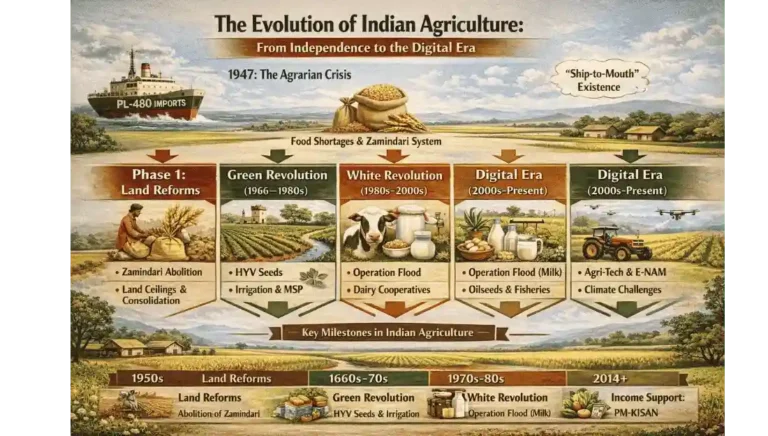
At the time of independence, India inherited a stagnant and crippled agrarian economy. The British Land Revenue Systems (Zamindari, Ryotwari, and Mahalwari) had led to extreme peasant indebtedness and low productivity. Agriculture contributed nearly 50% to the GDP, but the nation suffered from chronic food shortages, relying on PL-480 imports from the USA—a situation famously termed a “ship-to-mouth” existence.
Phase 1: Institutional Reforms and Land Redistribution (1947–1960s)
The early years focused on Social Justice through Land Reforms to dismantle the exploitative colonial structures.
1. The Abolition of Intermediaries
The first major step was the Abolition of Zamindari. This aimed to remove the layers of middlemen between the state and the actual tillers of the soil, providing tenancy rights to millions of farmers.
2. Land Ceilings and Consolidation
- Land Ceiling Acts: Laws were enacted to limit the maximum size of land an individual could own, with the surplus redistributed to landless laborers.
- Consolidation of Holdings: Fragmented land plots were merged to make farming more economically viable and efficient.
3. The Bhoodan Movement
Led by Vinoba Bhave, this voluntary land reform movement sought to persuade wealthy landowners to donate a portion of their land to the poor, emphasizing social consolidation without state coercion.
Phase 2: The Technological Breakthrough – The Green Revolution (1966–1980s)
By the mid-1960s, consecutive droughts and wars necessitated a shift from Institutional Reforms to Technological Solutions.
1. The High-Yielding Variety (HYV) Program
Under the leadership of M.S. Swaminathan and C. Subramaniam, India introduced HYV seeds (Mexican wheat and IR-8 rice). This required a “package” of inputs: chemical fertilizers, pesticides, and assured irrigation.
2. Expansion of Infrastructure
The government invested heavily in Canal Irrigation and Rural Electrification to support pump-sets. Institutional support was bolstered through the Minimum Support Price (MSP) and the Food Corporation of India (FCI) to ensure Food Security and price stability.
Phase 3: Diversification and the White Revolution (1980s–2000s)
While the Green Revolution secured calories, the next phase focused on nutrition and income diversification.
1. Operation Flood (The White Revolution)
Launched by Dr. Verghese Kurien, this was the world’s largest dairy development program. It transformed India from a milk-deficient nation into the world’s largest producer through the Cooperative Model (Amul).
2. The Yellow and Blue Revolutions
- Yellow Revolution: Focused on achieving self-sufficiency in oilseeds.
- Blue Revolution: Aimed at the rapid growth of aquaculture and fisheries.
Phase 4: Liberalization and Contemporary Challenges (2000s–Present)
Post-1991, agriculture faced the pressures of globalization and the need for Sustainable Intensification.
1. The Shift to High-Value Agriculture
Farmers transitioned toward Horticulture, Floriculture, and Organic Farming. The National Horticulture Mission (NHM) played a pivotal role in this diversification.
2. Major Structural Challenges
- Climate Change: Erratic monsoons and rising temperatures threaten crop yields.
- Fragmented Landholdings: Over 85% of Indian farmers are small and marginal, limiting their ability to invest in technology.
- Groundwater Depletion: Over-exploitation of aquifers due to water-intensive crops like paddy and sugarcane in semi-arid regions.
3. Digital and Precision Farming
The government is pushing for an Agristack—a digital ecosystem for agriculture. Initiatives like e-NAM (National Agriculture Market) aim to create a unified national market, while PM-KISAN provides Direct Benefit Transfers (DBT) to support farmer livelihoods.
Summary Table: Milestones in Indian Agriculture
Period | Major Policy / Movement | Objective |
1950s | Land Reforms | Abolition of Zamindari; Social Justice. |
1960s-70s | Green Revolution | Food Security; HYV Seeds. |
1970s-80s | White Revolution | Milk self-sufficiency; Cooperatives. |
1990s | LPG Era | Market integration; Agro-exports. |
2014-Present | Income Support | Doubling Farmers’ Income; PM-KISAN; Sustainable Farming. |
UPSC Prelims: PYQs & Practice Questions
Previous Year Questions (PYQs)
Question 1 (First Five-Year Plan 1951–56 – Planning)
Q: Which of the following was the main objective of the First Five-Year Plan (1951–56)?
Options:
(a) Rapid Industrialization
(b) Development of Agriculture including Irrigation
(c) Self-reliance in Defense
(d) Eradication of Poverty
Answer: (b)
Explanation: In the early 1950s, India faced major food shortages and a weak agrarian base. The First Plan focused on agriculture and irrigation to strengthen food security and rural stability, including major projects like Bhakra-Nangal.
Question 2 (Bhoodan Movement 1951 – Land Reforms)
Q: What was the purpose of the Bhoodan Movement started by Vinoba Bhave?
Options:
(a) To encourage collective farming
(b) To persuade landlords to voluntarily give land to landless laborers
(c) To protest against the British land revenue system
(d) To implement scientific farming techniques
Answer: (b)
Explanation: The Bhoodan Movement (1951) was a voluntary land reform initiative aimed at reducing land inequality. It sought to convince landowners to donate land as a "gift of land" to the landless, promoting social harmony without coercive state redistribution.
Prelims Practice Questions
Question 1
Q: With reference to the Green Revolution in India, consider the following statements:
1. It was primarily focused on the pulses and oilseeds sector.
2. It led to the introduction of High-Yielding Variety (HYV) seeds.
3. It resulted in regional disparities, favoring Punjab and Haryana initially.
Which of the statements given above are correct?
Options:
(a) 1 and 2 only
(b) 2 and 3 only
(c) 1 and 3 only
(d) 1, 2, and 3
Answer: (b) 2 and 3 only
Explanation: Statement 1 is incorrect because the Green Revolution initially focused mainly on wheat and rice, not pulses and oilseeds. Statements 2 and 3 are correct as it promoted HYV seeds along with irrigation, fertilizers, and pesticides, and its benefits were first concentrated in north-western India (especially Punjab and Haryana), creating regional disparities.
Question 2
Q: “Operation Flood” is a term associated with which sector?
Options:
(a) Fisheries and Aquaculture
(b) Dairy / Milk Production
(c) Poultry and Egg Production
(d) Edible Oil Production
Answer: (b) Dairy / Milk Production
Explanation: Operation Flood (launched in 1970 by the National Dairy Development Board – NDDB) is known as the White Revolution. It created a nationwide milk grid, strengthened dairy cooperatives (like the Anand model), increased rural incomes, and helped India emerge as the world’s leading milk producer.
UPSC Mains – Previous Year & Practice Questions
Mains Previous Year Questions (Indian Economy: Agriculture & Rural Development)
Green Revolution: Food Security vs Ecology
Question: "The Green Revolution has made India self-sufficient in food production but at the cost of environmental degradation." Discuss. (UPSC 2018/2020 Context)
Land Reforms and Rural Transformation
Question: Examine the role of Land Reforms in the socio-economic transformation of rural India in the post-independence period. (UPSC 2013/2016)
Minimum Support Price and Farmer Security
Question: Explain the significance of 'Minimum Support Price' (MSP) in ensuring the economic security of farmers. (UPSC 2018)
White Revolution and Women’s Empowerment
Question: How has the 'White Revolution' contributed to the empowerment of women in rural India? (UPSC - Social Issues/Economy)
Climate-Smart Agriculture and Erratic Monsoons
Question: Discuss the challenges of 'Climate-Smart Agriculture' in the context of erratic monsoons in India. (UPSC 2021)
Mains Practice Questions
Fragmentation of Landholdings & Farm Modernization
Question: “Fragmentation of landholdings is the single biggest bottleneck in the modernization of Indian agriculture.” Critically analyze. (250 Words)
e-NAM & APMC Monopoly
Question: Evaluate the impact of the 'e-NAM' (National Agriculture Market) on breaking the monopoly of the APMC Mandis. (250 Words)
ZBNF, Farmers’ Income & Soil Health
Question: Discuss the potential of 'Zero Budget Natural Farming' (ZBNF) in doubling farmers’ income while ensuring soil health. (250 Words)
Frequently Asked Questions (FAQs)
What is the 'Zamindari Abolition Act'?
It was the first major land reform after independence. It abolished the exploitative system of intermediaries (landlords) and established a direct relationship between the state and the tiller of the soil, granting millions of farmers ownership rights.
Why did the Green Revolution lead to 'Regional Disparity'?
The Green Revolution required high capital, assured irrigation, and electricity. Since regions like Punjab, Haryana, and Western UP already had better infrastructure, they benefited disproportionately compared to Eastern and Southern India.
What is 'Sustainable Agriculture'?
It is a method of farming that meets present food needs without compromising the ability of future generations to meet theirs. It includes practices like Organic Farming, Crop Rotation, and Drip Irrigation.
What is the significance of the 'National Food Security Act (2013)'?
It marks a shift from welfare to a rights-based approach. It provides legal entitlement to subsidized foodgrains to nearly two-thirds of India’s population, ensuring that agricultural production translates into nutritional security.
What is the 'Evergreen Revolution'?
Coined by Dr. M.S. Swaminathan, it refers to the path of increasing production and productivity without ecological harm. It emphasizes Precision Farming, soil health, and water conservation.