Table of Contents
ToggleEvolution of the Indian Economy: From Independence to Globalization
Introduction: The Colonial Legacy
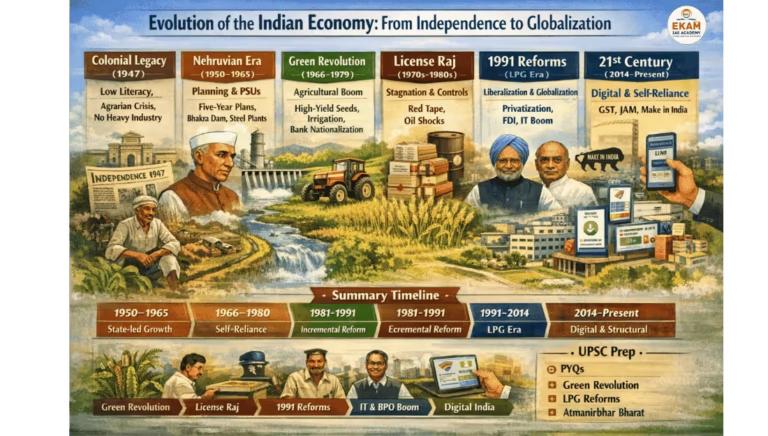
In 1947, India inherited an economy characterized by low per capita income, deindustrialization, and a crippled agrarian sector. The British left India with a literacy rate of just 17% and a near-total absence of heavy industry. The primary task for the Planning Commission was to achieve Economic Consolidation while ensuring Social Justice.
The Nehruvian Era: The Age of Planning (1947–1964)
The early years were dominated by the Nehru-Mahalanobis Model, which emphasized State-led Industrialization.
1. The Command and Control Economy
- First Five-Year Plan (1951–56): Focused on the agricultural sector and irrigation (e.g., Bhakra Nangal Dam) to achieve food security.
- Second Five-Year Plan (1956–61): Shifted focus to Heavy Industries and capital goods (Rourkela, Bhilai, and Durgapur steel plants). This era saw the birth of the Public Sector Undertakings (PSUs) as the “Temples of Modern India.”
2. Import Substitution Industrialization (ISI)
To protect infant domestic industries, India adopted a policy of Import Substitution, placing high tariffs on foreign goods and relying on Domestic Manufacturing.
Crisis and the Green Revolution (1960s–1970s)
The 1960s were marked by wars (1962, 1965), droughts, and a severe Foreign Exchange Crisis.
1. The Green Revolution
To overcome the “Ship-to-Mouth” existence, India launched the Green Revolution in the mid-1960s under M.S. Swaminathan.
- Key Features: Use of High-Yielding Variety (HYV) seeds, chemical fertilizers, and expanded irrigation.
- Impact: India achieved Self-Sufficiency in Foodgrains, though it led to regional disparities and environmental concerns.
2. Nationalization of Banks (1969)
Under Indira Gandhi, 14 major private banks were nationalized to ensure Financial Inclusion and redirect credit to Priority Sectors like agriculture and small-scale industries.
The Decade of Stagnation and "License Raj" (1970s–1980s)
This period was characterized by the Hindu Rate of Growth (around 3.5%), hindered by the License-Permit-Quota Raj.
- Red Tapism: Excessive government regulations and Bureaucratic Hurdles stifled private entrepreneurship.
- Oil Shocks: The global oil crises of 1973 and 1979 led to high inflation and widened the Current Account Deficit.
The 1991 Watershed: LPG Reforms
By 1991, India faced a catastrophic Balance of Payments (BoP) Crisis, with foreign reserves barely enough to cover two weeks of imports.
1. Liberalization, Privatization, and Globalization (LPG)
Under Prime Minister P.V. Narasimha Rao and Finance Minister Manmohan Singh, India initiated radical structural reforms:
- Liberalization: Dismantling the License Raj and de-reserving industries for the private sector.
- Privatization: Reducing the state’s role in PSUs through disinvestment.
- Globalization: Integrating with the global economy by reducing Import Duties and encouraging Foreign Direct Investment (FDI).
2. Shift to the Service Sector
Post-1991, India bypassed the traditional manufacturing-led growth model, seeing an explosion in the Information Technology (IT) and BPO sectors, making India the “Back office of the world.”
Contemporary Challenges and the Road to $5 Trillion
In the 21st century, the focus has shifted toward Inclusive Growth and Sustainable Development.
1. Digital Transformation
The JAM Trinity (Jan Dhan-Aadhaar-Mobile) and the Unified Payments Interface (UPI) have revolutionized Direct Benefit Transfers (DBT) and reduced leakages in welfare schemes.
2. Structural Reforms
- GST (Goods and Services Tax): Aimed at creating a Unified National Market.
- Insolvency and Bankruptcy Code (IBC): Addressing the problem of Non-Performing Assets (NPAs) in the banking sector.
- Atmanirbhar Bharat: A push for Self-Reliance and boosting the Manufacturing Sector through Production Linked Incentive (PLI) schemes.
Summary Table: Eras of Economic Development
Period | Theme | Major Policy/Event |
1950–1965 | State-led Growth | Five-Year Plans, Mahalanobis Model. |
1966–1980 | Self-Reliance | Green Revolution, Bank Nationalization. |
1981–1991 | Incremental Reform | Pro-business shift, but ending in BoP Crisis. |
1991–2014 | LPG Era | Market Liberalization, IT Boom, FDI inflow. |
2014–Present | Digital & Structural | GST, DBT, Make in India, Digital India. |
UPSC Prelims: PYQs & Practice Questions
Previous Year Questions (PYQs)
Question 1 (UPSC Prelims 2020 – Economy)
Q: With reference to the Indian economy after the 1991 economic liberalization, consider the following statements:
1. Worker productivity per worker increased in IT and service sectors.
2. The percentage share of agriculture in GDP increased enormously.
3. The share of India’s exports in world trade increased.
4. FDI inflows increased.
Which of the statements given above are correct?
Options:
(a) 1, 3 and 4 only
(b) 2 and 4 only
(c) 1 and 2 only
(d) 1, 2, 3 and 4
Answer: (a)
Explanation: After the 1991 reforms, the services sector (especially IT) saw a sharp rise in productivity due to technology adoption, global integration, and higher-value services. India’s share in world exports increased as trade barriers reduced and export-led growth expanded in goods and services. FDI inflows rose significantly due to liberalized policies, automatic routes, and improved investor confidence. However, the share of agriculture in GDP declined over time as the economy structurally shifted towards industry and services (even though agriculture continued to employ a large workforce).
Question 2 (UPSC Prelims 2010 – Economy/Planning)
Q: In the context of India’s Five-Year Plans, a shift in the pattern of industrialization with lower emphasis on heavy industries and more on infrastructure began in:
Options:
(a) Fourth Plan
(b) Sixth Plan
(c) Eighth Plan
(d) Tenth Plan
Answer: (b)
Explanation: The Sixth Five-Year Plan (1980–85) is seen as a turning point where policy focus began moving away from the rigid heavy-industry-first approach associated with earlier planning. The Plan placed greater stress on infrastructure development, poverty alleviation, and improving basic capacities that support broad-based growth. It also reflected early steps toward liberalization and modernization, creating conditions for later reforms. This shift gradually reduced the single-minded emphasis on heavy industries and expanded attention to growth-supporting sectors like energy, transport, and productivity-enhancing investments.
Prelims Practice Questions
Question 1
Q: Which of the following was the primary objective of the First Five-Year Plan (1951–1956)?
Options:
(a) Rapid Industrialization
(b) Agricultural Development and Food Security
(c) Self-Reliance in Defense
(d) Privatization of Banks
Answer: (b) Agricultural Development and Food Security
Explanation: The First Five-Year Plan prioritized the agrarian sector to address food shortages and stabilize the post-Partition economy. Major focus areas included irrigation, land and community development, and large multipurpose projects (e.g., Bhakra–Nangal) to boost agricultural output and ensure food security.
Question 2
Q: The term “Hindu Rate of Growth” refers to the low annual growth rate of the Indian economy (around 3.5%) during which period?
Options:
(a) 1947–1950
(b) 1950s to 1980s
(c) 1991–2000
(d) 2000–2010
Answer: (b) 1950s to 1980s
Explanation: Coined by economist Raj Krishna, the phrase highlighted India’s prolonged phase of slow economic growth (roughly 3–3.5%) from the 1950s to the 1980s. It is commonly linked to features like the License–Permit Raj, a tightly regulated economy, and an import substitution strategy before the acceleration seen around the late 1980s and post-1991 reforms.
UPSC Mains – Previous Year & Practice Questions
Mains Previous Year Questions (Indian Economy: Development & Reforms)
1991 LPG Reforms: Necessity vs Choice
Question: "The 1991 economic reforms were a product of necessity rather than choice." Critically analyze the circumstances that led to the LPG reforms. (UPSC - Historical Context)
Green Revolution and Rural Consolidation
Question: Evaluate the impact of the 'Green Revolution' on the socio-economic consolidation of rural India. (UPSC - Post-Independence)
From Planning Commission to NITI Aayog
Question: Explain the shift from 'Planning' to 'NITI Aayog' in the context of cooperative federalism and economic development. (UPSC 2015/2017)
Jobless Growth in Post-Reform India
Question: Discuss the challenges of 'Jobless Growth' in post-reform India despite high GDP growth rates. (UPSC 2015/2020)
PSUs as ‘Temples of Modern India’
Question: Examine the role of Public Sector Undertakings (PSUs) as 'Temples of Modern India' in the early phases of development. (UPSC - Society/History)
Mains Practice Questions
Service-led Growth & Job Creation Challenge
Question: “India bypassed the manufacturing stage and moved directly from an agrarian economy to a service-led economy.” Discuss the implications of this structural shift on employment. (250 Words)
JAM Trinity & Social Consolidation via DBT
Question: Analyze how the 'JAM Trinity' (Jan Dhan–Aadhaar–Mobile) has revolutionized social consolidation through Direct Benefit Transfers (DBT). (250 Words)
Atmanirbhar Bharat vs 1950s Import Substitution
Question: Evaluate the success of 'Atmanirbhar Bharat' in achieving self-reliance compared to the 'Import Substitution' policy of the 1950s. (250 Words)
Frequently Asked Questions (FAQs)
What was the 'License-Permit-Quota Raj'?
It was a system of excessive government regulations where private businesses required multiple licenses and permits to start, run, or expand an industry. It often led to red tapism, corruption, and stifled innovation.
How did the 1991 Balance of Payments (BoP) crisis start?
It was triggered by high fiscal deficits, the Gulf War (which raised oil prices), and a decline in remittances. India’s foreign exchange reserves dropped so low that it could only pay for two weeks of imports, forcing the government to airlift gold to the IMF for a loan.
What is the 'Nehru-Mahalanobis Model'?
This model, adopted in the Second Five-Year Plan, focused on Heavy Industrialization and Capital Goods (like steel and machines) through the public sector to make India a self-reliant industrial power.
Why is India’s growth called 'Service-Led'?
Unlike most developed nations that grew via the manufacturing sector, India’s growth since the 1990s has been driven by the Service Sector (IT, Telecom, Finance), which currently contributes over 50% to India’s Gross Value Added (GVA).
What is the role of NITI Aayog compared to the Planning Commission?
The Planning Commission followed a “top-down” approach with the power to allocate funds. NITI Aayog follows a “bottom-up” approach, acting as a Think Tank to foster Cooperative Federalism and provide strategic advice without fund-allocation powers.