Table of Contents
ToggleLinguistic Minorities in Post-Independence India: Rights, Challenges, and Policy
Introduction: The Tower of Babel and the New Republic
At the time of independence in 1947, India faced a “Crisis of Identity.” While the Social Consolidation of princely states was underway, the Linguistic Question emerged as a powerful force. With over 1,600 mother tongues, the task was to ensure that Linguistic Minorities—groups whose mother tongue differs from the majority in a state—were not marginalized in the process of State Reorganization.
The Constitutional Safeguards: A Shield for Diversity
The Constitution of India does not define the term ‘Minority’ but recognizes both Religious and Linguistic Minorities.
1. Fundamental Rights
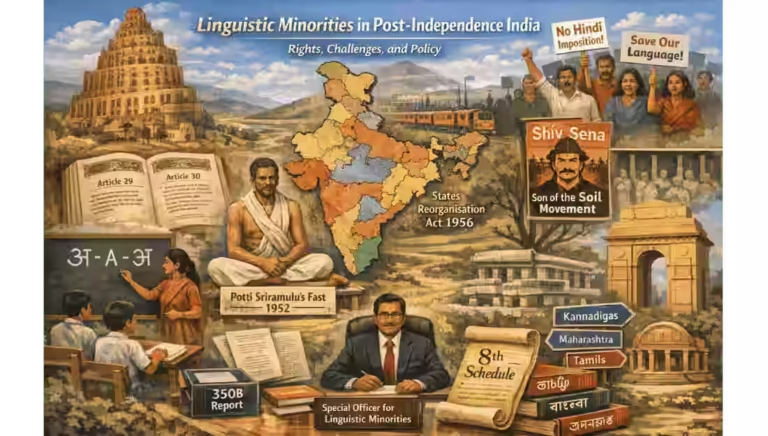
- Article 29: Grants any section of citizens residing in India having a distinct language, script, or culture the right to conserve the same.
- Article 30: Guarantees the right of Linguistic Minorities to establish and administer educational institutions of their choice.
2. Special Provisions
- Article 350A: Directs every state to provide adequate facilities for instruction in the mother tongue at the primary stage of education to children belonging to linguistic minority groups.
- Article 350B: Provided for the appointment of a Special Officer for Linguistic Minorities to investigate all matters relating to the safeguards provided for them.
Evolution of the Linguistic Conflict
1. The Demand for Linguistic States
Initially, the JVP Committee (Jawaharlal Nehru, Vallabhbhai Patel, Pattabhi Sitaramayya) resisted the creation of states based on language, fearing it would lead to Balkanization.
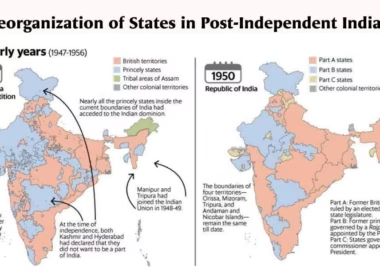
- Potti Sriramulu’s Fast: His death in 1952 led to the creation of Andhra State, the first state formed on a linguistic basis.
- States Reorganisation Act (1956): Based on the Fazl Ali Commission recommendations, India was divided into 14 states and 6 union territories based on language.
2. The Anti-Hindi Agitations
The attempt to make Hindi the sole Official Language by 1965 led to massive protests in Tamil Nadu and other non-Hindi speaking states.
- Official Languages Act (1963): Ensured the continued use of English as an associate official language, protecting the interests of linguistic minorities in the South and North-East.
Major Challenges Faced by Linguistic Minorities
1. The “Son of the Soil” Doctrine
In several states, Regionalism led to the “Son of the Soil” movement (e.g., Shiv Sena in Maharashtra). This created a hostile environment for Migrant Linguistic Minorities who were viewed as outsiders competing for local jobs and resources.
2. Educational Barriers
While the Three-Language Formula was introduced to promote Multilingualism, its implementation has been uneven. Linguistic minority students often face a lack of textbooks and trained teachers in their mother tongue, leading to higher dropout rates.
3. Administrative Marginalization
In many districts, the minority language is not recognized for Official Communication, making it difficult for citizens to interact with the judiciary or local government.
Institutional Framework for Protection
1. Commissioner for Linguistic Minorities (CLM)
The 7th Constitutional Amendment Act (1956) inserted Article 350B. The CLM submits annual reports to the President on the status of safeguards.
- Objective: To ensure Level Playing Fields for minority language speakers in recruitment and administration.
2. The 8th Schedule
Currently, 22 languages are listed in the 8th Schedule. While inclusion provides prestige and support for literature, many languages spoken by millions remain excluded, leading to a sense of Cultural Alienation.
Summary Table: Milestones in Linguistic Policy
Year | Milestone | Impact on Linguistic Minorities |
1953 | Andhra State Formation | Validated the principle of Linguistic Identity. |
1956 | 7th Amendment | Created the office of Special Officer for Linguistic Minorities. |
1963 | Official Languages Act | Protected non-Hindi speakers from Linguistic Imperialism. |
1968 | Three-Language Formula | Attempted to balance National Language and Vernaculars. |
2004 | Classical Language Status | Recognition of ancient linguistic heritage (Tamil, Sanskrit, etc.). |
UPSC Prelims: PYQs & Practice Questions
Previous Year Questions (PYQs)
Question 1 (UPSC Prelims 2013 – Polity)
Q: Which of the following bodies does not find mention in the Constitution?
Options:
1. National Development Council
2. Planning Commission (now NITI Aayog)
3. Zonal Councils
Select the correct answer using the codes given below:
(a) 1 and 2 only
(b) 2 only
(c) 1 and 3 only
(d) 1, 2, and 3
Answer: (d)
Explanation: National Development Council, Planning Commission/NITI Aayog, and Zonal Councils are not constitutional bodies. Zonal Councils are statutory bodies created under the States Reorganisation Act, 1956 to promote inter-state cooperation and coordination. In contrast, the Special Officer for Linguistic Minorities is a constitutional office under Article 350B.
Question 2 (UPSC Prelims – Contextual Polity)
Q: With reference to the Special Officer for Linguistic Minorities, consider the following statements:
1. The office was created by the original Constitution of India.
2. The officer is appointed by the President of India.
Which of the statements given above is/are correct?
(a) 1 only
(b) 2 only
(c) Both 1 and 2
(d) Neither 1 nor 2
Answer: (b)
Explanation: Statement 1 is incorrect. The office was not part of the original Constitution; it was added later (linked with the post-reorganisation constitutional changes). Statement 2 is correct. The President of India appoints the Special Officer, who investigates safeguards for linguistic minorities and reports to the President (Article 350B).
Prelims Practice Questions
Question 1
Q: Article 350A of the Indian Constitution is related to:
Options:
(a) Instructions in mother tongue at primary stage.
(b) Establishment of minority educational institutions.
(c) Protection of scripts of minorities.
(d) Appointment of the Special Officer for Linguistic Minorities.
Answer: (a) Instructions in mother tongue at primary stage
Explanation: Article 350A directs every State and local authority to provide facilities for instruction in the mother tongue at the primary stage to children belonging to linguistic minority groups. It reflects India’s commitment to linguistic rights, inclusive education, and reducing early learning barriers by enabling children to learn foundational concepts in a familiar language.
Question 2
Q: Which of the following languages was the first to be accorded the status of “Classical Language” in India?
Options:
(a) Sanskrit
(b) Tamil
(c) Kannada
(d) Telugu
Answer: (b) Tamil (2004)
Explanation: Tamil was the first language to receive the Classical Language status in 2004. The recognition is based on indicators such as antiquity, a rich body of ancient literature, and an independent literary tradition. After Tamil, the status was extended to other languages over time, including Sanskrit, Kannada, Telugu, Malayalam, and Odia.
UPSC Mains – Previous Year & Practice Questions
Mains Previous Year Questions (Society: Language & Linguistic Minorities)
Linguistic States and National Unity
Question: "The formation of linguistic states in India has actually strengthened the cause of Indian unity." Examine. (UPSC 2016)
Special Officer for Linguistic Minorities
Question: Discuss the role of the 'Special Officer for Linguistic Minorities' in safeguarding the interests of linguistic minorities in India. (UPSC - Polity Context)
'Son of the Soil' Movements and Minority Rights
Question: How do the 'Son of the Soil' movements affect the rights of linguistic minorities in different states of India? (UPSC - Society Context)
Three-Language Formula: Implementation Challenges
Question: Analyze the challenges in implementing the 'Three-Language Formula' across the country. (UPSC 2021/2022 Context)
Articles 29 & 30: Constitutional Protections
Question: Critically evaluate the constitutional protections provided to linguistic minorities under Articles 29 and 30. (UPSC 2018)
Mains Practice Questions
Linguistic Diversity vs Linguistic Chauvinism
Question: “Linguistic diversity is a strength, but linguistic chauvinism is a threat to social consolidation.” Elaborate. (250 Words)
8th Schedule & Minority Language Preservation
Question: To what extent has the 8th Schedule of the Constitution helped in the preservation of minority languages in post-independence India? (250 Words)
Official Languages Act, 1963 & Centre–South Relations
Question: Evaluate the impact of the Official Languages Act, 1963, on the relationship between the Centre and the Southern States. (250 Words)
Frequently Asked Questions (FAQs)
What is the 'Three-Language Formula'?
It is an educational strategy introduced in 1968. In Hindi-speaking states, it includes Hindi, English, and a modern Indian language (preferably Southern). In non-Hindi states, it includes the regional language, Hindi, and English. Its goal is to promote Multilingualism and National Integration.
Who is a 'Linguistic Minority'?
It is a group of people whose mother tongue is different from the principal language of the state or a particular part of the state. For example, Bengali speakers in Karnataka or Tamil speakers in Delhi are linguistic minorities in those respective states.
What is the significance of Potti Sriramulu?
He was a Gandhian activist whose 56-day fast and subsequent death in 1952 led to the creation of Andhra State. This forced the government to establish the States Reorganisation Commission, leading to the division of India on linguistic lines.
Can a state impose its official language on minority educational institutions?
No. Under Article 30, linguistic minorities have the right to establish and administer educational institutions of their choice. The Supreme Court has consistently held that the state cannot force its regional language as the sole medium of instruction in these institutions.
What are the criteria for a language to be declared 'Classical'?
- High antiquity of early texts/recorded history over 1,500–2,000 years.
- A body of ancient literature/texts considered a valuable heritage.
- The literary tradition must be original and not borrowed from another speech community.