Table of Contents
ToggleThe Evolution of Women's Movements and Issues in Post-Independence India
Introduction: The Gendered Transition of 1947
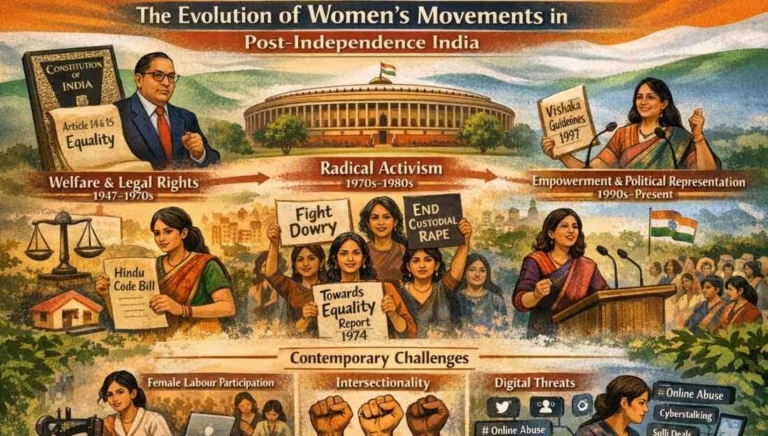
The independence of India was a pivotal moment for gender justice. While the colonial period focused on social reform (Sati, widow remarriage), the post-independence era transitioned toward constitutional rights and political agency. The Women’s Movement in India is not a monolithic entity; it has evolved through phases of state-led welfare, radical activism, and contemporary intersectional advocacy.
Phase 1: The Legalistic and Welfare Approach (1947–1970s)
In the early years of the Republic, women were viewed primarily as subjects of social welfare rather than independent economic actors.
1. The Constitutional Bedrock
The Founding Fathers ensured that the Constitution of India was a revolutionary document for women.
- Article 14 & 15: Guaranteed Equality before law and prohibited gender-based discrimination.
- Article 16: Ensured Equal opportunity in public employment.
- Directive Principles (DPSP): Under Article 39, the state was tasked with ensuring Equal pay for equal work.
2. The Hindu Code Bill: A Legislative Watershed
The 1950s were dominated by the Hindu Code Bill controversy. Spearheaded by B.R. Ambedkar and Jawaharlal Nehru, these reforms aimed to modernize personal laws.
- Hindu Marriage Act (1955): Outlawed polygamy and introduced provisions for divorce.
- Hindu Succession Act (1956): Granted women equal rights in inheritance (further strengthened in 2005).
Important Keywords: Personal Law Reform, Legal Agency, Formal Equality, Social Engineering.
Phase 2: Radicalization and Autonomous Movements (1970s–1980s)
The 1970s marked the birth of the “New Women’s Movement”, characterized by a move away from elite-led organizations to grassroots activism.
1. The “Towards Equality” Report (1974)
This report by the Committee on the Status of Women in India (CSWI) was a systemic shock. It highlighted the declining sex ratio, the feminization of poverty, and the failure of the “trickle-down” theory for women.
2. Protest against Bodily Violence
- The Mathura Rape Case (1972): The acquittal of policemen accused of raping a tribal girl led to nationwide outrage. This birthed autonomous women’s groups like Saheli and Stree Shakti Sanghatana.
- Criminal Law (Amendment) Act (1983): Protests led to the definition of custodial rape being added to the law.
Anti-Dowry Campaigns: The rise in dowry deaths led to the amendment of Section 498A of the Indian Penal Code (IPC), making matrimonial cruelty a non-bailable offense.
Phase 3: Empowerment and Institutionalization (1990s–Present)
The post-1990 era saw the influence of Liberalization, Privatization, and Globalization (LPG) and a shift toward political representation.
1. Political Agency: The 73rd and 74th Amendments (1992)
This was the most significant step for Political Empowerment.
- Reservation: 33% (now 50% in many states) of seats in Panchayati Raj Institutions (PRIs) were reserved for women.
- Impact: It broke the patriarchal monopoly on local governance, despite the challenge of “Pati-Panchayats” (husbands ruling on behalf of elected wives).
2. Landmark Legal Protections
- Vishaka Guidelines (1997): Established by the Supreme Court to address Sexual Harassment at the Workplace. This eventually led to the PoSH Act (2013).
- Protection of Women from Domestic Violence Act (2005): The first law to recognize economic and emotional abuse as forms of violence.
Important Keywords: Substantive Equality, Political Socialization, Glass Ceiling, Domestic Violence.
Contemporary Issues: The Unfinished Agenda
1. The Crisis of Female Labour Force Participation (FLFPR)
Despite rising education levels, India’s FLFPR has remained stagnant or declined. This is often attributed to the “U-Shaped Curve” theory and the heavy burden of unpaid care work.
2. Intersectionality: Caste and Religion
Modern movements emphasize Intersectionality—the idea that a woman’s experience is shaped by her caste (Dalit Feminism), religion, and class.
3. The Digital Frontier
Issues like Cyberstalking, Sulli Deals/Bulli Bai apps, and Online Misogyny represent the new “digital” battleground for women’s rights.
Summary Table for Quick Revision
Feature | Pre-1970s | 1970s-1990s | Post-1990s |
Focus | Welfare & Legal Rights | Violence & Protest | Empowerment & Policy |
Key Actors | Political Parties/State | Autonomous Groups | NGOs/Self-Help Groups |
Major Law | Hindu Code Bill | Section 498A (IPC) | PoSH Act, DV Act |
UPSC Prelims: PYQs & Practice Questions
Previous Year Questions (PYQs)
Question 1 (UPSC Prelims 2011/2013 Context)
Q: Which of the following gave a big impetus to the Women's Movement in India in the early 20th Century?
Options:
(a) The All India Women’s Conference (AIWC) | (b) The Self-Help Group Movement | (c) The 73rd Amendment Act | (d) The Chipko Movement
Answer: (a)
Explanation: The All India Women’s Conference (AIWC), founded in 1927, played a pioneering role in advocating women’s education, social reform, and later supported legislative reforms including issues related to personal laws, thereby giving a major impetus to the women’s movement.
Practice Question 2 (UPSC Prelims – Historical Relevance)
Q: The "Towards Equality" Report (1974) is associated with which of the following?
Options:
(a) Electoral reforms | (b) Status of Women in India | (c) Tribal integration | (d) Panchayati Raj
Answer: (b)
Explanation: The Committee on the Status of Women in India (CSWI) submitted the Towards Equality report in 1974. It was the first comprehensive assessment of women’s conditions in post-independence India and highlighted issues like declining sex ratio, social inequality, and weak economic agency.
Prelims Practice Questions
Question 1
Q: With reference to the Hindu Code Bill, consider the following statements:
1. It was strongly advocated by B.R. Ambedkar to provide legal rights to women.
2. It only addressed issues related to Hindu marriage and did not cover inheritance.
Which of the statements given above is/are correct?
Options:
(a) 1 only | (b) 2 only | (c) Both 1 and 2 | (d) Neither 1 nor 2
Answer: (a) 1 only
Explanation: Statement 1 is correct as B.R. Ambedkar strongly pushed for reforms to improve women’s legal rights. Statement 2 is incorrect because the Hindu Code Bill framework led to reforms beyond marriage, including inheritance—especially through the Hindu Succession Act, 1956, which improved women’s inheritance rights.
Question 2
Q: The “Vishaka Guidelines” were issued by the Supreme Court to address:
Options:
(a) Sexual Harassment at the Workplace | (b) Child Labour | (c) Dowry Harassment | (d) Manual Scavenging
Answer: (a) Sexual Harassment at the Workplace
Explanation: The guidelines were laid down in 1997 in the case of Vishaka vs. State of Rajasthan to prevent and redress workplace sexual harassment. They later formed the basis for the PoSH Act, 2013.
Mains Previous Year Questions (Women Issues)
Women’s Movement & Lower Social Strata
Question: "Women's movement in India has not addressed the issues of women of lower social strata." Substantiate your view. (UPSC 2018)
Patriarchy & Middle-Class Working Women
Question: How does patriarchy impact the position of middle-class working women in India? (UPSC 2014)
Globalization: Impact on Women
Question: Discuss the positive and negative effects of globalization on women in India. (UPSC 2013/2015)
Gig Economy & Women’s Empowerment
Question: Examine the role of 'Gig Economy' in the process of empowerment of women in India. (UPSC 2021)
Population–Poverty Link & Reproductive Rights
Question: Critically examine whether growing population is the cause of poverty or poverty is the main cause of population increase in India, with specific reference to women's reproductive rights. (UPSC 2015)
Mains Practice Questions
Women’s Movement: Pre-Independence vs Post-Independence
Question: Compare the nature of the women’s movement in the pre-independence era with that of the post-independence era. (250 Words)
73rd Amendment, Women’s Empowerment & “Pati-Panchayats”
Question: “Political representation through the 73rd Amendment has empowered women at the grassroots, but ‘Pati-Panchayats’ still hinder genuine agency.” Discuss. (250 Words)
Self-Help Groups and Rural Women’s Socio-Economic Consolidation
Question: Evaluate the role of Self-Help Groups (SHGs) in the socio-economic consolidation of rural women in post-independence India. (250 Words)
Frequently Asked Questions (FAQs)
What is 'Intersectionality' in the context of the Indian women’s movement? Ans: Intersectionality ?
refers to how different social identities (like caste, religion, and class) overlap to create unique modes of discrimination. For example, the struggles of a Dalit woman are compounded by both caste and gender, which may differ from those of an urban upper-caste woman.
What was the significance of the Mathura Rape Case (1972)?
It was a landmark case where the acquittal of two policemen sparked nationwide protests. This led to a surge in autonomous women’s organizations and forced the government to amend the Indian Penal Code to define custodial rape.
How did the 1990s economic reforms affect women?
The LPG reforms (Liberalization, Privatization, Globalization) opened up service sector jobs for women (IT, BPO) but also led to the informalization of labor, where many women work without social security or job stability.
What is the 'Uniform Civil Code' (UCC) and why is it a women's issue? Ans: A Uniform Civil Code ?
would replace individual personal laws (based on religion) with a common set of laws for all citizens. Proponents argue it would ensure gender justice by removing discriminatory practices in marriage, divorce, and inheritance prevalent in various personal laws.
What is 'Gender Budgeting'?
It is a fiscal tool where the government assesses the impact of the budget on women and ensures that a certain portion of funds is allocated specifically for women-centric schemes and empowerment programs.