Table of Contents
ToggleThe New Economic Policy of 1991: Liberalization, Privatization, and Globalization (LPG)
Introduction: The Crisis of 1991
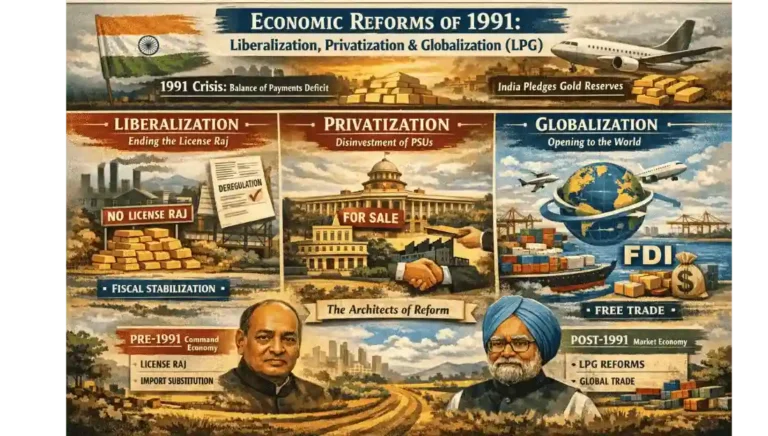
By the late 1980s, India’s economy was in shambles due to large and growing fiscal imbalances. The Balance of Payments (BoP) situation reached a dangerous low, with foreign exchange reserves barely sufficient to cover a few weeks of essential imports like oil and fertilizers. This was exacerbated by the Gulf War and a resultant hike in global oil prices
The Watershed Moment: Pledging the Gold
In early 1991, India was on the verge of defaulting on its sovereign payments
- Gold Pledging: In March 1991, the Chandra Shekhar government authorized the pledging of gold reserves to international banks to raise emergency funds
- The Transition: While this move caused a public outcry, it provided the necessary breathing room for the incoming government under P.V. Narasimha Rao to initiate radical reforms
The Pillars of the New Economic Policy: LPG
Upon taking office in June 1991, Prime Minister Narasimha Rao appointed Manmohan Singh, a non-political economist, as the Finance Minister. Together, they launched the New Economic Policy based on three fundamentals: Liberalization, Privatization, and Globalization (LPG).
1. Liberalization: Ending the License Raj
Liberalization aimed to release Indian industry from unnecessary controls and regulations.
- Industrial Licensing: The government abolished industrial licensing for almost all projects, except for a few sensitive sectors.
- De-reservation: Many areas previously reserved for the public sector were opened to private competition.
- Fiscal Stabilization: The policy sought to correct fiscal deficits to stabilize the economy.
2. Privatization: Redefining the Public Sector
Privatization involved reducing the state’s direct role in production.
- Disinvestment: The government began selling its equity in Public Sector Undertakings (PSUs) to private investors to improve efficiency and management.
- Efficiency over Ideology: While the government did not initially opt for full bank privatization, it shifted the focus toward making existing state-run entities more competitive.
3. Globalization: Integrating with the World
Globalization aimed to integrate the Indian economy with the global market.
- Currency Devaluation: The Indian Rupee was devalued to make Indian exports more competitive internationally.
- Trade Barriers: High tariffs and import quotas were gradually reduced to allow for a free flow of goods, services, and capital.
- Foreign Investment: The government relaxed rules for Foreign Direct Investment (FDI) to bring in better technology and capital.
The "Middle Path" of Reforms
Unlike some “shock therapy” models used elsewhere, Narasimha Rao opted for the Middle Path.
- Minimizing Pain: The reforms were designed to produce the least pain for the masses while still achieving high growth rates.
- Selective Opening: Certain sensitive areas like the farm sector were not immediately opened to global competition.
Summary Table: Impact of 1991 Reforms
Feature | Pre-1991 (Command Economy) | Post-1991 (Market Economy) |
Industrial Role | Regulated by License Raj. | Deregulated and Liberalized. |
Public Sector | Occupied “Commanding Heights”. | Subject to Disinvestment. |
Exchange Rate | Fixed/Controlled by RBI. | Market-linked (after devaluation). |
Global Trade | Import Substitution. | Globalization and Export focus. |
UPSC Prelims: PYQs & Practice Questions
Previous Year Questions (PYQs)
Question 1 (UPSC Prelims 2020 – Economy: 1991 Reforms)
Q: With reference to the Indian economy after the 1991 economic liberalization, consider the following statements: (UPSC Prelims 2020)
1. Worker productivity per worker increased in IT and service sectors.
2. The percentage share of agriculture in GDP increased enormously.
3. The share of India’s exports in world trade increased.
4. FDI inflows increased.
Which of the statements given above are correct?
Options:
(a) 1, 3 and 4 only
(b) 2 and 4 only
(c) 1 and 2 only
(d) 1, 2, 3 and 4
Answer: (a)
Explanation: After 1991, services and IT became key growth engines, improving productivity and value addition. India’s export share in world trade rose due to trade liberalisation and global integration. FDI inflows increased as licensing and sectoral caps were eased. However, the share of agriculture in GDP declined over time, even though it continued to employ a large workforce.
Question 2 (Hindu Rate of Growth – Historical Context)
Q: The "Hindu Rate of Growth" refers to the low annual growth rate of the Indian economy (around 3.5%) during which period? (UPSC Prelims – Historical Context)
Options:
(a) 1947 to 1951
(b) 1950s to 1980s
(c) 1991 to 2004
(d) 2004 to 2014
Answer: (b)
Explanation: The term describes the long phase of relatively low growth from the 1950s to the 1980s. This period was marked by the License–Permit–Quota Raj, limited competition, heavy regulation, and an import-substitution approach. The growth momentum improved significantly after the 1991 economic reforms, which expanded private investment, trade, and foreign capital participation.
Prelims Practice Questions
Question 1
Q: Which of the following was a primary driver for the 1991 Economic Reforms?
Options:
(a) A sudden surplus in foreign exchange reserves.
(b) A severe Balance of Payments (BoP) Crisis and rising fiscal imbalances.
(c) The success of the Third Five-Year Plan.
(d) A global decline in oil prices.
Answer: (b) A severe Balance of Payments (BoP) Crisis and rising fiscal imbalances
Explanation: The 1991 reforms were triggered by a major Balance of Payments crisis, where India faced acute pressure on foreign exchange reserves and external payments. This crisis, along with high fiscal deficits and macroeconomic instability, pushed the government to undertake structural reforms such as liberalisation, privatisation, and globalisation to restore stability and revive growth.
Question 2
Q: The “Middle Path” of economic reforms in India is associated with which Prime Minister?
Answer: P.V. Narasimha Rao
Explanation: The “Middle Path” approach is linked with P.V. Narasimha Rao, under whose leadership India initiated reforms while trying to balance growth with social stability. The strategy aimed to achieve higher growth through reform measures, but also to reduce the immediate burden of structural adjustment on vulnerable sections by moving in a phased and politically manageable manner.
UPSC Mains – Previous Year & Practice Questions
Mains Previous Year Questions (Indian Economy: 1991 Reforms & Post-Reform Challenges)
1991 Reforms: Necessity vs Choice
Question: "The 1991 reforms were a product of necessity rather than choice." Critically analyze the circumstances that led to the LPG reforms. (UPSC – Post-Independence context)
Service-led Growth After 1991
Question: Evaluate the impact of the 1991 reforms on the 'Service-led Growth' model of India. (UPSC 2015/2017 context)
From State-led Planning to Market Economy
Question: Explain the shift from 'State-led Planning' to 'Market-driven Economy' in the context of the New Economic Policy. (UPSC – Economy context)
Pledging Gold Reserves in 1991
Question: How did the 1991 crisis lead to the pledging of India's gold reserves? Discuss its political and economic impact. (UPSC – Historical context)
Jobless Growth in Post-Reform India
Question: Discuss the challenges of 'Jobless Growth' in post-reform India despite high GDP growth rates. (UPSC 2015/2020)
Post-Reform Challenges and Outcomes
Question: Critically evaluate the major outcomes and challenges of the post-1991 reform period, with focus on inequality, informalization, and sectoral imbalance. (UPSC – Analytical + Contemporary add-on)
Mains Practice Questions
Dismantling of License Raj & Entrepreneurship
Question: Analyze how the dismantling of the 'License Raj' helped in fostering entrepreneurship in India. (250 Words)
Globalization After 1991: A Double-Edged Sword
Question: “Globalization is a double-edged sword for the Indian economy.” Discuss with reference to the 1991 reforms. (250 Words)
Disinvestment & PSU Efficiency
Question: Evaluate the success of 'Disinvestment' in improving the efficiency of Public Sector Undertakings (PSUs). (250 Words)
Frequently Asked Questions (FAQs)
What was the 'Balance of Payments' crisis of 1991?
It was a situation where India’s foreign exchange reserves dropped to a dangerous low, sufficient for only a few weeks of essential imports like oil. This was caused by years of fiscal imbalances and the external shock of the Gulf War.
What are LPG reforms?
LPG stands for Liberalization (reducing government controls), Privatization (reducing the state’s role in production), and Globalization (integrating with the global economy).
Why did India pledge its gold in 1991?
Due to a severe liquidity crisis and the threat of defaulting on sovereign payments, the government authorized pledging gold reserves to international banks to raise emergency funds.
Who were the key architects of the New Economic Policy?
Prime Minister P.V. Narasimha Rao provided the political leadership, while Finance Minister Manmohan Singh designed the technical framework of the reforms.
What is 'Disinvestment'?
It is the process where the government sells its equity in Public Sector Undertakings (PSUs) to private investors to raise capital and improve organizational efficiency.