Table of Contents
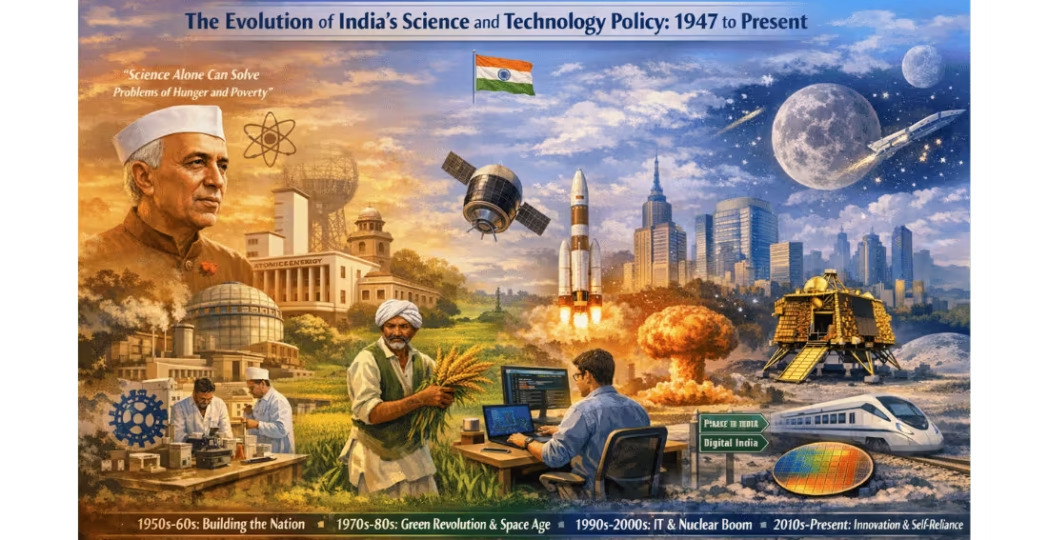
ToggleThe Evolution of India’s Science and Technology Policy: 1947 to the Present
Introduction: The Nehruvian Vision of Scientific Temper
At the dawn of independence, Prime Minister Jawaharlal Nehru famously declared that “it is science alone that can solve the problems of hunger and poverty.” His vision was to foster a scientific temper—a spirit of inquiry and rationalism—to transform a traditional society into a modern, industrial power. Science was not merely an academic pursuit but a pillar of National Consolidation.
Phase 1: Building the Infrastructure of Excellence (1947–1960s)
The early years focused on creating a robust institutional framework to achieve self-reliance in critical sectors.
1. The Birth of the ‘Temples of Modern India’
- CSIR (1942/1947): The Council of Scientific and Industrial Research was revitalized to promote industrial and applied research1.
- Atomic Energy Commission (1948): Led by Homi J. Bhabha, this commission aimed at harnessing nuclear energy for peaceful purposes and electricity2.
- IITs and RECs: Inspired by global models (like MIT), the first Indian Institute of Technology (IIT) was established in Kharagpur (1951) to create a world-class technical workforce.
2. Scientific Policy Resolution (SPR), 1958
This was the first formal policy document that recognized science as the key to national prosperity. It emphasized the “cultivation of science and scientific research in all its aspects” and the training of scientific and technical personnel on a massive scale.
Phase 2: From Food Security to Space Exploration (1960s–1980s)
As the nation matured, science was directed toward solving immediate survival crises and exploring the frontiers of the universe.
1. The Green Revolution: Agricultural Science
To overcome the “ship-to-mouth” existence, India launched the Green Revolution under M.S. Swaminathan. It relied on the High-Yielding Variety (HYV) seeds and modern irrigation technologies, achieving food security for millions.
2. The Indian Space Program
Founded by Vikram Sarabhai, the Indian Space Research Organisation (ISRO) was established in 1969.
- Aryabhata (1975): India’s first satellite marked its entry into the space age.
- SLV-3 (1980): Proved India’s capability to launch its own satellites into orbit.
3. Technology Policy Statement (TPS), 1983
Under Indira Gandhi, this policy focused on technological self-reliance and the reduction of vulnerability in strategic areas. It emphasized the absorption and adaptation of imported technologies to suit Indian conditions.
Phase 3: The Digital Revolution and Liberalization (1990s–2000s)
The New Economic Policy (1991) brought a shift toward globalization and the explosion of the Information Technology (IT) sector.
1. The IT Boom
India emerged as a global software hub. Policies like the Science and Technology Policy (STP), 2003 aimed at integrating science with social and economic goals, focusing on Intellectual Property Rights (IPR) and the knowledge economy.
2. Strategic Achievements
- Pokhran-II (1998): India declared itself a nuclear-armed state, achieving a major milestone in strategic autonomy and defense technology.
- Chandrayaan-1 (2008): India’s first mission to the Moon discovered water molecules, placing ISRO on the global map for deep space exploration.
Phase 4: Innovation and Self-Reliance (2010s–Present)
The current era is characterized by a push for indigenous innovation and digital transformation.
1. Science, Technology, and Innovation Policy (STIP), 2013
This policy aimed to position India among the top five global scientific powers. It focused on “Right-sizing” the research ecosystem and promoting private sector participation in R&D.
2. The Era of “Make in India” and Startups
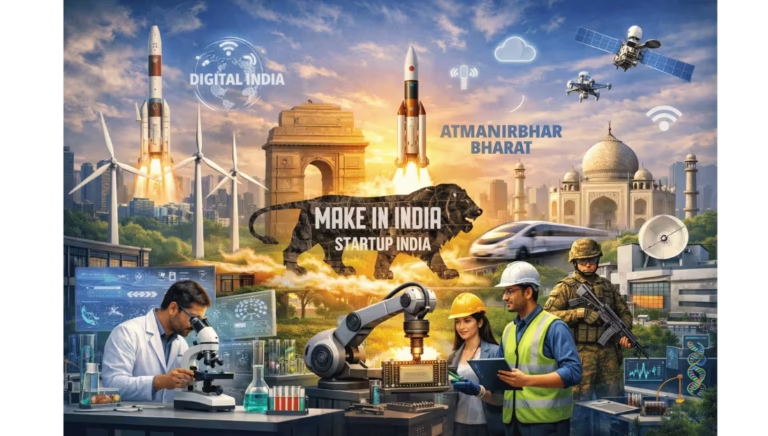
- Digital India: A flagship program to transform India into a digitally empowered society and knowledge economy4.
- Atmanirbhar Bharat: Focused on indigenous manufacturing in sectors like defense, biotechnology, and semiconductors.
- Draft STIP 2020: Aims for a “pro-active” approach to Open Science and the decentralization of institutional research.
Summary: Major Scientific Milestones
Decade | Focus Area | Key Achievement |
1950s | Infrastructure | Establishment of IITs, CSIR, and AEC. |
1960s | Agriculture | Green Revolution; ISRO founded. |
1970s | Strategic/Space | Smiling Buddha (1974) nuclear test; Aryabhata. |
1980s | Indigenous Tech | Prithvi missiles; Telecom Revolution. |
1990s | IT/Nuclear | IT Sector boom; Pokhran-II5. |
2010s-Present | Space/Digital | Mangalyaan; UPI; Gaganyaan (planned). |
UPSC Prelims: PYQs & Practice Questions
Previous Year Questions (PYQs)
Question 1 (UPSC Prelims 2015 – IOR-ARC)
Q: With reference to the Indian Ocean Rim Association for Regional Cooperation (IOR-ARC), consider the following statements: (UPSC Prelims 2015 – Science & Tech Context)
1. It was established very recently in response to incidents of piracy and accidents of oil spills.
2. It is an alliance meant for maritime security only.
Which of the statements given above is/are correct?
Options:
(a) 1 only
(b) 2 only
(c) Both 1 and 2
(d) Neither 1 nor 2
Answer: (d)
Explanation: IOR-ARC (now IORA) was not established “very recently” and was not formed only as a reaction to piracy or oil spills. It is also not limited to maritime security; it focuses on broader regional cooperation including trade, economic ties, and sustainable development. Hence, both statements are incorrect, making option (d) the correct answer.
Question 2 (Scientific Policy Resolution – Historical Context)
Q: The Scientific Policy Resolution which laid the foundation of scientific temper in India was passed in the year: (UPSC Prelims – Historical Context)
Options:
(a) 1948
(b) 1958
(c) 1968
(d) 1983
Answer: (b)
Explanation: The Scientific Policy Resolution (SPR), 1958 was India’s first formal policy step to promote science and technology for national development. It emphasized building a scientific temper, strengthening research institutions, and using scientific progress to improve economic growth and social welfare. Therefore, the correct answer is 1958.
Prelims Practice Questions
Question 1
Q: Which of the following was the primary objective of the Technology Policy Statement, 1983?
Options:
(a) To establish the first IIT in India.
(b) To achieve technological self-reliance and reduce vulnerability in strategic areas.
(c) To launch the Digital India mission.
(d) To privatize the space sector.
Answer: (b) To achieve technological self-reliance and reduce vulnerability in strategic areas
Explanation: The Technology Policy Statement (1983) emphasized indigenous capability building and the absorption/adaptation of technology so India would not remain dependent on external sources in critical sectors. The larger objective was to strengthen self-reliance, especially in strategic and core industrial areas, and reduce vulnerability to foreign supply disruptions.
Question 2
Q: Project Aryabhata, India’s first satellite, was launched in 1975 using a launch vehicle from which country?
Options:
(a) United States (USA)
(b) Soviet Union (USSR)
(c) France
(d) United Kingdom (UK)
Answer: (b) Soviet Union (USSR)
Explanation: Aryabhata (1975) was launched with assistance from the Soviet Union, reflecting India’s early space phase when the country depended on international cooperation for launch services. Later, India strengthened its independent capability through indigenous launch vehicles, moving towards greater strategic autonomy in space technology.
UPSC Mains – Previous Year & Practice Questions
Mains Previous Year Questions (Science & Technology: Scientific Temper, Space, Nuclear Policy, STIP)
Scientific Temper & Modernization
Question: "Jawaharlal Nehru’s vision of a 'scientific temper' was a prerequisite for India’s modernization." Discuss. (UPSC - Post-Independence context)
ISRO & Socio-Economic Development
Question: Evaluate the contribution of the Indian Space Research Organisation (ISRO) in the socio-economic development of India since its inception. (UPSC 2015/2020)
Space S&T Achievements & Applications
Question: Discuss India's achievements in the field of Space Science and Technology. How has the application of this technology helped India in its socio-economic development? (UPSC 2016)
Evolution of Nuclear Policy (1974–1998)
Question: Examine the evolution of India's nuclear policy from 'peaceful purposes' (1974) to 'credible minimum deterrence' (1998). (UPSC - Internal Security/History)
Science, Technology & Innovation Policy (STIP) 2013
Question: What are the key features of the Science, Technology, and Innovation Policy (STIP) 2013? (UPSC 2014 context)
India’s Strategic S&T Trajectory
Question: Trace how India’s scientific temper, space capability and nuclear doctrine together shaped national development and strategic autonomy. Substantiate with examples. (Model analytical add-on)
Mains Practice Questions
From Brain Drain to Brain Gain: S&T Policy & Diaspora
Question: “From 'Brain Drain' to 'Brain Gain', India’s S&T policy has come a long way.” Analyze the impact of recent policies on the Indian diaspora and innovation. (250 Words)
1958 Scientific Policy vs Draft STIP 2020
Question: Compare the Scientific Policy Resolution (1958) with the Draft STIP 2020 in terms of their approach toward private sector participation. (250 Words)
CSIR & Industrial Self-Reliance
Question: Analyze the role of the Council of Scientific and Industrial Research (CSIR) in achieving industrial self-reliance in post-independence India. (250 Words)
Frequently Asked Questions (FAQs)
What is 'Scientific Temper'?
Coined by Jawaharlal Nehru, it refers to an individual’s way of life which uses the scientific method and, consequently, embodies the spirit of inquiry and a rational approach to social and personal problems.
Why was the 1958 Scientific Policy Resolution significant?
It was the first time a developing nation officially recognized science as the main driver of economic consolidation. It led to the establishment of the IITs and several national laboratories under CSIR.
How did India's 'Green Revolution' involve science policy?
It was a triumph of agricultural science. The policy facilitated the import and local adaptation of HYV seeds, the establishment of Agricultural Universities, and the deployment of extension services to take lab-research to the farms.
What is the 'Technology Policy Statement' (1983)?
This policy emphasized indigenous technology development. It aimed to ensure that foreign technology was only used as a catalyst, while the ultimate goal remained self-reliance (Atmanirbharta) in strategic and industrial sectors.
What is the significance of the 1974 'Smiling Buddha' test?
It was India’s first peaceful nuclear explosion. It signaled to the world that India had the scientific capability for nuclear technology, though it maintained a policy of using it for energy and non-military purposes at that time.