
Table of Contents
ToggleThe Reorganization of States in Post-Independent India: A Comprehensive Analysis
1. Introduction: The Cartographic Challenge of 1947
At the dawn of independence, India was a patchwork of territories. The British left behind two distinct types of administrative units:
- British Provinces: Directly ruled by the British government.
- Princely States: Approximately 565 states ruled by native princes under British paramountcy.
The immediate priority for the new nation was the integration of these diverse units. However, once political integration was achieved—largely through the efforts of Sardar Vallabhbhai Patel—the next major challenge was the internal reorganisation of these units into viable administrative states.
2. The Legacy of the British Administrative Setup
The British had carved out provinces for their own administrative convenience and military strategy, often ignoring linguistic, cultural, or historical commonalities. By 1947, the “Part A, B, C, and D” classification was an interim arrangement under the new Constitution:
- Part A States: Former British provinces (e.g., Bombay, Madras).
- Part B States: Former princely states or groups of states (e.g., Hyderabad, Mysore, Rajasthan).
- Part C States: Former Chief Commissioner’s provinces and some princely states (e.g., Ajmer, Coorg, Delhi).
- Part D States: The Andaman and Nicobar Islands.
This classification was inherently temporary and lacked a long-term vision for a democratic, federal India.
3. The Demand for Linguistic States: Evolution and Sentiment
The demand for reorganising states on a linguistic basis was not new. It had its roots in the freedom struggle:
- Nagpur Session of INC (1920): The Indian National Congress officially recognized the linguistic principle as the basis for its own internal organization.
- The Nehru Report (1928): Advocated for the redistribution of provinces on a linguistic basis to foster democratic participation.
Post-1947, however, the leadership (Nehru, Patel, and Prasad) grew wary. They feared that linguistic states might encourage “sub-nationalism” and threaten the hard-won unity of India.
4. Commissions and Committees: The Path to Reorganisation
A. The Dhar Commission (1948)
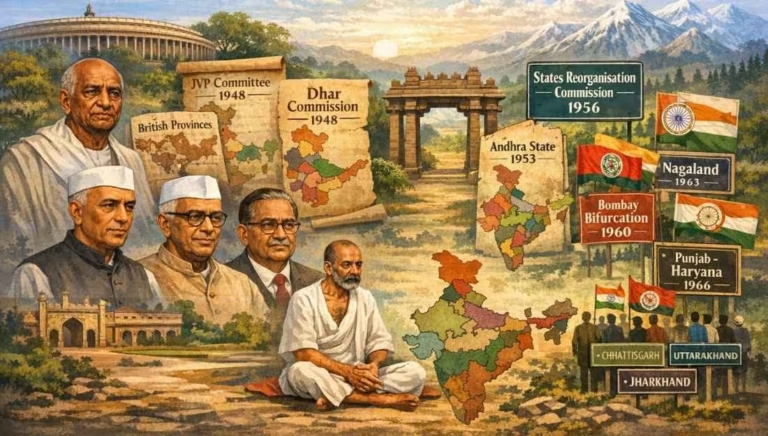
To address the growing demands, particularly for a separate Andhra state, the government appointed the Linguistic Provinces Commission headed by S.K. Dhar.
- Recommendations: It strongly advised against reorganisation based solely on language. Instead, it proposed administrative convenience, geographical contiguity, and financial self-sufficiency as the primary criteria.
- Impact: The report caused widespread resentment, especially in South India.
B. The JVP Committee (1948)
Following the Dhar Commission’s report, the Congress appointed another committee consisting of Jawaharlal Nehru, Vallabhbhai Patel, and Pattabhi Sitaramayya.
- Outcome: The JVP Committee also rejected language as the basis for reorganisation for the time being, emphasizing that the “primary consideration must be the security, unity, and economic prosperity of India.”
- Shift in Stance: However, they conceded that if public sentiment was “insistent and overwhelming,” the government might have to submit to it.
C. The Turning Point: Potti Sriramulu’s Sacrifice (1952)
The demand for a separate Andhra state for Telugu speakers intensified. In 1952, Potti Sriramulu, a Gandhian leader, went on an indefinite fast.
- Outcome: After 56 days of fasting, Sriramulu died. His death led to widespread riots and forced the government’s hand.
- First Linguistic State: On October 1, 1953, Andhra State was created by carving out Telugu-speaking areas from the Madras Presidency.
5. The States Reorganisation Commission (SRC) and the 1956 Act
The creation of Andhra sparked similar demands across the country. In December 1953, Nehru appointed the States Reorganisation Commission (SRC), consisting of:
- Fazl Ali (Chairman)
- H.N. Kunzru
- K.M. Panikkar
Key Recommendations of the SRC (1955):
- Accepted language as a major factor but rejected the “one language, one state” theory.
- Emphasized the preservation of India’s unity and security.
- Recommended the abolition of the four-fold classification of states (Part A, B, C, D).
- Proposed the creation of 16 states and 3 union territories.
The States Reorganisation Act, 1956:
The government largely accepted these recommendations with some modifications. Through the 7th Constitutional Amendment Act (1956):
- The distinction between Part A and Part B states was abolished.
- 14 States and 6 Union Territories were created.
6. Subsequent Reorganisations: A Case-by-Case Analysis
A. The Bifurcation of Bombay (1960)
The bilingual Bombay state saw a massive movement (Samyukta Maharashtra and Mahagujarat movements).
- Result: Bombay was divided into Maharashtra (for Marathi speakers) and Gujarat (for Gujarati speakers).
B. The Northeast Reorganisation
The Northeast presented unique challenges due to its ethnic diversity and strategic location.
- Nagaland (1963): Created to satisfy the Naga tribal demands.
- North-Eastern Areas (Reorganisation) Act, 1971: This landmark act transformed the map of the region, creating Manipur, Tripura, and Meghalaya, and elevating Mizoram and Arunachal Pradesh to Union Territories (later states in 1987).
C. The Punjab Suba Movement (1966)
Demands for a Punjabi-speaking state (Punjabi Suba) led by the Akali Dal resulted in the division of the state of Punjab.
- Result: Punjab (Sikh/Punjabi majority), Haryana (Hindi majority), and the Union Territory of Chandigarh. The hill areas were merged with the then Union Territory of Himachal Pradesh (which became a state in 1971).
D. Creation of Smaller States (2000)
In 2000, three new states were created, primarily on the basis of developmental neglect and distinct regional identity rather than language:
- Chhattisgarh (from Madhya Pradesh)
- Uttarakhand (from Uttar Pradesh)
- Jharkhand (from Bihar)
E. The Formation of Telangana (2014)
After a prolonged movement based on regional disparity and cultural identity within the Telugu-speaking population:
- Result: Telangana was carved out of Andhra Pradesh, with Hyderabad as the joint capital for ten years.
F. Reorganisation of Jammu & Kashmir (2019)
In a historic move, the special status of Jammu and Kashmir under Article 370 was revoked.
- Result: The state was bifurcated into two Union Territories: Jammu & Kashmir (with a legislature) and Ladakh (without a legislature).
7. Critical Evaluation: Impact on National Unity
The reorganisation of states on linguistic and regional lines has been a “safety valve” for Indian democracy:
- Strengthened Democracy: It brought the administration closer to the people by using local languages in governance.
- Cultural Preservation: It allowed for the flourishing of regional cultures and identities within the Indian Union.
- Federal Balance: It helped manage regional aspirations that could have otherwise turned into secessionist movements.
However, challenges remain, including inter-state border disputes (e.g., Belagavi dispute between Maharashtra and Karnataka) and water-sharing conflicts (e.g., Cauvery river dispute).
8. Conclusion for UPSC Aspirants
For the UPSC Civil Services Examination, the reorganisation of states is a recurring theme in both GS Paper I (Post-Independence History) and GS Paper II (Polity and Governance). Key takeaways include:
- Understand the Constitutional Articles (Art 1 to 4) regarding the formation of new states.
- Memorize the sequence of state formation and the specific commissions involved.
- Analyze the shift from “linguistic” criteria to “developmental and administrative” criteria in the 21st century.
The story of India’s reorganisation is a testament to the flexibility of the Indian Constitution and the resilience of its democratic fabric.
UPSC Prelims: PYQs & Practice Questions
Previous Year Questions (PYQs)
Question 1 (2007)
Q: Which one of the following is the correct chronological order of the formation of the following states as full states of the Indian Union?
(a) Sikkim — Arunachal Pradesh — Nagaland — Haryana
(b) Nagaland — Haryana — Sikkim — Arunachal Pradesh
(c) Sikkim — Haryana — Nagaland — Arunachal Pradesh
(d) Nagaland — Arunachal Pradesh — Sikkim — Haryana
Answer: (b)
Explanation: Nagaland was formed in 1963. Haryana was carved out of Punjab in 1966. Sikkim became a full state in 1975 (36th Amendment). Arunachal Pradesh attained statehood in 1987.
Question 2 (1996)
Q: The states of the Indian Union were reorganised in 1956 on the basis of:
Options:
(a) Administrative convenience | (b) Religious affiliation | (c) Linguistic and cultural uniformity | (d) Geographical contiguity
Answer: (c)
Explanation: The States Reorganisation Act, 1956 primarily used language as the basis for redrawing state boundaries to ensure linguistic and cultural uniformity.
Practice Questions for Prelims
Question 1
Q: With reference to the JVP Committee (1948), consider the following statements:
1. It was appointed to examine the feasibility of linguistic states.
2. It formally rejected language as the basis for the reorganisation of states.
3. Its members included Jawaharlal Nehru, Vallabhbhai Patel, and Pattabhi Sitaramayya.
Which of the statements given above is/are correct?
Options:
(a) 1 and 2 only | (b) 2 and 3 only | (c) 1 and 3 only | (d) 1, 2, and 3
Answer: (d)
Explanation: The JVP Committee (1948) was constituted after the Dhar Commission to examine the demand for linguistic reorganisation of states. It included Jawaharlal Nehru, Vallabhbhai Patel, and Pattabhi Sitaramayya. The committee rejected language as the immediate basis for reorganisation, citing the need to prioritise national unity and administrative convenience. Hence, all statements are correct.
Question 2
Q: The "Samyukta Maharashtra Samiti" was associated with the demand for which state?
Options:
(a) A separate Telugu state | (b) A separate Marathi-speaking state | (c) The merger of Goa with Maharashtra | (d) The division of Uttar Pradesh
Answer: (b)
Explanation: The Samyukta Maharashtra Samiti led the movement demanding a separate Marathi-speaking state. This agitation contributed to the bifurcation of the bilingual Bombay State into Maharashtra and Gujarat in 1960.
UPSC Mains: Previous Year Questions (PYQs)
Linguistic Reorganisation: Democracy & National Unity
Question: "Linguistic reorganisation of states has not only helped in deepening Indian democracy but also in strengthening the national unity." Comment. (UPSC 2023)
First Linguistic State: Causes & Later Reorganisation
Question: Discuss the factors that led to the creation of the first linguistic state in India. How did it impact the subsequent reorganisation of states? (UPSC 2018)
Integration of Princely States: Role of Sardar Patel
Question: The process of integration of princely states was a complex task. Discuss the role of Sardar Patel in this regard. (UPSC 2017)
Fazl Ali Commission: Recommendations & Federal Impact
Question: Critically examine the recommendations of the Fazl Ali Commission and its impact on the federal structure of India. (UPSC 2015)
Smaller States: Governance, Administration & Development
Question: Has the formation of smaller states in India helped in better administration and economic development? Give reasons for your answer. (UPSC 2016)
Mains Practice Questions
North-East Since 1947: State Evolution & Ethnic Identity
Question: Analyze the evolution of the North-Eastern states from 1947 to the present. How has ethnic identity shaped the political map of this region? (250 Words)
State Reorganisation: 1956 vs 2000
Question: Compare the grounds for state reorganisation in 1956 with those in 2000 (formation of Jharkhand, Chhattisgarh, and Uttarakhand). (250 Words)
Articles 1–4: Altering State Boundaries & Federalism
Question: Examine the constitutional provisions (Articles 1–4) that empower the Parliament to alter state boundaries. Does this affect the federal nature of the Indian Union? (250 Words)
Frequently Asked Questions (FAQs)
Which was the first state created on a linguistic basis in independent India?
- Andhra State was the first, created in October 1953 following the death of Potti Sriramulu after a 56-day fast.
What was the primary reason for the Dhar Commission (1948) rejecting linguistic states?
- The commission feared that linguistic states would threaten national integration and preferred administrative convenience as the primary criterion.
What did the 7th Constitutional Amendment Act (1956) achieve?
- It implemented the States Reorganisation Act, abolishing the classification of states into Parts A, B, C, and D and establishing 14 states and 6 Union Territories.
Why was Punjab bifurcated in 1966?
- Due to the Punjabi Suba movement, the state was divided into Punjab (Punjabi speakers), Haryana (Hindi speakers), and the Union Territory of Chandigarh.
What is the significance of the North-Eastern Areas (Reorganisation) Act, 1971?
- This act majorly reorganised the Northeast, granting statehood to Manipur, Tripura, and Meghalaya, and creating the Union Territories of Mizoram and Arunachal Pradesh.