Table of Contents
ToggleDrug Trafficking in India: Understanding Narco-Terrorism and Internal Security Implications
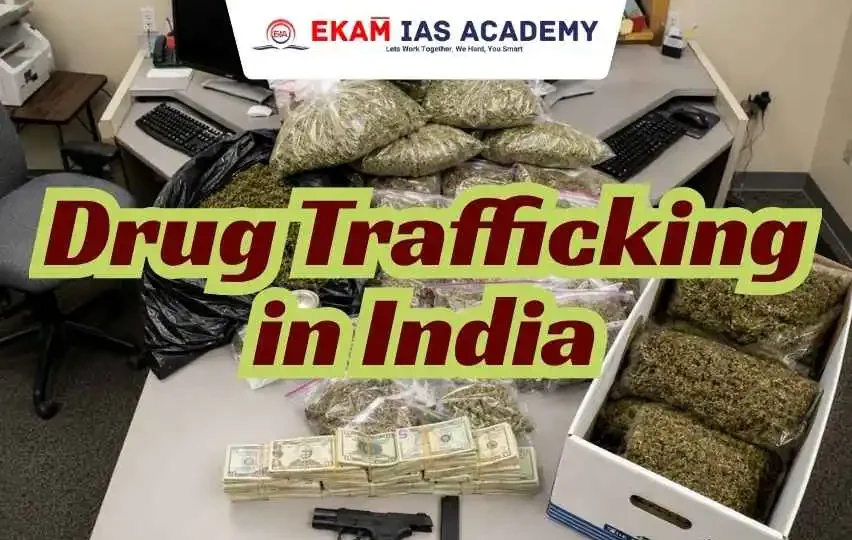
The architectural paradigm of India’s national security faces a multi-dimensional challenge. Drug Trafficking in India has transitioned from a localized public health issue into a highly sophisticated, transnational security threat. For aspirants masterfully analyzing Internal Security modules, evaluating the illicit flow of Narcotics in India is vital. Modern syndicates are systematically linking trade pipelines with insurgent groups, turning Drug Smuggling into a core economic driver for anti-national forces.
Drug Trafficking Scenario in India
Geopolitically, the Indian subcontinent suffers from a precarious geographical location. India is sandwiched between the world’s two largest illicit opium-producing hubs: the Golden Crescent (comprising Iran, Afghanistan, and Pakistan) to the west, and the Golden Triangle (comprising Myanmar, Laos, and Thailand) to the east. This proximity has turned the country into both a major transit zone and a target destination, leading to an exponential surge in Organized Crime and domestic Drug Abuse.
Major Sources, Routes, and Types of Drugs
- The Western Sector: Flowing through the Golden Crescent, high-grade heroin and hashish are smuggled across the porous borders of Punjab, Jammu & Kashmir, and Gujarat via drones and maritime routes.
- The Eastern Sector: Sourced from the Golden Triangle, synthetic drugs like methamphetamine, Yaba tablets, and opium enter through the riverine terrains of Mizoram, Manipur, and Nagaland.
- The Maritime Vector: Deep-sea routes across the Indian Ocean and the Arabian Sea have emerged as primary pathways for bulk multi-ton contraband shipments.
- Pharmaceutical Diversion: Illicit conversion of domestic chemical precursors like ephedrine and tramadol into synthetic contraband.
Causes and Structural Drivers
According to comprehensive security analyses, several underlying drivers fuel the expansion of trafficking networks. Difficult riverine and mountainous border terrains make physical monitoring highly complex. Furthermore, the anonymity of encrypted dark-web marketplaces and untraceable cryptocurrency payments allows syndicates to operate completely hidden from conventional financial surveillance, accelerating systemic corruption and network resilience.
Drug Trafficking and National Security (Narco-Terrorism)
The convergence of narcotics cartels and insurgent groups has given rise to the lethal threat of Narco-Terrorism. The vast financial liquid capital generated through illicit sales directly funds proxy wars along the Line of Control (LoC) and feeds Left-Wing Extremism (LWE). This highly dangerous nexus bypasses legitimate banking channels to buy advanced weaponry, finance localized stone-pelting, and sustain active sleeper cells, severely undermining the National Security grid.
Impact of Drug Trafficking
The multi-dimensional impact of these operations damages India’s growth trajectory. Beyond the tragic erosion of human capital due to widespread addiction, trafficking creates a vast parallel economy. It actively funds extortion rackets, promotes money laundering, increases public healthcare burdens, and forces the state to divert significant capital toward law enforcement rather than socio-economic development.
Government Initiatives & Legal Framework
To strengthen deterrence, the state has fortified its administrative and legal defenses:
- The NDPS Act (1985): The Narcotic Drugs and Psychotropic Substances Act serves as India’s primary legal framework, providing strict penalties, asset forfeiture clauses, and preventive detention mandates.
- Narcotics Control Bureau (NCB): The premier national coordinating and enforcement agency tasked with dismantling transnational cartels.
- NCORD Mechanism: A four-tier coordination matrix designed to align local state police grids with central intelligence agencies.
- SIMS & NIDAAN: Integrated digital portals for mapping seizure data and archiving profiles of inter-state drug offenders.
International Cooperation & Challenges
Because trafficking is inherently borderless, India collaborates closely with global bodies like the United Nations Office on Drugs and Crime (UNODC) and Interpol. India also enforces bilateral security pacts with neighboring countries to optimize joint cross-border enforcement. However, tracking decentralized darknet operations, checking low-cost cross-border drone deliveries, and stopping chemical precursor diversion remain significant operational challenges.
Way Forward
To achieve total deterrence, India must adopt a proactive, technology-led doctrine:
- Smart Border Infrastructure: Deploying anti-drone laser systems, deep-sea coastal radars, and thermal imaging along smuggling vectors.
- Financial Intelligence: Empowering the Financial Intelligence Unit (FIU-IND) to monitor darknet crypto-wallets and suspicious cash transaction reports.
- Demand Reduction: Strengthening localized rehabilitation grids alongside enforcement to dry up cartels’ revenue bases.
Conclusion
Neutralizing the menace of Drug Trafficking in India requires an adaptive strategy combining strict enforcement of the NDPS Act with advanced technical surveillance. By choking financial channels and deepening international intelligence cooperation, India can successfully secure its internal stability against the fluid architectures of transnational cartels. Keep checking our updating repository for comprehensive micro-analyses and visual study guides.
UPSC Prelims: PYQs & Practice Questions
Previous Year Questions (Prelims)
Q: With reference to India's legal framework to combat illicit drug networks, consider the following statements regarding the Narcotic Drugs and Psychotropic Substances (NDPS) Act: (UPSC CSE 2021)
1. The Act provides for the constitution of a specialized fund called the National Fund for Control of Drug Abuse (NFCDA).
2. Under the provisions of this Act, property derived from, or used in, the illicit traffic of narcotics can be frozen and forfeited by the designated authorities.
Which of the statements given above is/are correct?
(a) 1 only
(b) 2 only
(c) Both 1 and 2
(d) Neither 1 nor 2
Answer: (c) Both 1 and 2
Explanation:
Both statements are correct. Section 7A of the NDPS Act, 1985 mandates the creation of the National Fund for Control of Drug Abuse (NFCDA) to meet expenditures incurred in combating illicit traffic and controlling drug abuse. Further, Chapter VA of the Act provides strict legal measures for tracing, freezing, seizure, and forfeiture of illegally acquired property derived from narcotics trafficking.
Q: In the context of international security and transnational drug corridors, the term "Golden Triangle", a major source of illicit narcotic flows into India's Northeastern states, primarily represents the border confluence of which of the following countries? (UPSC CSE 2018)
(a) Pakistan, Iran, and Afghanistan
(b) Thailand, Laos, and Myanmar
(c) Colombia, Peru, and Bolivia
(d) Vietnam, Cambodia, and Malaysia
Answer: (b) Thailand, Laos, and Myanmar
Explanation:
The Golden Triangle is one of Asia's major illegal opium-producing areas, located at the mountainous confluence of Thailand, Laos, and Myanmar. It acts as a major source region for heroin and synthetic drug smuggling into India through porous borders in the Northeast, especially through routes linked to Mizoram, Manipur, and Nagaland.
Practice Questions
Q: To streamline operational coordination against Drug Trafficking in India, the Ministry of Home Affairs utilizes a specialized institutional architecture. Consider the following statements regarding the Narco-Coordination Centre (NCORD) mechanism:
1. NCORD functions as a four-tier coordination matrix ranging from the central apex level down to the district level.
2. The NCORD portal acts as an all-in-one digital system for sharing intelligence and profiling inter-state drug offenders among all Drug Law Enforcement Agencies (DLEAs).
Which of the statements given above is/are correct?
(a) 1 only
(b) 2 only
(c) Both 1 and 2
(d) Neither 1 nor 2
Answer: (c) Both 1 and 2
Explanation:
Both statements are correct. The NCORD mechanism was restructured into a four-tier system covering the apex, state, executive, and district levels to improve coordination between central and state agencies. The dedicated NCORD digital portal enables real-time intelligence mapping, trend capturing, and integrated data sharing among multiple DLEAs to counter sophisticated drug cartels.
Q: Which of the following law enforcement and security forces in India are formally empowered to carry out searches, seizures, and arrests under the provisions of the NDPS Act, 1985 to curb cross-border and inland trafficking?
1. Border Security Force (BSF)
2. Indian Coast Guard (ICG)
3. Railway Protection Force (RPF)
Select the correct answer using the code given below:
(a) 1 and 2 only
(b) 2 and 3 only
(c) 1 and 3 only
(d) 1, 2 and 3
Answer: (d) 1, 2 and 3
Explanation:
To build a comprehensive whole-of-government approach against narcotics, enforcement powers have been expanded across multiple agencies. Border guarding forces such as the BSF are empowered at international land boundaries, the Indian Coast Guard handles maritime interdiction, and the Railway Protection Force helps inspect and intercept trafficking networks across railway routes.
UPSC Mains – Previous Year & Practice Questions
Mains Previous Year Questions
UPSC CSE 2024
Question: The nexus between international drug cartels, untraceable digital networks, and insurgent groups poses a grave challenge to India’s internal security. Discuss the geopolitical vulnerabilities of India being sandwiched between the Golden Crescent and the Golden Triangle.
GS-3 | 15 Marks | 250 Words
UPSC CSE 2023
Question: In what ways does Narco-Terrorism act as a primary funding mechanism for proxy warfare along India’s western and northwestern borders? Evaluate the efficacy of current anti-drone and maritime surveillance architectures in countering this menace.
GS-3 | 15 Marks | 250 Words
UPSC CSE 2022
Question: Cross-border smuggling of illicit drugs and weapons using unmanned aerial vehicles (UAVs) has emerged as a disruptive security threat. Analyze the multi-dimensional challenges this poses to border management forces.
GS-3 | 10 Marks | 150 Words
UPSC CSE 2018
Question: Proximity to the Golden Crescent and Golden Triangle has made India highly vulnerable to drug trafficking. Enumerate the socio-economic and security challenges generated by illicit drug trade and highlight institutional measures taken to curb it.
GS-3 | 15 Marks | 250 Words
UPSC CSE 2015
Question: The illicit drug economy easily transforms into a parallel financial system that feeds organized crime and Left-Wing Extremism (LWE). Elaborate on the financial investigation tools required to dismantle the structural funding loops of drug cartels.
GS-3 | 15 Marks | 250 Words
Mains Practice Questions
[15 Marks | 250 Words]
Question: With the Taliban’s shifting policies in the West and the civil unrest in Myanmar to the East, India's traditional narcotic transit pathways are undergoing a rapid geopolitical transformation. Critically analyze the changing geography of drug trafficking corridors along India's eastern and western sectors.
[15 Marks | 250 Words]
Question: The rise of encrypted darknet marketplaces and anonymous cryptocurrency transactions has effectively decoupled drug smuggling from physical distribution networks. Examine the gaps in India's technology-led policing framework and suggest structural reforms for the Narcotics Control Bureau (NCB).
[10 Marks | 150 Words]
Question: Dismantling the threat of Narco-Terrorism requires a strategy that simultaneously targets demand reduction domestically and supply chokepoints internationally. Evaluate how initiatives like the Nasha Mukt Bharat Abhiyan complement the hard-line enforcement of the NDPS Act.



Drug Trafficking in India-FAQs
What is drug trafficking in India?
Drug trafficking in India refers to the illegal production, smuggling, transport and sale of narcotic drugs and psychotropic substances across domestic and international networks.
Why is India vulnerable to drug trafficking?
India is vulnerable because it lies between the Golden Crescent and Golden Triangle, two major global drug-producing regions, and has porous land and maritime borders.
What is narco-terrorism?
Narco-terrorism refers to the use of money earned from illegal drug trade to fund terrorism, insurgency, weapons purchase, sleeper cells and anti-national activities.
Which laws and agencies deal with drug trafficking in India?
The NDPS Act, 1985, Narcotics Control Bureau, NCORD mechanism, FIU-IND, state police and international agencies like UNODC and Interpol help counter drug trafficking.
Why is drug trafficking important for UPSC?
It is important for UPSC because it connects with GS Paper III internal security, organized crime, border management, narco-terrorism, money laundering, drug abuse and national security.