Table of Contents
ToggleWhat is an Earthquake?
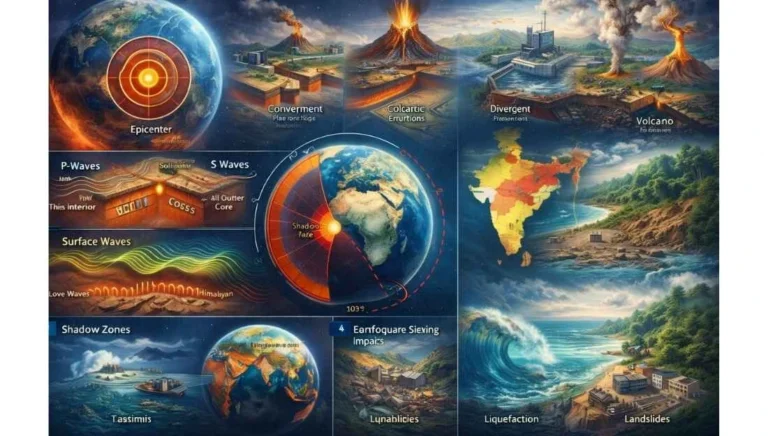
An earthquake is the shaking of the Earth’s surface resulting from a sudden release of energy in the Lithosphere that creates seismic waves.
- Focus (Hypocenter): The point within the Earth where the energy is released.
- Epicenter: The point on the Earth’s surface directly above the focus. It is usually the place where the most intense damage occurs.
Why Do Earthquakes Occur? (Causes)
The causes are categorized into Natural and Anthropogenic (human-induced).
Natural Causes
- Plate Tectonics: Most earthquakes occur at plate boundaries.
- Convergent Boundaries: Plates collide, leading to massive stress (e.g., Himalayan Earthquakes).
- Divergent Boundaries: Plates move apart (e.g., Mid-Atlantic Ridge).
- Transform Boundaries: Plates slide past each other (e.g., San Andreas Fault).
- Volcanic Eruptions: The movement of magma can trigger localized tremors.
- Faulting: The sudden displacement of rock along a fault plane.
Anthropogenic Causes
- Reservoir Induced Seismicity (RIS): Pressure from massive water bodies behind dams (e.g., Koyna Earthquake, Maharashtra).
- Mining Activity: Deep underground mining can cause roof collapses or pressure changes.
- Nuclear Explosions: Testing of nuclear weapons releases immense artificial energy.
Seismic Waves: The Messengers of the Interior
Seismic waves are the primary tool for scientists to study the Interior of the Earth.
Body Waves
These travel through the interior of the Earth and are divided into:
- P-Waves (Primary Waves): Longitudinal waves similar to sound waves. They travel through solids, liquids, and gases. They are the fastest waves.
- S-Waves (Secondary Waves): Transverse waves that can only travel through solids. Their inability to pass through the Outer Core proves its liquid state.
Surface Waves
These travel along the Earth’s surface and are responsible for the actual destruction of property.
- Love Waves and Rayleigh Waves: These move slower but have a high amplitude, causing structures to collapse.
Measurement of Earthquakes
- Richter Scale (Magnitude): A logarithmic scale that measures the energy released. It ranges from 0–10. An increase of 1 on the scale represents a 10-fold increase in amplitude and roughly 32 times more energy.
- Mercalli Scale (Intensity): A qualitative scale (I–XII) that measures the visible damage caused by the earthquake.
Earthquake Shadow Zones
A shadow zone is an area on Earth’s surface where seismographs do not detect seismic waves.
- P-wave Shadow Zone: Exists between 103° and 142° from the epicenter due to refraction at the mantle-core boundary.
- S-wave Shadow Zone: Extends beyond 103° entirely, because S-waves cannot pass through the liquid outer core.
Global Distribution of Earthquakes
Earthquakes are not random; they follow specific seismic belts:
-
Circum-Pacific Belt (Ring of Fire): Accounts for about 68% of the world’s earthquakes.
-
Mid-World Mountain Belt (Alpine-Himalayan Belt): Includes the Himalayas, Alps, and Mediterranean mountains.
-
Mid-Atlantic Ridge: Associated with divergent plate boundaries.
Earthquake Zoning in India
India is highly vulnerable due to the northward movement of the Indian Plate. The Bureau of Indian Standards (BIS) has divided India into four seismic zones:
- Zone V (Very High Risk): Includes the Himalayas, North-East India, and Rann of Kutch.
- Zone IV (High Risk): Includes Delhi, parts of the Indo-Gangetic plain, and Jammu & Kashmir.
- Zone III (Moderate Risk): Parts of the Peninsular Block.
- Zone II (Low Risk): The rest of the country.
Impacts of Earthquakes
- Tsunamis: Submarine earthquakes displace massive volumes of water.
- Liquefaction: Saturated soil loses strength and behaves like a liquid, causing buildings to sink.
- Landslides: Particularly in hilly regions like the Himalayas and Western Ghats.
- Flash Floods: Caused by the bursting of dams or blocking of river courses.
UPSC Prelims: PYQs & Practice Questions
Previous Year Questions (Prelims)
Question 1 (2011)
Q: Consider the following statements:
1. All earthquakes are caused by plate tectonics.
2. The Richter scale is used to measure the intensity of an earthquake.
3. The epicenter is the point on the surface directly above the focus.
Which of the statements given above is/are correct?
(a) 1 and 2 only
(b) 3 only
(c) 1 and 3 only
(d) 1, 2, and 3
Answer: (b)
Explanation: Statement 1 is incorrect because earthquakes can also be anthropogenic (Reservoir Induced Seismicity) or volcanic in origin. Statement 2 is incorrect because the Richter scale measures magnitude (energy released), while the Mercalli scale measures intensity (damage caused). Statement 3 correctly defines the epicenter as the point on the Earth's surface directly above the focus (hypocenter).
Question 2 (General UPSC Pattern)
Q: Which of the following is/are correct regarding the S-waves?
1. They can travel through both solid and liquid materials.
2. They are slower than P-waves.
3. They are transverse waves.
Select the correct code:
(a) 1 only
(b) 2 and 3 only
(c) 1 and 3 only
(d) 1, 2 and 3
Answer: (b)
Explanation: Statement 1 is incorrect because S-waves cannot travel through liquids; they disappear at the liquid outer core. Statement 2 is correct as S-waves are slower than P-waves. Statement 3 is correct because S-waves are transverse waves, with particle motion perpendicular to the direction of wave propagation.
Practice Questions (Prelims)
Question 1
Q: Arrange the following Seismic Zones of India from highest risk to lowest risk:
1. Zone V
2. Zone II
3. Zone IV
4. Zone III
Select the correct sequence:
(a) 1-3-4-2
(b) 1-4-3-2
(c) 3-1-4-2
(d) 1-3-2-4
Answer: (a)
Explanation: Zone V represents the most seismically active regions (Himalayas and North-East India), followed by Zone IV (high risk), Zone III (moderate risk), and Zone II (low risk). There is no Zone I in the current seismic zoning classification of India.
Question 2
Q: Why does the 'Shadow Zone' of S-waves cover a larger area than that of P-waves?
(a) S-waves are faster and travel further.
(b) S-waves are refracted by the inner core.
(c) S-waves cannot pass through the liquid outer core.
(d) S-waves only travel along the surface.
Answer: (c)
Explanation: S-waves cannot travel through liquids. Since the Earth's outer core is liquid, S-waves do not pass through it, creating a complete shadow zone beyond 103° from the epicenter.
UPSC Mains – Previous Year & Practice Questions
Mains Standard Questions
Reservoir Induced Seismicity
Question: Explain the mechanism of 'Reservoir Induced Seismicity' with special reference to the Koyna earthquake in India. (150 words)
Himalayan Earthquake Vulnerability
Question: "The Himalayan region is highly prone to frequent and destructive earthquakes." Analyze the tectonic factors behind this vulnerability. (250 words)
Richter Scale vs Mercalli Scale
Question: Compare and contrast the Richter scale and the Mercalli scale in terms of their measurement criteria and utility. (150 words)
Submarine Earthquakes & Tsunamis
Question: Discuss the impact of submarine earthquakes on the generation of Tsunamis. How has India improved its Tsunami warning systems? (250 words)
Elastic Rebound Theory
Question: Describe the 'Elastic Rebound Theory' and how it explains the sudden release of energy during an earthquake. (150 words)
Mains Practice Questions
Seismic Gap Theory & Himalayas
Question: Analyze the role of 'Seismic Gap' theory in predicting future earthquakes along the Himalayan belt. (250 words)
Earthquake-Resistant Architecture & Preparedness
Question: "Earthquake-resistant architecture and community preparedness are more effective than earthquake prediction." Critically evaluate. (250 words)
Soil Liquefaction & Urban Infrastructure
Question: Examine the process of 'Soil Liquefaction' and its consequences on urban infrastructure during high-magnitude tremors. (150 words)
Earthquakes: A Comprehensive UPSC Guide to Seismic Activity - FAQs
What is the difference between Magnitude and Intensity?
Magnitude (Richter Scale) measures the total energy released at the source and remains the same regardless of distance. Intensity (Mercalli Scale) measures the observed damage at a specific location, which decreases as you move away from the epicenter.
What is the 'Pacific Ring of Fire'?
It is a major area in the basin of the Pacific Ocean where a large number of earthquakes and volcanic eruptions occur. It is associated with a nearly continuous series of oceanic trenches and volcanic arcs due to plate subduction.
Can earthquakes be predicted accurately?
No. While scientists can identify Seismic Gaps (areas where stress is building), the exact timing and location of an earthquake cannot yet be predicted with current technology.
What are 'Aftershocks'?
They are smaller earthquakes that occur in the same general area as the mainshock. They happen as the crust adjusts to the displacement caused by the primary event and can continue for weeks or months.
Why is the Peninsular Block of India no longer considered 'Seismically Stable'?
Events like the Latur (1993) and Koyna (1967) earthquakes proved that the ancient, rigid Peninsular Block can also experience significant seismic activity due to intra-plate stress and human activities.