Table of Contents
ToggleWhat is a Volcano?
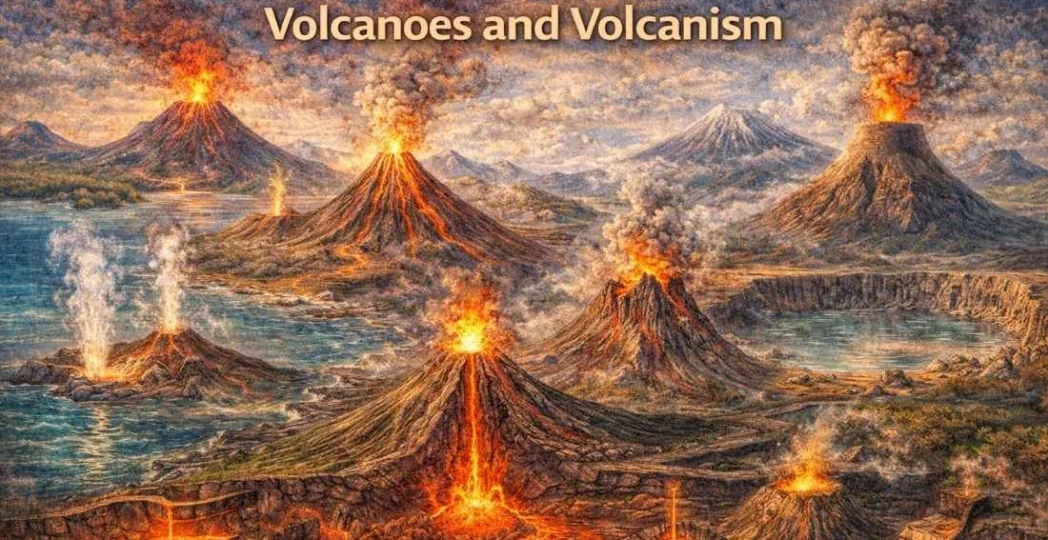
A volcano is a vent or opening in the Earth’s crust through which molten rock (magma), gases, and pyroclastic material erupt. Volcanism refers to the entire process of magma formation, its ascent, and its eventual solidification either underground or on the surface.
- Magma: Molten rock located below the Earth’s surface.
- Lava: Molten rock that reaches the surface.
Why Do Volcanoes Erupt? (Causes)
The primary driver of volcanism is the high geothermal gradient and the movement of lithospheric plates.
- Divergent Boundaries: As plates pull apart at Mid-Oceanic Ridges, pressure on the underlying Asthenosphere decreases, causing partial melting and the rise of magma (e.g., Mid-Atlantic Ridge).
- Convergent Boundaries: In subduction zones, the denser oceanic plate sinks. Water trapped in the plate lowers the melting point of the mantle, creating magma (e.g., The Andes, The Himalayas – though the latter is primarily continental collision).
- Hotspots: These are stationary plumes of intense heat rising from the Core-Mantle boundary. They create volcanoes far from plate boundaries (e.g., Hawaii, Reunion Island).
Types of Volcanoes (Based on Form and Composition)
- For UPSC Prelims, understanding the physical characteristics of these structures is essential.
Shield Volcanoes
- Composed of highly fluid Basaltic lava.
- Characterized by low-angle slopes and a broad shape.
- Example: Mauna Loa in Hawaii.
Composite Volcanoes (Stratovolcanoes)
- Erupt cooler, more viscous (Andesitic) lava.
- Built up by layers of ash and lava, resulting in steep, conical peaks.
- Example: Mt. Fuji (Japan), Mt. Vesuvius (Italy).
Cinder Cones
- The simplest type, built from particles and blobs of congealed lava ejected from a single vent.
- Usually small and crater-topped.
Caldera
- The most explosive volcanoes. They are so violent that when they erupt, they collapse into the empty magma chamber, forming a large depression.
Volcanic Landforms
- Volcanic activity creates both Extrusive (surface) and Intrusive (underground) landforms.
Intrusive Landforms (Plutonic Rocks)
Magma that cools and solidifies within the crust creates:
- Batholiths: Massive granitic bodies that form the core of mountain ranges.
- Laccoliths: Dome-shaped intrusive bodies with a level base.
- Sills: Horizontal sheets of solidified magma.
- Dykes: Vertical or near-vertical wall-like structures that cut across rock layers.
Extrusive Landforms
- Lava Plateaus: Formed by fissure eruptions covering vast areas (e.g., Deccan Traps in India).
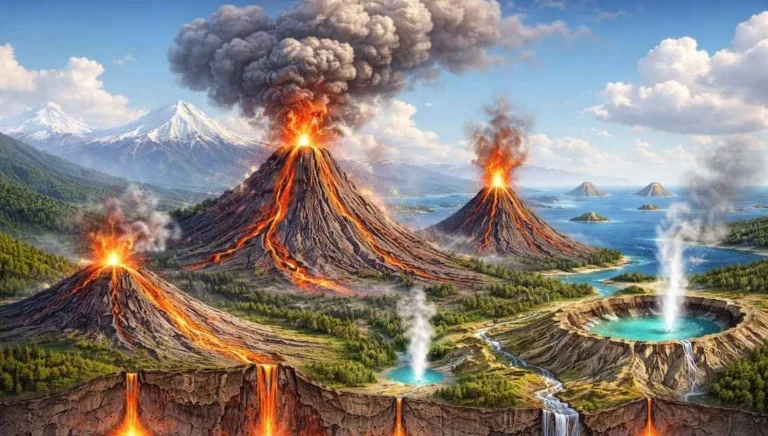
- Geysers and Hot Springs: Manifestations of subterranean volcanic heat heating groundwater.
Global Distribution of Volcanoes
Volcanoes are concentrated along specific zones:
- Circum-Pacific Belt (Ring of Fire): Contains over 75% of the world’s active volcanoes due to the subduction of the Pacific Plate.
- Mid-Atlantic Belt: Associated with the seafloor spreading.
- Mid-Continental Belt: Includes the volcanoes of the Mediterranean and East Africa.
Volcanism in India
While mainland India is mostly stable, volcanic history and active features are critical:
- Deccan Traps: A Large Igneous Province formed by volcanic activity 66 million years ago.
- Barren Island: India’s only active volcano, located in the Andaman Sea.
- Narcondam Island: An extinct/dormant volcano in the Andaman and Nicobar chain.
Environmental and Human Impacts
- Soil Fertility: Volcanic ash breaks down into mineral-rich Black Soil (Regur), ideal for cotton.
- Climate Change: Large eruptions release sulfur dioxide, which can form aerosols that reflect sunlight, leading to global cooling (e.g., Mt. Pinatubo).
- Geothermal Energy: Harnessing heat for electricity (e.g., Puga Valley in Ladakh).
UPSC Prelims: PYQs & Practice Questions
Previous Year Questions (Prelims)
Question 1 (2018)
Q: Consider the following statements:
1. Barren Island volcano is an active volcano located in the Indian territory.
2. Barren Island lies about 140 km east of Great Nicobar.
3. The last time the Barren Island volcano erupted was in 1991 and it has remained inactive since then.
Which of the statements given above is/are correct?
(a) 1 only
(b) 2 and 3 only
(c) 3 only
(d) 1 and 3 only
Answer: (a)
Explanation: Statement 1 is correct as Barren Island is India’s only active volcano. Statement 2 is incorrect; it lies about 140 km North-East of Port Blair, not east of Great Nicobar. Statement 3 is incorrect; although it erupted in 1991, it has erupted multiple times since then (including 2017 and 2018).
Question 2
Q: Why are shield volcanoes usually the largest on Earth?
(a) They are composed of highly viscous andesitic lava.
(b) They are formed from fluid basaltic lava that spreads over long distances.
(c) They are formed exclusively at subduction zones.
(d) They are result of violent explosions that deposit thick ash layers.
Answer: (b)
Explanation: Shield volcanoes, such as Mauna Loa, are formed by low-viscosity basaltic lava. Because the lava is highly fluid, it spreads over long distances before solidifying, creating a broad, gently sloping, shield-like profile.
Practice Questions (Prelims)
Question 1
Q: Match the following Volcanic Landforms with their descriptions:
A. Batholith — 1. Horizontal sheet-like intrusive body.
B. Dyke — 2. Massive granitic body at great depth.
C. Sill — 3. Near-vertical wall-like intrusive body.
Select the correct code:
(a) A-2, B-3, C-1
(b) A-3, B-2, C-1
(c) A-2, B-1, C-3
(d) A-1, B-2, C-3
Answer: (a)
Explanation: Batholiths are massive deep-seated intrusive granitic bodies. Dykes are near-vertical or transverse intrusive formations. Sills are horizontal or concordant sheet-like intrusive bodies.
Question 2
Q: The "Ring of Fire" is associated with which of the following?
1. Subduction Zones
2. Convergent Plate Boundaries
3. Deep-sea Trenches
Select the correct code:
(a) 1 and 2 only
(b) 2 and 3 only
(c) 1 and 3 only
(d) 1, 2, and 3
Answer: (d)
Explanation: The Pacific Ring of Fire is characterized by subduction of oceanic plates at convergent boundaries. This process creates deep-sea trenches and intense volcanic and seismic activity along the margins of the Pacific Ocean.
UPSC Mains – Previous Year & Practice Questions
Mains Standard Questions
Deccan Traps Formation
Question: Explain the formation of the Deccan Traps in India and its impact on the region's agricultural characteristics. (150 words)
Volcanoes & Plate Tectonics
Question: "The distribution of volcanoes is a strong evidence for the theory of Plate Tectonics." Discuss. (250 words)
Acidic vs Basic Lava
Question: Compare the characteristics of acidic (viscous) and basic (fluid) lavas and the landforms they create. (150 words)
Secondary Manifestations of Volcanism
Question: Describe the secondary manifestations of volcanism, such as Geysers, Fumaroles, and Hot Springs. (250 words)
Hotspots & Volcanic Island Chains
Question: Discuss the role of 'Hotspots' in the formation of volcanic island chains like Hawaii. (150 words)
Mains Practice Questions
Volcanic Eruptions & Global Climate
Question: Analyze how large volcanic eruptions can influence global climate patterns in the short term. (250 words)
Volcanism & Earth's Interior
Question: "Volcanism provides a window into the Earth's interior." Elaborate on the materials ejected during an eruption and their scientific significance. (250 words)
Pyroclastic Flows & Lahars
Question: Examine the hazards associated with 'Pyroclastic Flows' and 'Lahars' in densely populated volcanic regions. (150 words)
Volcanism Explained for UPSC: - FAQs
What is the difference between Magma and Lava?
Magma is molten rock stored under the Earth’s crust. Once it breaks through the surface and erupts through a vent, it is called Lava.
Why are there no active volcanoes in the Himalayas?
The Himalayas are formed by the collision of two thick continental plates (Indian and Eurasian). Because there is no subduction of oceanic crust to a depth where it can melt, magma is not generated, resulting in seismic activity but no volcanism.
What is a 'Caldera'?
A Caldera is a large, cauldron-like depression that forms when a volcano erupts so violently that the magma chamber beneath it empties, causing the summit of the volcano to collapse inward.
Are all volcanoes dangerous?
While eruptions can be destructive, they also create fertile Black Soil (Regur), provide Geothermal energy, and bring precious minerals like diamonds and copper to reachable depths.
What is 'Pumice'?
Pumice is a light-colored, extremely porous volcanic rock that forms during explosive eruptions. It contains so many air bubbles that it is the only rock that can float on water.