

Table of Contents
ToggleELECTRICITY TRADING IN INDIA AND SHIFT TO MARKET COUPLING
TOPIC: (GS3) ECONOMY: THE HINDU
The Central Electricity Regulatory Commission (CERC) has proposed new rules to introduce market coupling in India’s electricity trading system.
Background
- Traditionally, electricity in India was traded through longterm Power Purchase Agreements (PPAs) between generators and distribution companies (DISCOMs).
- With rising demand fluctuations, shortterm markets emerged via power exchanges, allowing surplus electricity to be sold at marketdriven prices.
- Currently, multiple exchanges (like IEX, PXIL, HPX) discover prices separately, leading to price disparities.
Market Coupling Proposal
- Concept: Market coupling means aggregating buy and sell bids from all exchanges to determine a single, uniform Market Clearing Price (MCP).
- Operator: The Grid Controller of India (Grid India) will act as the Market Coupling Operator (MCO).
- Procedure:
- Exchanges collect bids in a standard format.
- Bids are transmitted securely to the MCO.
- MCO applies a central algorithm to maximize economic surplus (benefits for buyers and sellers).
- Phased Rollout: Initially applied to the DayAhead Market (DAM) and RealTime Market (RTM), later extended to other segments.
Objectives of Market Coupling
- Ensure uniform price discovery across exchanges.
- Reduce regional price differences.
- Provide a benchmark price for policymakers.
- Enhance market efficiency, transparency, and stability.
Role of Grid India
- Establish a dedicated internal cell for market coupling.
- Draft a Power Market Coupling Procedure (PMCP) within six months, defining roles, bid formats, and algorithms.
- Oversee centralized price discovery until full implementation.
Current Market Structure
- LongTerm Contracts: PPAs (often 25 years) between generators and DISCOMs.
- ShortTerm Markets:
- DayAhead Market (DAM): Auctions for nextday delivery.
- RealTime Market (RTM): Nearinstant trading for balancing demand.
- Intraday & TermAhead Markets (TAM): Contracts ranging from hours to 11 days.
- Key Players:
- India Energy Exchange (IEX): Dominant, >90% DAM share.
- Power Exchange India Ltd (PXIL).
- Hindustan Power Exchange (HPX).
Growth of ShortTerm Markets
- Shortterm transactions grew from 65.9 BU (200910) to 238.35 BU (202425).
- CAGR: 8.9% for shortterm vs 5.8% for total generation.
- Share of shortterm trading in total generation rose from 9.6% to 13.03%.
Challenges
- Insider Trading Allegations: SEBI flagged irregularities, including leaks involving a CERC official.
- Industry Opposition: IEX opposed market coupling, fearing loss of competitive advantage under uniform pricing.
- Legal Uncertainty: Concerns about regulatory overreach and impact on exchange autonomy.
Way forward
- Moves India toward a centralized, transparent electricity market.
- Provides a reliable benchmark price for policy and investment decisions.
- Enhances grid efficiency and supports integration of renewable energy.
- Aligns India’s power market with global best practices in electricity trading.
Conclusion
While opposition from dominant exchanges and legal challenges remain, the reform could significantly strengthen India’s electricity sector and support its transition to a more competitive, renewabledriven energy future.
INDIA’S FERTILISER CRISIS AND SUPPLY SHOCKS
TOPIC: (GS3) ECONOMY: THE HINDU
Fertiliser prices in India have surged sharply due to supply disruptions from the US–Israel–Iran conflict and the closure of the Strait of Hormuz.
Background
- India is heavily dependent on imports for fertilisers, especially urea and DAP.
- The Gulf region supplies both finished fertilisers and LNG (a key input for urea production).
- Disruptions in this region have directly impacted imports and domestic production capacity.
Price Surge Across Fertilisers
- Urea: Jumped to $935–959/tonne (from ~$508–512 in February).
- DAP (DiAmmonium Phosphate): Rose to $865–925/tonne (from ~$680–720).
- Sulphur: Increased to $900/tonne (from ~$300–550).
- Ammonia: Climbed to $850–900/tonne (from ~$435).
- Both finished fertilisers and raw materials have become costlier.
Supply Chain Disruptions
- Strait of Hormuz closure restricted global shipments.
- QatarEnergy and Maaden facilities shut down after Iranian strikes.
- India turned to Indonesia, Malaysia, Morocco, and Jordan, but competition with South America raised prices further.
Kharif Season Challenge
- Requirement: ~19.4 million tonnes of fertilisers.
- Stock (April): ~5.5 mt, indicating a shortfall.
- Domestic production: Normal: ~2.5 mt/month. March: ~1.5 mt; April: ~1.7–1.8 mt.
- LNG supply issues reduced output, recovery unlikely before June.
Dependence on Imports
- Annual urea consumption: 39–40 mt.
- Domestic production: 30–31 mt.
- Imports: 9–10 mt, with ~40% from GCC countries.
- Over 60% of LNG sourced from Gulf, making India highly vulnerable.
Relative Position of Other Fertilisers
- Better availability: DAP, MOP, SSP, and complex NPK fertilisers.
- Critical shortage: Urea remains the biggest concern.
- Kharif vs Rabi: Kharif season May be managed with difficulty but Rabi season have Greater risk of shortages due to higher fertiliser demand.
Way forward
- Shift to Alternative Fertilisers: TSP (Triple Super Phosphate), MAP (Mono Ammonium Phosphate), SSP. Helps balance nutrient supply despite shortages.
- Fortified Fertilisers: Coating urea/DAP with micronutrients (zinc, iron, boron). Adding sulphur, calcium, magnesium. Improves yields and nutrient efficiency.
- Biostimulants: Derived from microbes, seaweed, organic matter. Enhance nutrient uptake and soil health. Example: phosphatesolubilising bacteria unlock soil phosphorus.
Conclusion:
Diversification through alternative fertilisers, fortified products, and biostimulants can reduce vulnerability and improve nutrient efficiency, ensuring food security in the long run.
ESPORTS IN INDIA AND NEW ONLINE GAMING RULES
TOPIC: (GS2) GOVERNANCE: THE HINDU
The Government of India has notified new online gaming rules under the Promotion and Regulation of Online Gaming Act, 2025.
Concept and Growth of Esports
- Esports: Competitive video gaming with structured tournaments, professional players, and prize money.
- Distinct from casual gaming: Organized leagues, spectator base, and professional recognition.
- Growth Drivers in India:
- Affordable internet and smartphones.
- Young demographic.
- Rise of streaming platforms and sponsorships.
- Market Size: Estimated at $1–1.5 billion, with rapid expansion through mobile gaming and largescale tournaments.
Types of Esports and Ecosystem
- Mobile Esports: Dominant in India due to accessibility (battle royale, multiplayer strategy).
- PC/Console Esports: More global, requiring higher infrastructure.
- Teambased Leagues: Structured franchises and tournaments.
- Ecosystem Components: Players, teams, organizers, streaming platforms, sponsors, and audiences.
- Revenue Streams: Advertising, media rights, ingame purchases, sponsorships.
Government Recognition and Regulation
- Esports recognized as part of multisports events under the Ministry of Youth Affairs and Sports.
- Distinguished from gambling/betting activities.
- Promotion and Regulation of Online Gaming Act, 2025:
- Provides legal framework for online gaming.
- Focus on innovation with user safety.
- Introduces lighttouch regulation for nonrisk games.
Provisions of New Rules
- Online Gaming Authority of India (OGAI): Sixmember body under Ministry of Electronics and IT. Includes representatives from multiple ministries.
- Mandatory Registration: Esports platforms must register. Other online games exempt unless classified as highrisk.
- Safeguards: Operational and behavioral checks to prevent financial/psychological harm. Grievance redressal systems with escalation to regulator.
- Financial Oversight: Banks must verify legality of platforms before enabling transactions. Restrict services to noncompliant entities.
Approach and Challenges
- Regulationlight model: Encourages growth while maintaining oversight.
- Future Provisions: Age classification systems, codes of practice to address addiction.
- Challenges:
- Illegal betting platforms.
- Offshore gaming sites accessed via VPNs.
- Difficulty in enforcement across borders.
Conclusion
While challenges like illegal betting and offshore platforms persist, the creation of OGAI and mandatory registration for esports platforms mark a significant step toward building a safe and globally competitive esports ecosystem in India.
DRUZHBA PIPELINE
TOPIC: (GS2) INTERNATIONAL RELATIONS: THE HINDU
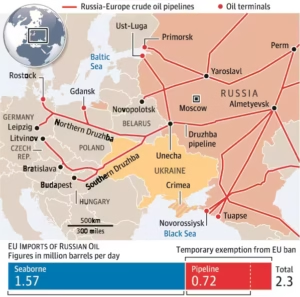
The Druzhba pipeline, which carries Russian oil through Ukraine to Hungary and Slovakia, has been repaired and resumed operations after months of disruption.
Background
- The Druzhba Pipeline (meaning Friendship Pipeline) is one of the largest crude oil pipeline networks in the world.
- Built in the 1960s by the USSR to supply oil to European countries.
- Today, it remains the main route for Russian and Kazakh oil exports to Europe.
Structure and Route
- Length: ~5,500 km including branches.
- Starting Point: Almetyevsk (Russia), where oil from Siberia, Urals, and Caspian regions converge.
- Main Division:
- Northern Branch: Runs via Belarus and Poland to Germany.
- Southern Branch: Passes through Ukraine, splitting at Uzhgorod:
- Druzhba 1: To Slovakia, then branching to Czech Republic and Hungary.
- Druzhba 2: Directly to Hungary.
Capacity
- Current transport capacity: 1.2–1.4 million barrels/day.
- Potential expansion: up to 2 million barrels/day.
Strategic Importance
- Supplies oil to Central and Eastern Europe, including Germany, Poland, Hungary, Slovakia, and Czech Republic.
- Acts as a critical energy lifeline for landlocked countries dependent on Russian crude.
- Any disruption impacts European energy security and raises geopolitical tensions.
Recent Issues
- Pipeline operations were disrupted due to the Russia–Ukraine conflict.
- Repairs and resumption are crucial for Hungary and Slovakia, which rely heavily on Druzhba for energy needs.
- Highlights the vulnerability of Europe’s energy supply chains amid ongoing geopolitical crises.
Conclusion
The Druzhba Pipeline is not just an oil route but a symbol of Cold Warera energy cooperation, Its recent repair and reopening underline how geopolitical conflicts directly affect critical infrastructure, influencing both regional stability and global energy markets.
PRAJNA SYSTEM
TOPIC: (GS3) SCIENCE AND TECHNOLOGY: THE HINDU
The Union Ministry of Home Affairs has recently received the indigenously developed AIenabled satellite imaging system ‘Prajna’.
Background
- Modern security challenges require realtime intelligence and surveillance.
- Conventional satellite imagery often produces large volumes of data that are difficult to process quickly.
- The Prajna System integrates artificial intelligence with satellite imaging to provide actionable insights faster and more accurately.
Features of Prajna System
- Indigenous Development: Built by DRDO’s CAIR, showcasing India’s selfreliance in advanced defence technology.
- AIDriven Analytics: Processes massive satellite data, identifies patterns, and flags anomalies.
- RealTime Decision Support: Provides immediate inputs to security agencies during critical operations.
- Situational Awareness: Enhances monitoring of sensitive regions and border areas.
- CounterTerrorism Aid: Helps detect suspicious activities and supports rapid response.
Strategic Importance
- Internal Security: Strengthens surveillance against terrorism, infiltration, and insurgency.
- Border Management: Improves monitoring of vulnerable zones along India’s borders.
- Disaster Response: Can be used for tracking floods, landslides, or other emergencies.
- Technological Edge: Reduces dependence on foreign imaging systems and enhances India’s defence preparedness.
Advantages Over Conventional Systems
- Speed: AI enables faster analysis compared to manual interpretation.
- Accuracy: Detects hidden or subtle patterns that human analysts may miss.
- Scalability: Capable of handling vast datasets from multiple satellites.
- Integration: Can be linked with other defence and intelligence platforms for holistic monitoring.
Challenges Ahead
- Ensuring data security and preventing misuse.
- Need for continuous AI training to adapt to evolving threats.
- Integration with existing defence infrastructure may require time and resources.
Conclusion
By combining satellite imagery with advanced analytics, it enhances situational awareness, internal security, and counterterrorism capabilities. Its deployment reflects India’s push for indigenous innovation in strategic sectors, strengthening both national security and technological sovereignty.
UNITED NATIONS ECONOMIC AND SOCIAL COMMISSION FOR ASIA AND THE PACIFIC (UNESCAP)
TOPIC: (GS3) ECONOMY: THE HINDU
A recent UNESCAP report projects inflation in developing AsiaPacific economies to rise to 4.6% in 2026, up from 3.5% in 2025.
About UNESCAP
- Established: 1947.
- Nature: Most inclusive intergovernmental platform in the AsiaPacific region.
- Mandate: Promote economic and social development through cooperation among member states.
- Membership: 53 member states. 9 associate members.
- Status: One of the five regional commissions of the United Nations.
- Headquarters: Bangkok, Thailand.
Functions
- Promotes regional and subregional cooperation for sustainable development.
- Works across multiple areas:
- Macroeconomic policy and poverty reduction.
- Trade, investment, and innovation.
- Transport and connectivity.
- Environment and sustainable development.
- ICT and disaster risk reduction.
- Social development and inclusion.
Significance
- Provides a platform for dialogue and cooperation among AsiaPacific nations.
- Helps countries address shared challenges like inflation, poverty, climate change, and digital transformation.
- Supports policy coordination and capacity building for sustainable growth.
Conclusion
UNESCAP plays a crucial role in shaping the economic and social agenda of the AsiaPacific region. Its latest inflation forecast underlines the need for regional cooperation and resilient policies to safeguard growth and stability in developing economies.
JUDICIAL ACCOUNTABILITY IN INDIA AND THE JUSTICE VARMA CASE
TOPIC: (GS2) POLITY: THE HINDU
Justice Yashwant Varma resigned during a parliamentary inquiry into allegations of misconduct.
Constitutional Framework for Removal of Judges
- Articles 124(4) & 217: Provide procedure for removal of Supreme Court and High Court judges.
- Grounds: Proved misbehaviour or incapacity.
- Process:
- Motion initiated in Parliament.
- Inquiry by a threemember committee under Judges (Inquiry) Act, 1968.
- If charges proved → Removal motion passed in both Houses with special majority.
- Final removal order issued by the President of India.
- Objective: Balance judicial independence with accountability.
Judges Inquiry Committee
- Composition:
- One Supreme Court judge.
- One High Court Chief Justice.
- One eminent jurist.
- Functions:
- Conduct hearings, examine witnesses, review evidence.
- Proceedings usually incamera for confidentiality.
- Ensure natural justice and opportunity for defence.
- Outcome: Report decides if Parliament proceeds with impeachment.
Issue of Resignation During Inquiry
- Constitution and Judges (Inquiry) Act silent on continuation after resignation.
- Past practice: Mixed – some inquiries stopped, others continued.
- Concerns: Resignation may allow judges to escape accountability. Continuing inquiry serves public purpose by establishing truth.
- Debate: Should resignation automatically terminate proceedings?
Justice Varma Case
- Allegations: Unaccounted cash found at residence after fire incident.
- Inquiry committee held multiple hearings, examined witnesses.
- Evidence suggested:
- Possession of unexplained cash.
- Interference with evidence.
- Misleading explanations.
- Inquiry was about to enter defence stage when resignation occurred.
- Committee closed proceedings, stating impeachment applies only to sitting judges.
- Government rejected claims of bias; criminal proceedings may still follow under ordinary law.
Implications
- Raises doubts about credibility of judicial accountability mechanisms.
- Highlights need for clear legal provisions on resignation during inquiry.
- Suggests reforms to ensure inquiries continue even if removal becomes redundant.
Conclusion
Strengthening laws to ensure transparency and accountability even after resignation is vital to maintain public trust in the judiciary.