Table of Contents
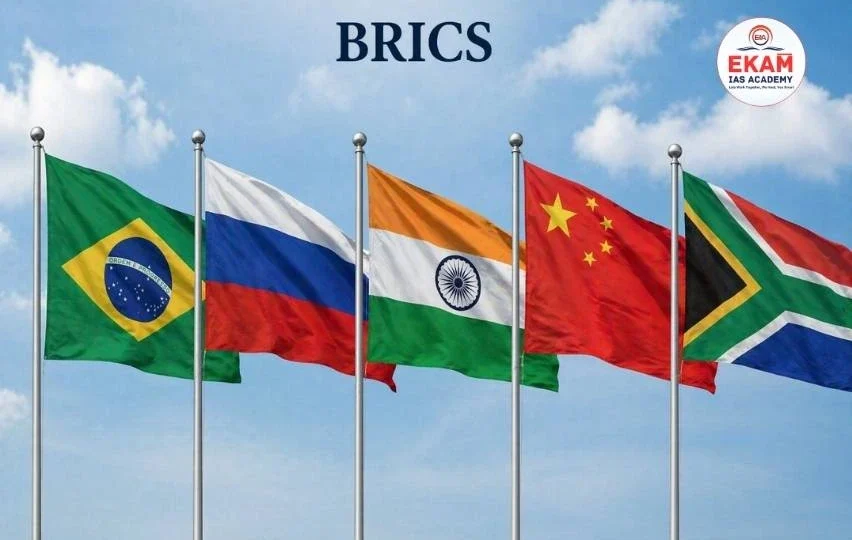
ToggleBRICS UPSC notes focus on the association of five major emerging national economies: Brazil, Russia, India, China, and South Africa. Representing over 40% of the world’s population and nearly one-fourth of the global GDP, BRICS has evolved from an acronym into a formidable geopolitical force. It seeks to challenge the dominance of Western-led institutions and advocates for a more representative, multipolar world order.
Historical Background
The term “BRIC” was coined in 2001 by Jim O’Neill (Goldman Sachs) to identify high-growth economies.
- The First Summit: The group was formalized in 2006, with the first summit held in Yekaterinburg, Russia, in 2009.
- Expansion: South Africa joined in 2010, changing the acronym to BRICS.
- BRICS Plus: In 2024, the group underwent a historic expansion, inviting countries like Egypt, Ethiopia, Iran, and the UAE to join, reflecting its growing appeal in the Global South.
Objectives and Principles
The core BRICS role in global governance is defined by its principles:
- Mutual Respect: Respect for territorial integrity and national sovereignty.
- Non-Interference: Strict adherence to non-interference in internal affairs.
- Equality and Consensus: All decisions are made based on consensus, ensuring every member has an equal voice.
- Multilateralism: Reforming the UNSC, IMF, and World Bank to reflect 21st-century realities.
Key Areas of Cooperation
- Economic & Financial: Trade facilitation and investment promotion.
- Security: Counter-terrorism, cyber-security, and energy security.
- People-to-People: Academic exchanges, youth forums, and cultural festivals.
Important Institutions and Initiatives
- New Development Bank (NDB): Headquartered in Shanghai, the NDB acts as an alternative to the World Bank for infrastructure and sustainable development projects.
- Contingent Reserve Arrangement (CRA): A framework providing protection against global liquidity pressures, acting as a “mini-IMF.”
- BRICS Payment System: Discussions regarding a digital currency or alternative to SWIFT to de-risk from the US Dollar.
Strategic Significance
BRICS serves as a platform for the Global South to voice concerns on climate justice, trade barriers, and global health. Its strategic weight lies in its control over critical minerals, energy resources, and its role as the world’s manufacturing and services hub.
India and BRICS
India and BRICS share a symbiotic relationship.
- Strategic Autonomy: BRICS allows India to balance its relations with the West while maintaining a strong foothold in the non-Western world.
- Leadership Role: India has spearheaded initiatives like the BRICS Vaccine R&D Centre and the Digital Health initiative.
- Economic Growth: It provides India access to capital from the NDB and energy security through ties with Russia and now Iran/UAE.
Key Challenges
- Internal Friction: The ongoing border tensions between India and China often overshadow the group’s agenda.
- Heterogeneity: Diverse political systems (democracies vs. autocracies) and economic structures make a unified stance difficult.
- China-Centricity: Concerns that the group might become a vehicle for China’s regional and global ambitions.
Recent Developments
- The Kazan Summit (2024): Focused on the integration of new members and the development of the BRICS Grain Exchange.
- De-dollarization: Increasing use of Local Currency Settlements for bilateral trade among members.
- Partner Country Category: Introduction of a “Partner Country” status to include nations like Malaysia and Thailand without full membership.
Way Forward
- Institutional Strengthening: Enhancing the NDB’s credit rating and expanding its lending capacity.
- Conflict Resolution: Developing an internal mechanism to resolve bilateral disputes between members.
- SME Integration: Linking small and medium enterprises across the BRICS nations to boost ground-level economic ties.
Conclusion
BRICS is no longer just a “talk shop” but a pillar of the Emerging World Order. For the UPSC, understanding BRICS is vital to comprehending India’s “Multi-aligned” foreign policy. As the world shifts away from unipolarity, BRICS will remain the primary vehicle for rewriting the rules of global engagement.
UPSC Prelims: PYQs & Practice Questions
Previous Year Questions (Prelims)
Q: With reference to the ‘New Development Bank’ (NDB), consider the following statements: (2016)
1. It is an initiative of the BRICS.
2. The headquarters of the New Development Bank is in Shanghai.
Which of the statements given above is/are correct?
(a) 1 only
(b) 2 only
(c) Both 1 and 2
(d) Neither 1 nor 2
Answer: (c) Both 1 and 2
Explanation:
The NDB was established by the BRICS nations during the 6th Summit in Fortaleza (2014) to mobilize resources for infrastructure and sustainable development projects. Its headquarters is located in Shanghai, China.
Q: The ‘Fortaleza Declaration’, frequently mentioned in the news, is related to the affairs of: (2015)
(a) ASEAN
(b) BRICS
(c) OECD
(d) WTO
Answer: (b) BRICS
Explanation:
The Fortaleza Declaration (2014) is associated with BRICS. It led to the signing of agreements related to the New Development Bank (NDB) and the Contingent Reserve Arrangement (CRA).
Practice Questions
Q: Regarding the 'Contingent Reserve Arrangement' (CRA), consider the following statements:
1. It is a framework for providing protection against global liquidity pressures.
2. All members contribute an equal amount to the CRA fund.
Which of the statements given above is/are correct?
(a) 1 only
(b) 2 only
(c) Both 1 and 2
(d) Neither 1 nor 2
Answer: (a) 1 only
Explanation:
Statement 2 is incorrect. Unlike the NDB, where capital contribution is equal, members contribute differently to the CRA. China provides the largest share, while South Africa provides the smallest share.
Q: In 2024, which of the following countries became full members of BRICS?
(a) Argentina and Turkey
(b) Iran, UAE, Egypt, and Ethiopia
(c) Saudi Arabia and Indonesia
(d) Nigeria and Vietnam
Answer: (b) Iran, UAE, Egypt, and Ethiopia
Explanation:
During the 15th BRICS Summit in Johannesburg (2023), six countries were invited. After Argentina's withdrawal and Saudi Arabia's pending status, Iran, UAE, Egypt, and Ethiopia officially joined as full members on January 1, 2024.
UPSC Mains – Previous Year & Practice Questions
Mains Previous Year Questions
Question: The ‘New Development Bank’ (NDB) and the ‘Contingent Reserve Arrangement’ (CRA) are milestones in BRICS cooperation. How do they complement or challenge the existing global financial architecture?
Question: The inclusion of South Africa transformed BRIC into BRICS. Analyze the geopolitical significance of Africa’s representation in this grouping.
Question: Critically examine the role of BRICS in promoting a 'multipolar world' in the face of rising unilateralism.
Question: Discuss the internal contradictions within BRICS, especially the India-China relationship, and its impact on the group's cohesiveness.
Question: Evaluate the performance of the BRICS grouping in its first decade of existence. To what extent has it been successful in achieving its objectives?
Mains Practice Questions
[15 Marks | 250 Words]
Question: With the expansion to 'BRICS+', the grouping has moved from an economic bloc to a broader geopolitical representative of the Global South. Discuss.
[15 Marks | 250 Words]
Question: Examine the potential of a 'BRICS Currency' or 'Local Currency Settlement' systems in reducing the global dominance of the US Dollar.
[10 Marks | 150 Words]
Question: Analyze the strategic importance of the Middle East's inclusion (Iran and UAE) in the BRICS framework for India’s energy security.



BRICS-FAQs
What is the "Kazan Declaration"?
It is the outcome document of the 16th BRICS Summit (2024) held in Russia. It focused on strengthening multilateralism, the “Partner Country” category, and financial integration through the BRICS Clear system.
How is the NDB different from the World Bank?
In the World Bank, voting power is based on capital share (favoring the US/Europe). In the NDB, each of the five founding members has equal voting power and an equal share of the initial capital, ensuring no single country has a veto.
What does "De-dollarization" mean in the BRICS context?
It refers to the efforts of BRICS nations to reduce their reliance on the US Dollar by using local currencies (like the Rupee or Renminbi) for bilateral trade and creating alternative payment systems to SWIFT.
Is BRICS an anti-Western grouping?
While some members like Russia and China may use it to counter Western influence, India and Brazil view it as a “Non-Western” platform aimed at reforming global governance to make it more inclusive, rather than purely anti-Western.
What is the "BRICS Plus" model?
It is an outreach mechanism where BRICS members invite other developing nations (from the Global South) to participate in summits. This eventually led to the 2024 expansion of full membership.