
Table of Contents
ToggleAI & COMMUNITYLED DEVELOPMENT IN RAJASTHAN
TOPIC: (GS3) SCIENCE AND TECHNOLOGY: THE HINDU
Recently, a pilot project called AI4WaterPolicy in Rajasthan’s Sirohi and Pali districts showed how AI can strengthen water resilience and lastmile governance by listening to communities and improving responsiveness.
Background
- India is in an AI adoption phase across agriculture, health, finance, and governance.
- Most AI tools assume information gaps, but rural challenges often stem from institutional gaps — delays, lack of coordination, and social barriers.
- The pilot used AI to listen to communities, not just push information.
The Pilot Project – AI4WaterPolicy
- Conducted in 50 villages over 6 months, with 352 interviews.
- AI chatbot held 20minute WhatsApp conversations in Hindi/local dialects with:
- Pani Mitras (community water volunteers)
- Panchayat leaders
- CmF frontline staff
- Conversations captured local realities: pride in water gains, women’s double burden, and delays in Panchayat approvals.
- Findings were validated in “Pause and Reflect” workshops, leading to midcycle redesign of training programmes.
Key Insights
- Community Pride: Villagers reported visible water table improvements.
- Gender Burden: Women faced dual responsibilities — community work plus household duties.
- Institutional Delays: Panchayat approvals slowed project execution.
- Behavioural Barriers: Limited knowledge of Panchayat procedures reduced participation.
Challenges
- Digital Divide: Access gaps due to caste, class, gender, and smartphone availability.
- Fragmented Responsibility: Health, labour, disaster, and platform governance act separately.
- Dependence on Human Intermediaries: AI worked only because CmF had built trust with communities.
Way Forward
- Treat AI as Listening Tool: Use AI to capture qualitative insights at scale, not just push advisories.
- Integrate with Governance: Link findings to Panchayati Raj training, Jal Jeevan Mission, and rural development schemes.
- Platform Responsibility: Encourage digital platforms to adopt climateresponsive and communityresponsive design.
- Inclusive Design: Ensure women and marginalised groups have access to devices and safe spaces for participation.
- Institutional Coordination: Strengthen collaboration between local bodies, state departments, and NGOs.
Strategic Significance
- Demonstrates how AI can empower, not replace, human intermediaries like Pani Mitras.
- Provides a model for lastmile responsiveness in programmes such as Jal Jeevan Mission, VBGRAM, and rural extension systems.
- Shows that communityled development becomes more effective when AI enables active listening and rapid feedback loops.
CONCLUSION:
Rajasthan pilot shows that AI can strengthen communityled development by enabling active listening and rapid feedback loops. This approach makes programmes more inclusive, responsive, and resilient, ensuring local voices shape real policy action.
SUMMER HEAT & GIG WORKERS’ INCOME SHOCK
TOPIC: (GS3) ECONOMY: THE HINDU
Recently, early forecasts warn of intense heatwaves in India’s summer of 2026, raising concerns about the economic vulnerability of gig and delivery workers who form a growing part of India’s urban workforce.
Background
- Heatwaves are now a recurring feature of Indian summers, not rare events.
- India had significant heatrelated mortality in 2022, and meteorological data shows longer, more frequent heatwaves in the past decade.
- Gig workers — food delivery riders, appbased drivers, couriers — number 7.7 million (202021) and are projected to reach 23 million by 2030 (NITI Aayog).
Challenges for Gig Workers
- Direct Income Loss: Earnings depend on trips/orders; extreme heat slows movement and reduces logged hours.
- No Paid Leave: Unlike salaried employees, gig workers cannot “work from home” or take paid breaks.
- Health Risks: Exposure leads to dehydration, heat exhaustion, and longterm health stress.
- Policy Gaps: Heat Action Plans focus on health emergencies, not income volatility.
- Infrastructure Deficit: Cooling centres, water kiosks, shaded areas rarely designed for mobile workers.
- Fragmented Responsibility: Health, labour, disaster management, and platform governance act separately, leaving gig workers unprotected.
- Gender Dimension: Women gig workers face added safety and care burdens, worsening income disruption.
Economic & Social Impact
- Heat stress reduces urban productivity and disrupts essential services like food and medicine delivery.
- Income shocks deepen inequality, as lowincome gig workers lack social security nets.
- Vulnerability of gig workers reflects broader climatelabour intersection in India’s economy.
Way Forward
- Treat Heat as Labour Issue: Introduce rest norms, shaded waiting points, and water access at common delivery hubs.
- Income Protection: Integrate gig workers into social security schemes (EPFO, ESIC, Code on Social Security 2020); cushion income volatility through welfare linkages.
- Platform Responsibility: Digital platforms should adopt heatresponsive design — flexible metrics, reduced delivery pressure during peak heat hours.
- Institutional Coordination: Labour departments, urban local bodies, disaster agencies, and platform regulators must collaborate for integrated adaptation.
- GenderSensitive Measures: Special safeguards for women gig workers, including safe rest areas and health support.
Conclusion
Heatwaves are no longer just a health emergency but an economic shock for India’s gig workforce. Building resilience means ensuring workers can earn safely without silent income losses, through labour protections, welfare integration, and platform accountability.
INTERNATIONAL WATERS RULES & STRAIT OF HORMUZ CONFLICT
TOPIC: (GS2) INTERNATIONAL RELATIONS: THE HINDU
Tensions escalated in the Strait of Hormuz after Iran attacked and detained vessels in retaliation for U.S. seizures of Iranianlinked ships in international waters, raising questions about freedom of navigation under UNCLOS.
Background
- The Strait of Hormuz is a critical global energy route, with ~100 ships passing daily before the conflict.
- Since February 2026, vessel movement dropped sharply due to restrictions imposed by Iran.
- U.S. actions included blockade measures, radio warnings, and seizure of Iranianlinked vessels.
Legal Framework – UNCLOS
- High Seas Principle: Freedom of navigation applies beyond national jurisdiction.
- Exceptions: Interception allowed only for hot pursuit, UN Security Council authorisation, stateless ships, or flagstate consent.
- Territorial Waters: Ships enjoy “innocent passage” if transit does not threaten coastal security.
- International Straits: Strait of Hormuz classified as an international strait; principle of transit passage ensures uninterrupted movement.
Iran’s Position vs International Law
- Iran attempted to regulate ship movement and impose tolls.
- Under UNCLOS, Iran cannot block or charge fees for merchant vessels.
- It can only enforce limited conditions: continuous passage, designated routes, and prohibition of illegal loading/unloading.
U.S. Actions and Legal Debate
- U.S. seized vessels like Touska (container ship) and Tifani (crude carrier) in international waters.
- These actions are based on domestic sanctions law, not UN authorisation, raising questions of legality.
- Aim: disrupt Iran’s oil exports and weaken its control over the strait.
Challenges
- Cycle of Retaliation: Titfortat actions between Iran and U.S. destabilise global trade.
- Energy Security Risk: Strait handles ~20% of global oil trade; disruptions raise prices.
- Legal Ambiguity: U.S. unilateral sanctions clash with UNCLOS principles.
- Selective Enforcement: IMO condemned Iran’s tolls but not U.S. seizures, showing diplomatic imbalance.
Way Forward
- Strengthen IMO Role: Facilitate safe passage, uphold freedom of navigation, and mediate disputes.
- Diplomatic Engagement: Encourage dialogue between Iran, U.S., and affected nations like India.
- Global Cooperation: Reinforce UNCLOS compliance to prevent unilateral restrictions.
- Energy Diversification: Importing nations must diversify supply routes to reduce vulnerability.
Conclusion
The Strait of Hormuz crisis highlights how international waters law under UNCLOS is central to global stability. Resolving tensions requires multilateral diplomacy and strict adherence to transit passage rights to safeguard energy security and maritime freedom.
100% ETHANOL BLENDING IN INDIA
TOPIC: (GS3) ENVIRONMENT: THE HINDU
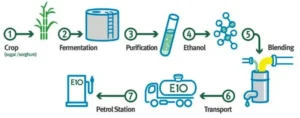
Recently, the Union Road Transport Minister advocated for 100% ethanol blending (E100) as part of India’s push for energy selfreliance and reducing dependence on fossil fuel imports.
Understanding Ethanol Blending
- E100 Fuel: Pure ethanol used as fuel; delivers 45–55% less energy per litre compared to petrol.
- Vehicle Compatibility: Most Indian vehicles are designed for E20; higher blends like E85/E100 need flexfuel engines.
- FlexFuel Vehicles: Require corrosionresistant systems, advanced sensors, and optimised combustion tuning. Brazil has adopted widely; India has limited prototypes (Toyota, Maruti, Hyundai).
Infrastructure & Supply Chain Needs
- Requires new fuel storage, distribution, and retail systems.
- Alignment with domestic manufacturing push is essential.
- Aggressive blending targets raise concerns about vehicle readiness and infrastructure bottlenecks.
Ethanol Production in India
- Current Source: Primarily from sugarcane (waterintensive, grown in stressed regions).
- Sustainability Concerns: Impacts food supply and water use.
- SecondGeneration Ethanol (2G): Made from crop residues (e.g., rice straw); reduces stubble burning and pollution. Supported by Indian Oil Corporation and other PSUs.
Cost & Policy Support
- Ethanol production cost is comparable or higher than petrol.
- Requires government pricing support and subsidies.
- Ethanol Blending Programme:
- Launched in 2003.
- Blending rose from ~2% (2014) → E10 (2022).
- E20 rollout from 2023, nationwide by 2025 (ahead of 2030 target).
Link with CAFE Norms
- CAFE I (2017), II (2022), III (2027): Progressive tightening of emission targets (~30% stricter under CAFE III).
- Indirect Link: CAFE III may push automakers towards higher ethanol blends (E85/E100) to meet emission norms.
- Consumer Concerns: E20 fuel gives 6–7% lower mileage, raising cost worries.
Challenges of 100% Ethanol Blending
- Vehicle Compatibility: Most cars are built for E20 fuel; higher blends like E85/E100 need flexfuel engines with special design.
- Consumer Acceptance: Ethanol gives lower mileage (6–7% less for E20), raising cost concerns for users.
- Infrastructure Gaps: India lacks adequate storage, transport, and distribution systems for high ethanol blends.
- Feedstock Dependence: Ethanol mainly comes from sugarcane, which is waterintensive and unsustainable in droughtprone regions.
- High Production Costs: Ethanol is often costlier than petrol; without climate finance or subsidies, adoption is difficult.
Way Forward
- FlexFuel Vehicles: Promote industry incentives for flexfuel engine production to handle E85/E100 blends.
- SecondGeneration Ethanol: Expand 2G ethanol plants using crop residues (rice straw, maize stalks) to reduce reliance on sugarcane.
- Policy Integration: Link ethanol blending targets with CAFE III emission norms to push automakers towards cleaner fuels.
- Pricing Support: Provide subsidies and administered pricing to balance consumer costs and encourage adoption.
- Diversified Energy Strategy: Combine ethanol with green hydrogen (National Hydrogen Mission) and renewables for longterm energy security.
Conclusion
India’s push for 100% ethanol blending reflects its energy security goals, but success depends on vehicle readiness, sustainable feedstocks, infrastructure upgrades, and consumer acceptance.
HINDU KUSH HIMALAYA (HKH)
TOPIC: (GS1) GEOGRAPHY: THE HINDU
A recent report by the International Centre for Integrated Mountain Development (ICIMOD) highlighted a 27% decline in snow persistence in the Hindu Kush Himalaya, raising concerns about climate change impacts on water security and ecosystems.
About the Region
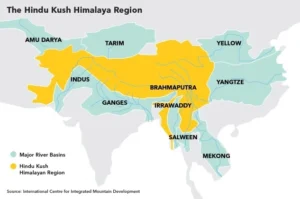
- Extent: Stretches 3,500 km across 8 countries, Afghanistan, Bangladesh, Bhutan, China, India, Nepal, Myanmar, and Pakistan.
- Geography: Runs northeast to southwest, separating the Amu Darya valley (north) from the Indus valley (south).
- Third Pole: Largest permanent ice cover outside the Arctic and Antarctic; crucial for global climate regulation.
- Biodiversity: Hosts 4 global biodiversity hotspots with diverse ecosystems — glaciers, alpine meadows, forests, wetlands, and grasslands.
- Peaks: Includes high snowcapped mountains; Tirich Mir (7,708 m, Pakistan) is the highest.
- Rivers: Source of 10 major Asian river systems — Indus, Ganga, Brahmaputra, Mekong, Yangtse, Yellow River, etc.
Environmental Concerns
- Snow Decline: 27% drop in snow persistence threatens water availability for millions.
- Climate Vulnerability: Glacial retreat and erratic rainfall affect agriculture, hydropower, and livelihoods.
- Desert Valleys: Inner valleys receive little rainfall, supporting desert vegetation.
Challenges
- Rapid glacier melt impacting river flows.
- Rising temperature extremes and frequent disasters.
- Pressure on local communities dependent on fragile ecosystems.
Way Forward
- Strengthen regional cooperation through ICIMOD and SAARC frameworks.
- Promote sustainable agriculture and water management.
- Invest in climateresilient infrastructure and early warning systems.
- Enhance communitybased adaptation to safeguard livelihoods.
Conclusion
The Hindu Kush Himalaya, often called the Third Pole, is vital for Asia’s water and climate security. Protecting this region requires coordinated action, sustainable practices, and climateresilient policies to safeguard ecosystems and millions of dependent people.
ARTEMIS ACCORDS
TOPIC: (GS3) SCIENCE AND TECHNOLOGY: THE HINDU
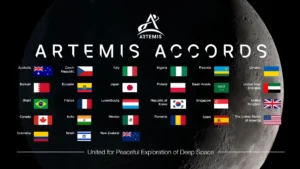
Recently, Jordan signed the Artemis Accords at NASA Headquarters, joining the list of countries supporting cooperative principles for civil space exploration.
About the Accords
- Launch Year: Introduced in 2020.
- Nature: A nonbinding framework of principles guiding peaceful and sustainable space exploration.
- Founding Members: Led by NASA and U.S. Department of State, with seven initial signatories — Australia, Canada, Italy, Japan, Luxembourg, UAE, and UK.
- India’s Role: India is also a signatory, reflecting its growing participation in global space governance.
Key Principles
- Peaceful Exploration: Activities must remain nonmilitary and cooperative.
- Transparency: Public release of scientific data and openness in missions.
- Interoperability: Systems designed to work together for safety and sustainability.
- Emergency Assistance: Support for astronauts and personnel in distress.
- Preservation of Heritage: Protecting historic sites like Apollo landing areas.
- Resource Utilisation: Extraction/use of space resources must comply with the Outer Space Treaty (1967).
- Orbital Debris Management: Safe disposal of debris to maintain longterm sustainability.
Significance
- Strengthens global cooperation in lunar and deepspace missions.
- Provides a governance framework for resource use and heritage protection.
- Supports India’s ambitions under ISRO’s lunar programme and Artemis partnership.
- Encourages responsible behaviour in space, reducing risks of conflict and debris.
Conclusion
The Artemis Accords mark a step toward inclusive and transparent space governance, ensuring exploration remains peaceful and sustainable. For India, participation aligns with its vision of being a responsible space power while advancing future lunar and planetary missions.