Table of Contents
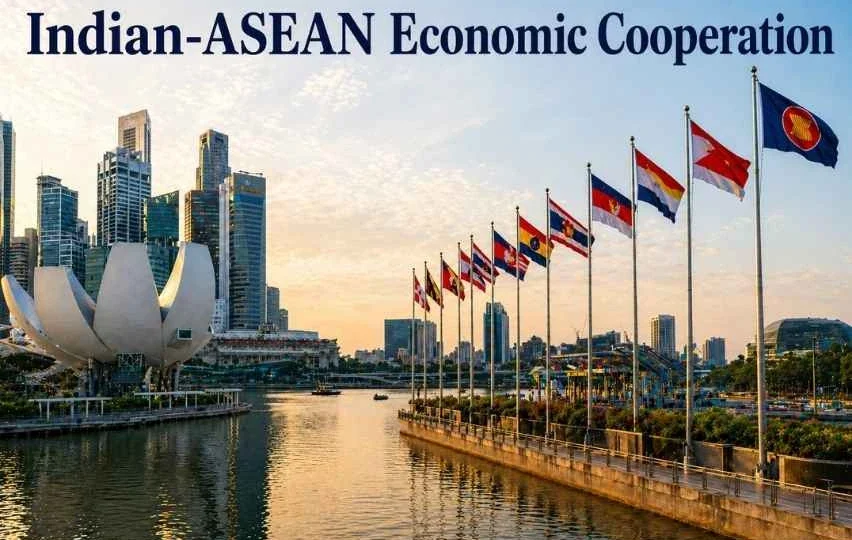
ToggleThe Indian-ASEAN Economic cooperation UPSC syllabus highlights the transition of India’s engagement with Southeast Asia from the “Look East” to the “Act East” policy. As one of the world’s most dynamic regional blocs, the Association of Southeast Asian Nations (ASEAN) is central to India’s dream of becoming a $5 trillion economy. The relationship has evolved into a Comprehensive Strategic Partnership, focusing on maritime security, connectivity, and robust trade.
Historical Background
- Sectoral Partner (1992): India began its formal engagement post-liberalization.
- Full Dialogue Partner (1995): The relationship deepened during the mid-90s.
- Summit-Level Partnership (2002): Formalized at the Phnom Penh Summit.
- Act East Policy (2014): A move to more proactive, action-oriented engagement under the current administration.
Overview of ASEAN
ASEAN was established in 1967 with the Bangkok Declaration. It comprises ten nations: Brunei, Cambodia, Indonesia, Laos, Malaysia, Myanmar, Philippines, Singapore, Thailand, and Vietnam. It operates on the “ASEAN Way“—a governance model based on non-interference, informal consultation, and consensus-building.
Objectives and Principles of Cooperation
The IR ASEAN upsc notes emphasize that the partnership is guided by:
- ASEAN Centrality: Recognizing ASEAN as the driver of regional architecture in the Indo-Pacific.
- Economic Integration: Reducing trade barriers through the ASEAN India FTA UPSC frameworks.
- Sustainable Development: Aligning the ASEAN Outlook on the Indo-Pacific (AOIP) with India’s SAGAR vision.
Key Areas of Economic Cooperation
- Trade in Goods: The ASEAN-India Trade in Goods Agreement (AITIGA) signed in 2009.
- Trade in Services & Investment: Agreements signed in 2014 to facilitate professional mobility and capital flow.
- Connectivity: Massive infrastructure projects like the India-Myanmar-Thailand Trilateral Highway and the Kaladan Multi-modal Project.
- Digital Economy: Collaboration on Fintech (UPI integration with Singapore and Thailand) and Digital Public Infrastructure (DPI).
Importance for India's Economy and Foreign Policy
- Market Access: ASEAN is India’s 4th largest trading partner. Total bilateral trade has crossed the $130 billion mark.
- Supply Chain Resilience: ASEAN provides an alternative to China-centric supply chains, especially in electronics and semiconductors.
- North-East Development: For India, ASEAN is the gateway to the development of its landlocked North-Eastern states.
- Strategic Autonomy: Strengthening ties with ASEAN allows India to balance the regional power dynamics in the South China Sea.
Key Challenges
- Trade Deficit: India’s trade deficit with ASEAN has widened significantly post-FTA, leading to demands for a review of AITIGA.
- RCEP Withdrawal: India’s decision to opt-out of the Regional Comprehensive Economic Partnership (RCEP) has created a perception of protectionism.
- Non-Tariff Barriers: Indian exporters face complex phytosanitary and technical standards in ASEAN markets.
- Infrastructure Delays: Flagship connectivity projects are years behind schedule due to terrain and political instability in Myanmar.
Recent Developments
- AITIGA Review: In 2025, both sides fast-tracked negotiations to make the FTA more “trade-facilitative and symmetrical.”
- Green Hydrogen Partnership: India has signed MoUs with Malaysia and Indonesia for Green Ammonia supply chains.
- Local Currency Settlement: India is expanding Rupee-based trade with Vietnam and the Philippines to de-risk from the US Dollar.
Way Forward
- Rules of Origin: Strengthening norms to prevent the “re-routing” of Chinese goods through ASEAN countries into India.
- Blue Economy: Leveraging the maritime potential of the Andaman Sea and the Bay of Bengal for sustainable fishing and deep-sea mining.
- SME Integration: Linking the small and medium enterprises of both regions to create a grassroots-level economic ecosystem.
Conclusion
The India-ASEAN axis is the heartbeat of the Indo-Pacific. While challenges like the trade imbalance remain, the transition toward high-tech cooperation and energy security marks a new chapter in INDIA trade relations UPSC studies. A prosperous ASEAN is essential for a stable and “Viksit” India.
UPSC Prelims: PYQs & Practice Questions
Previous Year Questions (Prelims)
Q: The term ‘Regional Comprehensive Economic Partnership’ (RCEP) often appears in the news in the context of the affairs of a group of countries known as: (2016)
(a) G20
(b) ASEAN
(c) SCO
(d) BRICS
Answer: (b) ASEAN
Explanation:
RCEP is a free trade agreement between the ten member states of ASEAN and its five FTA partners: Australia, China, Japan, New Zealand, and South Korea. India was an original negotiating member but opted out in 2019 due to concerns over trade imbalances and market access.
Q: Consider the following countries: (2018)
1. Australia
2. Canada
3. China
4. India
5. Japan
6. USA
Which of the above are among the ‘free-trade partners’ of ASEAN?
(a) 1, 2, 4 and 5
(b) 3, 4, 5 and 6
(c) 1, 3, 4 and 5
(d) 2, 3, 4 and 6
Answer: (c) 1, 3, 4 and 5
Explanation:
ASEAN has six major FTA partners: Australia, China, India, Japan, New Zealand, and South Korea. Canada and the USA do not have a collective FTA with ASEAN as a bloc.
Practice Questions
Q: With reference to the ‘ASEAN-India Trade in Goods Agreement’ (AITIGA), consider the following statements:
1. It was signed in 2009 and came into effect in 2010.
2. It covers trade in services as well as intellectual property rights.
Which of the statements given above is/are correct?
(a) 1 only
(b) 2 only
(c) Both 1 and 2
(d) Neither 1 nor 2
Answer: (a) 1 only
Explanation:
Statement 1 is correct. Statement 2 is incorrect because AITIGA specifically covers trade in goods. Separate agreements for Services and Investment were signed later in 2014.
Q: The ‘Mekong-Ganga Cooperation’ (MGC), an initiative involving India and five ASEAN members, focuses primarily on:
(a) Defense and maritime security
(b) Tourism, culture, education, and transportation
(c) Nuclear energy cooperation
(d) Joint petroleum exploration in the South China Sea
Answer: (b)
Explanation:
Launched in 2000, the MGC involves India and five ASEAN nations: Cambodia, Laos, Myanmar, Thailand, and Vietnam. It focuses on soft-power and functional areas like tourism, culture, education, and connectivity.
UPSC Mains – Previous Year & Practice Questions
Mains Previous Year Questions
Question: Evaluate the economic and strategic dimensions of India’s Look East Policy in the context of the post-Cold War international scenario. (2016)
Question: The 'ASEAN Centrality' is a core principle of India's Act East Policy. Discuss the challenges and opportunities for India in the Indo-Pacific region through ASEAN.
Question: India’s decision to stay out of RCEP was driven by domestic economic concerns. Analyze the implications of this move on India’s trade relations with ASEAN.
Question: Connectivity is the new currency of diplomacy. In this light, examine the significance of the India-Myanmar-Thailand Trilateral Highway.
Question: Discuss the role of the Indian Diaspora in Southeast Asia as a catalyst for deeper economic and cultural ties between India and ASEAN.
Mains Practice Questions
[15 Marks | 250 Words]
Question: The widening trade deficit with ASEAN necessitates a comprehensive review of the ASEAN-India Trade in Goods Agreement (AITIGA). Examine the sectors where India needs better market access.
[10 Marks | 150 Words]
Question: How can India leverage its Digital Public Infrastructure (DPI) to deepen economic integration with ASEAN nations? Discuss with examples like UPI-PayNow.
[15 Marks | 250 Words]
Question: Examine the impact of political instability in Myanmar on the progress of India’s Act East Policy and regional connectivity projects.



India-ASEAN Economic Cooperation-FAQs
Why is India reviewing its FTA with ASEAN?
India’s trade deficit with ASEAN has ballooned from nearly $5 billion in 2010 to over $40 billion recently. India seeks to address non-tariff barriers, “rules of origin” violations (to prevent Chinese goods from being re-routed), and better access for its services sector.
What is the "ASEAN Way"?
It refers to the unique style of diplomacy in Southeast Asia based on informality, non-interference in internal affairs, and reaching decisions through consensus rather than voting.
Is India a member of ASEAN?
No. India is a Comprehensive Strategic Partner and a member of the East Asia Summit (EAS) and the ASEAN Regional Forum (ARF), but full membership is restricted to the ten Southeast Asian nations.
What is the "Act East Policy"?
Launched in 2014, it is the successor to the “Look East Policy.” It is more proactive and focuses on the 4 Cs: Culture, Commerce, Connectivity, and Capacity Building, emphasizing the security and strategic dimensions of the Indo-Pacific.
How does the "Trilateral Highway" benefit India?
It will provide a land link between Moreh (Manipur) and Mae Sot (Thailand) via Myanmar. This will drastically reduce transport costs and time for goods moving between India and Southeast Asia, acting as a lifeline for the North-East’s economy.