Table of Contents
ToggleSAARC UPSC notes highlight the South Asian Association for Regional Cooperation (SAARC) as the primary regional intergovernmental organization for South Asia. Established to promote economic and regional integration, SAARC represents a region that is home to 21% of the world’s population but accounts for only a small fraction of global trade, making it a “paradox of plenty” in International Relations.
Historical Background
- Genesis: The idea was first mooted in 1980, leading to the Dhaka Declaration on December 8, 1985, which officially established the association.
- Charter: The SAARC Charter defines its legal framework, emphasizing cooperation in non-contentious areas.
- Expansion: Originally formed by seven nations, Afghanistan became the eighth member at the 13th Summit in 2005 (joining in 2007).
Member Countries
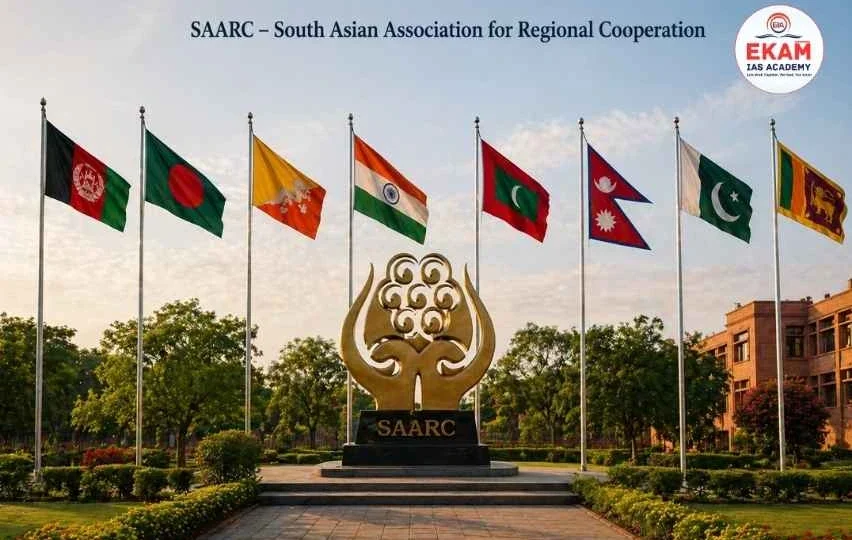
- The IR SAARC Countries upsc notes identify the 8 members:
Afghanistan
Bangladesh
Bhutan
India
Maldives
Nepal (Secretariat in Kathmandu)
Pakistan
Sri Lanka
Objectives and Principles of SAARC
The core SAARC countries and objectives include:
- Welfare Economics: To promote the welfare of the people of South Asia and improve their quality of life.
- Collective Self-Reliance: To strengthen cooperation among developing nations.
- Principles: Cooperation is based on sovereign equality, territorial integrity, political independence, and non-interference in internal affairs.
- Consensus Rule: Decisions at all levels are taken on the basis of unanimity, and bilateral/contentious issues are excluded from deliberations.
Key Areas of Cooperation & Institutions
- Economic: The South Asian Free Trade Area (SAFTA), launched in 2006 to reduce customs duties.
- Educational: South Asian University (SAU) in New Delhi.
- Financial: SAARC Development Fund (SDF) and the SAARC Currency Swap Framework.
- Specialized Bodies: SAARC Arbitration Council (Pakistan) and South Asian Regional Standards Organization (SARSO, Bangladesh).
Achievements of SAARC
Despite the political deadlock, SAARC has seen success in:
- Social Charter: A framework for poverty alleviation and women/child development.
- SAARC Satellite: (South Asia Satellite) launched by India to provide communication and disaster management support to neighbors (except Pakistan).
- Food Bank & Seed Bank: Mechanisms to ensure regional food security during crises.
SAARC Challenges UPSC: Why is it Stagnating?
- Indo-Pak Rivalry: The primary hurdle. The 2016 Uri attack led to the indefinite postponement of the 19th Summit, rendering the body effectively dysfunctional.
- Lack of Trust: Smaller neighbors often suffer from “Big Brother” syndrome regarding India’s dominance.
- Poor Connectivity: Intra-regional trade remains at a dismal 5%, compared to 25% in ASEAN.
- China’s Influence: Increasing Chinese footprints in the neighborhood through the BRI has created fissures within the group.
Declining Relevance and Comparison with BIMSTEC
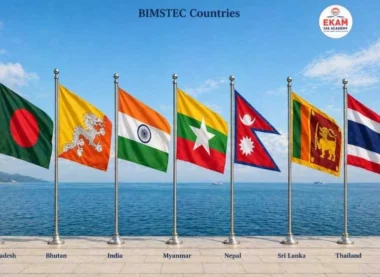
India has increasingly pivoted toward BIMSTEC as a SAARC alternative.
| Feature | SAARC | BIMSTEC |
| Focus | Regional (South Asia) | Inter-regional (Bay of Bengal) |
| Main Hurdle | Pakistan’s obstructionism | Coordination between 7 nations |
| India’s Stance | “Neighborhood First” (Stalled) | “Act East” (Active Bridge) |
| Success Rate | High institutionalization, low output | Low institutionalization, high momentum |
Recent Developments
- Currency Swap: In 2026, India approved a $30 billion withdrawal for Maldives under the SAARC Currency Swap Framework, proving that functional cooperation continues even without summits.
- Climate Change: The region remains one of the most vulnerable to global warming, necessitating a joint SAARC Climate Action Plan.
Way Forward
- Functionalism over Politics: Focus on “low-politics” areas like health, environment, and disaster management.
- Reform Consensus Rule: Moving toward a “Member-Minus-One” approach where willing countries can proceed with projects (e.g., BBIN Motor Vehicle Agreement).
- Connectivity: Prioritizing the SAARC Railway Agreement to boost trade.
Conclusion
While SAARC is currently in “deep freeze,” it remains the only platform where all South Asian leaders can potentially sit at one table. For UPSC aspirants, SAARC is a lesson in the limits of regionalism when bilateral trust is absent. Its revival depends on a paradigm shift from “conflictual geopolitics” to “cooperative economics.”
UPSC Prelims: PYQs & Practice Questions
Previous Year Questions (Prelims)
Q: The ‘South Asia Free Trade Agreement’ (SAFTA) was introduced with a view to:
(a) Create a common currency for all South Asian nations.
(b) Reduce customs duties of all traded goods to zero by 2016.
(c) Establish a military alliance against external threats.
(d) Facilitate the free movement of labor across South Asian borders.
Answer: (b)
Explanation:
SAFTA was signed during the 12th SAARC Summit in 2004 and came into force in 2006. Its core objective was to reduce tariffs to zero for almost all traded goods among member countries to boost intra-regional trade.
Q: Which one of the following was the last country to join SAARC?
(a) Bhutan
(b) Afghanistan
(c) Maldives
(d) Sri Lanka
Answer: (b) Afghanistan
Explanation:
Afghanistan became the 8th member of SAARC during the 14th Summit held in New Delhi in 2007.
Practice Questions
Q: With reference to the ‘South Asian University’ (SAU), consider the following statements:
1. It is an international university established by the eight member nations of SAARC.
2. It is headquartered in Kathmandu, Nepal.
Which of the statements given above is/are correct?
(a) 1 only
(b) 2 only
(c) Both 1 and 2
(d) Neither 1 nor 2
Answer: (a) 1 only
Explanation:
Statement 1 is correct. Statement 2 is incorrect because while the SAARC Secretariat is in Kathmandu, the South Asian University is located in New Delhi, India.
Q: The ‘SAPTA’ (SAARC Preferential Trading Arrangement) was a precursor to which of the following?
(a) BIMSTEC FTA
(b) SAFTA
(c) BBIN Motor Vehicle Agreement
(d) SAARC Currency Swap
Answer: (b) SAFTA
Explanation:
SAPTA was signed in 1993 and provided a framework for exchange of concessions on tariffs. It paved the way for the more comprehensive SAFTA or South Asian Free Trade Area.
UPSC Mains – Previous Year & Practice Questions
Mains Previous Year Questions
Question: Do you agree that SAARC is a parallel organization like the BIMSTEC? What are the similarities and dissimilarities between the two? How are Indian interests served by being a part of an emerging organization? (2022)
Question: The SAARC has failed to live up to its expectations. Discuss the reasons for the failure of SAARC and suggest measures to make it an effective regional organization.
Question: Critically examine the role of the 'Indo-Pak' rivalry in hindering the progress of regional integration in South Asia.
Question: Analyze the significance of sub-regional groupings like BBIN (Bangladesh, Bhutan, India, Nepal) as an alternative to the stagnant SAARC process.
Question: Evaluate the performance of SAARC's functional institutions, such as the SAARC Development Fund (SDF), in the absence of political summits.
Mains Practice Questions
[15 Marks | 250 Words]
Question: SAARC is in a state of 'permanent transition.' Can the group survive without a rapprochement between India and Pakistan? Discuss.
[10 Marks | 150 Words]
Question: Examine the 'Neighborhood First' policy in the context of India's decision to bypass SAARC in favor of BIMSTEC and IORA.
[15 Marks | 250 Words]
Question: The COVID-19 Emergency Fund and the 2026 SAARC Currency Swap suggest that 'functional regionalism' is still alive in South Asia. Elaborate.



SAARC-FAQs
What is the "SAARC Currency Swap Framework"?
It is a facility provided primarily by India (RBI) to help SAARC neighbors manage short-term foreign exchange liquidity requirements or balance of payment crises. In 2024-2026, this has been vital for countries like Sri Lanka and Maldives.
What is the "BBIN" initiative?
Since SAARC is stalled, India, Bangladesh, Bhutan, and Nepal formed the BBIN sub-regional group to cooperate on water power management, inter-grid connectivity, and a Motor Vehicle Agreement (MVA) for seamless cargo movement.
Who are the "Observers" of SAARC?
There are 9 observers: Australia, China, the European Union, Iran, Japan, Mauritius, Myanmar, South Korea, and the USA. China has frequently applied for full membership, which India has resisted.
What is the difference between SAARC and BIMSTEC?
SAARC is a purely South Asian regional group (including Pakistan). BIMSTEC is an inter-regional group linking South Asia and Southeast Asia (excluding Pakistan). India has prioritized BIMSTEC recently to ensure regional progress remains unblocked by bilateral hostilities.