Table of Contents
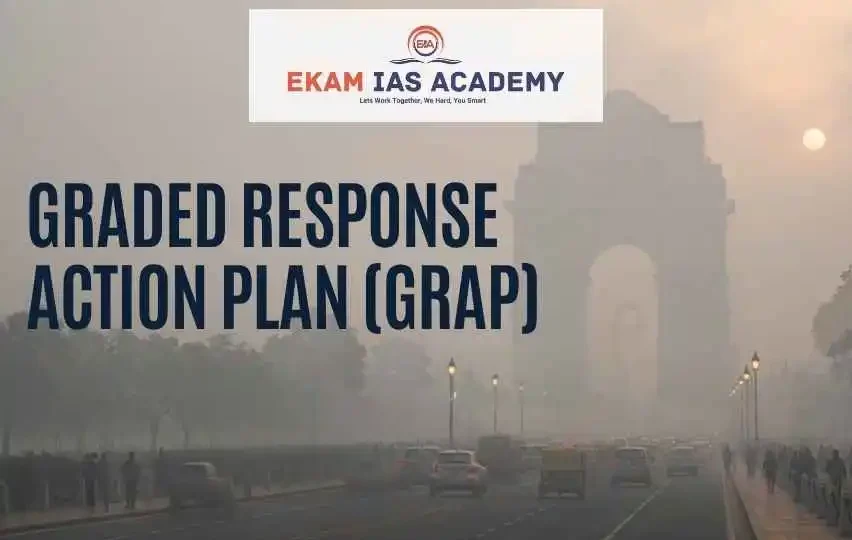
ToggleThe National Capital Region (NCR) suffers from severe atmospheric stagnation every winter due to a mix of industrial emissions, vehicle exhaust, stubble burning, and seasonal weather patterns. To tackle this recurring crisis, the Supreme Court of India stepped in during the M.C. Mehta v. Union of India (2016) case.
Background of GRAP
Following the court’s directives, the Ministry of Environment, Forest and Climate Change (MoEFCC) notified GRAP in 2017. Rather than functioning as a year-round preventive policy, GRAP was designed strictly as an emergency response mechanism to prevent air quality from dropping to hazardous levels when winter smog peaks.
Institutional Framework: AQI and GRAP UPSC Governance
Initially implemented by the Environmental Pollution (Prevention and Control) Authority (EPCA), the governance of GRAP was handed over in 2021 to a powerful statutory body: the Commission for Air Quality Management (CAQM) in NCR and Adjoining Areas.
The operational activation of GRAP relies completely on the Air Quality Index (AQI). The CAQM tracks daily pollution levels across a network of continuous ambient air monitoring stations. A critical operational shift occurred recently: GRAP measures are now triggered based on predictive meteorological forecasts up to three days in advance, allowing authorities to take action before air pollution actually peaks, rather than reacting after the air turns toxic.
The Four Stages of GRAP
The Graded Response Action Plan uses a tiered structure, activating progressively stricter emergency bans as the regional AQI crosses specific pollution thresholds:
| GRAP Stage | AQI Range | Key Measures |
|---|---|---|
| Stage 1: Poor | 201–300 | Mechanized sweeping, dust suppression, and waste checks. |
| Stage 2: Very Poor | 301–400 | Ban on coal/firewood use and hike parking fees to encourage public transport. |
| Stage 3: Severe | 401–450 | Ban on non-essential construction & demolition activities and halt old vehicles. |
| Stage 4: Severe+ | Above 450 | Entry ban on trucks, shift schools online, and implement odd-even vehicle curbs. |
Stage I – 'Poor' Air Quality (AQI 201–300)
Focuses on controlling dust at construction sites, enforcing strict bans on open waste burning, and increasing mechanized road sweeping and water sprinkling
Stage II – 'Very Poor' Air Quality (AQI 301–400)
Bans the use of coal and firewood in open eateries, restricts the use of diesel generator sets, and hikes parking fees to discourage the use of private vehicles.
Stage III – 'Severe' Air Quality (AQI 401–450)
Mandates a strict ban on non-essential Construction and Demolition (C&D) activities, shuts down stone crushers, and allows states to halt the use of older, polluting petrol (BS-III) and diesel (BS-IV) light motor vehicles.
Stage IV – 'Severe +' Air Quality (AQI > 450)
Activates extreme emergency measures, including banning non-essential truck traffic into Delhi, shifting schools online, and implementing the odd-even vehicle rationing scheme.
Policy Comparison: GRAP vs. National Clean Air Programme (NCAP)
To build high-yielding answers for the civil services exam, aspirants must understand how these two frameworks differ in their structural approach:
| Feature/Dimension | Graded Response Action Plan (GRAP) | National Clean Air Programme (NCAP) |
| Primary Nature | Emergency response tool triggered by immediate pollution spikes. | Long-term, preventive policy focused on structural changes. |
| Geographic Scope | Limited strictly to Delhi-NCR and adjoining areas. | Pan-India framework covering over 130 non-attainment cities. |
| Core Objective | Prevent immediate environmental and health breakdowns during peak smog periods. | Achieve a 20% to 30% permanent reduction in PM2.5 and PM10 levels over a multi-year period. |
Challenges in Implementation and Significance
While GRAP provides an organized roadmap for crisis management, its execution faces severe hurdles. A major challenge is inter-state coordination—the NCR airshed spans across Delhi, Haryana, Uttar Pradesh, and Rajasthan, and delayed enforcement across state borders often weakens the plan’s overall impact. Additionally, short-term emergency bans cause sudden economic disruptions for construction workers and daily wage laborers.
However, the significance of GRAP UPSC modules cover is clear: it provides an objective, data-driven template for environmental action. By linking administrative orders directly to scientific AQI thresholds, it eliminates political delays and forces local municipalities to take immediate action to protect public health.
Conclusion
Analyzing the Graded Response Action Plan shows that while emergency measures are vital during pollution spikes, they cannot replace long-term environmental planning. Clearing the skies over Delhi-NCR permanently requires moving past temporary winter bans toward structural solutions. By combining the immediate steps of GRAP with regional energy transitions—such as expanding public electric transport, upgrading industrial boilers to clean fuel, and supporting farmers with bio-decomposer technologies to stop stubble burning—India can move away from seasonal crisis management and secure clean air year-round.
UPSC Prelims: PYQs & Practice Questions
Previous Year Questions (Prelims)
UPSC CSE Prelims 2020
Q: In the context of India, which of the following is/are considered to be of landmark significance in strengthening institutional mechanisms to combat Delhi NCR pollution?
1. The establishment of the
Environment Pollution (Prevention and Control) Authority (EPCA) under the
Environment (Protection) Act, 1986.
2. The notification of the
Graded Response Action Plan (GRAP) following Supreme Court orders in the
M.C. Mehta case.
Select the correct answer using the code given below:
(a) 1 only
(b) 2 only
(c) Both 1 and 2
(d) Neither 1 nor 2
Answer: (c) Both 1 and 2
Explanation:
Both statements are correct. The
EPCA was constituted as a key monitoring and regulatory body for air pollution control in the
National Capital Region (NCR).
Under the Supreme Court’s continuous monitoring in M.C. Mehta v. Union of India, the Graded Response Action Plan (GRAP) was notified in 2017 as an emergency response framework to address worsening air quality.
However, the operational governance of GRAP has now shifted to the Commission for Air Quality Management (CAQM), a statutory body created for air quality management in NCR and adjoining areas.
UPSC CSE Prelims 2016
Q: In the cities of our country, which among the following atmospheric gases are normally considered in calculating the value of the Air Quality Index (AQI)?
1. Carbon dioxide
2. Carbon monoxide
3. Nitrogen dioxide
4. Sulfur dioxide
5. Methane
Select the correct answer using the code given below:
(a) 1, 2 and 3 only
(b) 2, 3 and 4 only
(c) 1, 4 and 5 only
(d) 1, 2, 3, 4 and 5
Answer: (b) 2, 3 and 4 only
Explanation:
India’s National Air Quality Index (AQI) monitors eight major criteria pollutants:
PM10, PM2.5,
NO2, SO2,
CO, O3,
NH3, and Pb.
Carbon monoxide, nitrogen dioxide, and sulfur dioxide are local air pollutants and are included in AQI calculation.
Carbon dioxide and methane are greenhouse gases linked mainly with long-term climate change. They are not used in daily AQI calculation.
Understanding AQI pollutants is important because AQI and GRAP are directly linked: GRAP measures are activated based on the severity of air quality levels.
Practice Questions
Q: In the context of the recent structural and operational modifications made to the Graded Response Action Plan (GRAP) for Delhi-NCR, consider the following statements:
1. The implementation of GRAP stages is purely reactive, meaning Stage III or Stage IV restrictions can only be legally activated after the actual ambient AQI crosses the respective numbers.
2. The statutory authority responsible for monitoring, updating, and issuing enforcement orders under GRAP is the
Commission for Air Quality Management (CAQM).
Which of the statements given above is/are correct?
(a) 1 only
(b) 2 only
(c) Both 1 and 2
(d) Neither 1 nor 2
Answer: (b) 2 only
Explanation:
Statement 1 is incorrect. GRAP is no longer only a reactive mechanism. Recent operational changes have made it more
forecast-based and preventive.
The CAQM can activate stricter measures such as Stage III or Stage IV in advance, based on meteorological conditions, pollution forecasts, and expected AQI deterioration.
Statement 2 is correct. The Commission for Air Quality Management is the statutory authority responsible for monitoring, updating, and enforcing GRAP across the Delhi-NCR airshed.
Q: Under the revised Graded Response Action Plan (GRAP) guidelines, a complete ban on non-essential Construction and Demolition (C&D) activities, along with restrictions on older BS-III petrol and BS-IV diesel light motor vehicles, is mandated under which specific stage?
(a) Stage I — Poor
(b) Stage II — Very Poor
(c) Stage III — Severe
(d) Stage IV — Severe Plus
Answer: (c) Stage III — Severe
Explanation:
Stage III of GRAP is activated when air quality reaches the
Severe category, generally corresponding to an AQI range of
401–450.
This stage targets major local pollution sources by imposing a strict ban on non-essential construction and demolition activities, closing stone crushers, and restricting highly polluting activities.
It also includes restrictions on older and more polluting vehicles such as BS-III petrol and BS-IV diesel light motor vehicles in NCR areas, helping reduce vehicular emissions during severe pollution episodes.
UPSC Mains – Previous Year & Practice Questions
Mains Previous Year Questions
Mains 2021
Question: Describe the key points of the Revised
Global Air Quality Guidelines issued by the
World Health Organization (WHO) and how these differ from its last update of 2005. What changes in India's
National Clean Air Programme are required to achieve these revised standards?
(Directly connects to understanding the strict air quality thresholds that trigger emergency programs like GRAP.)
Mains 2018
Question: How city-states like
Delhi are dealing with severe
air pollution crises? Suggest structural measures.
(Directly requires evaluating the role of GRAP alongside long-term strategies like expanding the metro and fuel switches.)
Mains 2020
Question: How does the draft
Environment Impact Assessment (EIA) Notification differ from the existing
EIA Notification, 2006?
(Useful for linking environmental clearances with pollution control, industrial regulation, and NCR air quality governance.)
Mains 2015
Question: Industrial corridors are engines of economic growth but come with heavy environmental costs. Discuss.
(Can discuss how heavy industrial zoning surrounding the NCR complicates seasonal airshed stabilization.)
Mains 2013
Question: Enumerate the
National Green Tribunal’s roles and responsibilities in handling
environmental clearance disputes.
(Can be connected to institutional environmental justice, pollution control orders, and air quality enforcement mechanisms.)
Mains Practice Questions
[15 Marks | 250 Words]
Question: The Graded Response Action Plan (GRAP) is an emergency firefighting tool, not a permanent cure for Delhi NCR pollution. Differentiate between the emergency mandates of GRAP and the structural goals of the National Clean Air Programme (NCAP).
[15 Marks | 250 Words]
Question: Analyze how shifting the execution of GRAP from a reactive model to a predictive model based on meteorological forecasting changes its administrative effectiveness. What challenges remain regarding compliance across multiple states?
[10 Marks | 150 Words]
Question: While Stage III and Stage IV restrictions under the Graded Response Action Plan are necessary to safeguard public health during severe smog episodes, they cause significant livelihood losses for informal and construction laborers. Suggest welfare measures to balance environmental health with economic survival.



GRAP-FAQs
What is GRAP?
GRAP is an emergency pollution-control plan for Delhi-NCR. It activates stage-wise restrictions based on AQI levels to reduce severe winter air pollution.
How does CAQM trigger GRAP early?
CAQM uses IITM’s Air Quality Early Warning System to predict pollution up to 72 hours in advance. It uses satellite data, stubble-burning inputs, wind speed, and weather models.
What happens during GRAP Stage IV?
Stage IV applies when AQI crosses 450. It includes truck entry bans, construction halts, possible school closures, and stricter vehicle restrictions.
Why does Delhi-NCR face winter air stagnation?
Winter thermal inversion traps pollutants near the ground. Low wind speed and stubble-burning smoke from northwestern states worsen Delhi-NCR’s air pollution.
Difference between GRAP and NCAP?
GRAP is a short-term emergency plan for Delhi-NCR pollution spikes. NCAP is a long-term national programme to reduce air pollution in non-attainment cities.