Table of Contents
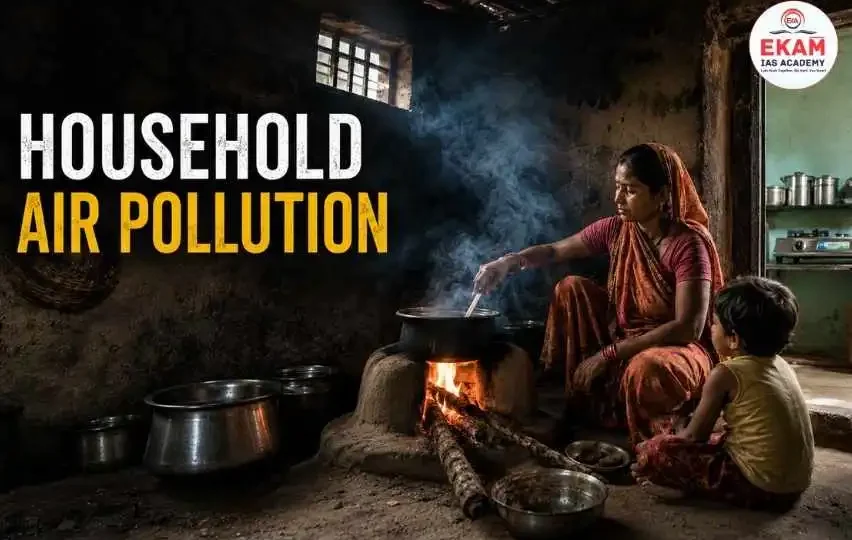
ToggleHousehold Air Pollution (HAP), often studied interchangeably with indoor air pollution UPSC modules, refers to the chemical, physical, and biological contamination of air inside residential spaces. This problem is particularly severe in households that rely on incomplete combustion of solid fuels in poorly ventilated kitchens. The World Health Organization (WHO) identifies HAP as one of the leading environmental causes of avoidable disease and premature death globally.
Sources, Major Pollutants, and Causes
The primary causes of household air pollution stem from socio-economic factors and traditional energy practices.
Core Sources:
- Traditional Biomass Fuel: Relying heavily on firewood, crop residues, and dried cow dung cakes for daily cooking and space heating.
- Kerosene Consumption: Using simple kerosene lamps for lighting and primitive pressure stoves for cooking.
- Structural and Lifestyle Factors: Poor architectural design with minimal ventilation traps toxic fumes inside living quarters, alongside the use of chemical mosquito coils and incense sticks.
Major Indoor Pollutant Impact Particulate Matter (PM₂.₅) Penetrates deep into the bloodstream Carbon Monoxide (CO) Binds with hemoglobin, causing asphyxiation Toxic Organics Includes Polycyclic Aromatic Hydrocarbons (PAHs) and Formaldehyde
Health and Environmental Impacts
The health impacts of indoor air pollution fall heavily on vulnerable groups, particularly women and young children who spend the most time near domestic hearths.
A. Severe Health Impacts
- Respiratory Diseases: Chronic Obstructive Pulmonary Disease (COPD), acute lower respiratory infections in children, and aggravated asthma.
- Systemic Health Risks: Ischemic heart disease, stroke, and cataracts caused by constant exposure to fine particulate matter ($PM_{2.5}$).
- Maternal Risks: Adverse pregnancy outcomes, including low birth weight and premature delivery.
B. Environmental Impacts
HAP is not just a localized health issue; it directly impacts broader ecosystems. The incomplete combustion of biomass releases large amounts of black carbon, a potent short-lived climate pollutant that accelerates global warming and alters regional monsoon cycles. Furthermore, gathering firewood drives local deforestation and habitat fragmentation.
The Indian Context and Sustainable Development
In India, the geographic spread of HAP follows a clear rural-urban divide, closely tied to energy poverty. Millions of rural households still rely on traditional chulhas (mud stoves), making indoor smoke a significant contributor to the country’s overall ambient air pollution.
Alignment with Sustainable Development Goals (SDGs):
Addressing HAP is vital for achieving several United Nations targets:
- SDG 3 (Good Health and Well-Being): Reducing deaths caused by indoor air toxins.
- SDG 5 (Gender Equality): Saving women from the time-consuming and exhausting chore of gathering firewood.
- SDG 7 (Affordable and Clean Energy): Ensuring universal access to modern clean cooking solutions.
Government Initiatives and Mitigation Measures
The Government of India has launched targeted programs to transition rural kitchens toward clean energy:
- Pradhan Mantri Ujjwala Yojana (PMUY): The Pradhan Mantri Ujjwala Yojana UPSC notes highlight is India’s flagship program designed to provide clean cooking fuel to poor households. By distributing deposit-free LPG connections to women from below-poverty-line (BPL) families, PMUY has significantly reduced reliance on traditional biomass, fundamentally transforming rural health and energy access.
- Unnat Chulha Abhiyan: A supportive initiative focused on designing and distributing high-efficiency, biomass-burning cookstoves with built-in chimneys for areas where LPG adoption remains difficult.
Challenges and Future Strategies
Despite the success of the Pradhan Mantri Ujjwala Yojana UPSC monitors, deep challenges remain. A major obstacle is sustained refill cylinder adoption—while initial connections are free, the high recurring cost of commercial LPG refills often pushes low-income families back to using free, gathered biomass. Additionally, deeply ingrained cultural preferences for food cooked on traditional mud stoves present behavioral hurdles to complete energy adoption.
Future Strategies:
To overcome these challenges, India must implement tiered cylinder refill subsidies for vulnerable communities, scale up the domestic manufacturing of affordable induction cooktops, and promote biogas plants in cattle-rich rural regions to secure a clean, decentralized, and sustainable energy future.
Conclusion
Analyzing household air pollution UPSC notes shows that energy access is a human rights and environmental priority, not just an economic metric. Resolving this crisis requires moving beyond one-time fuel distribution toward a reliable model of clean energy use. By fixing supply-chain issues, expanding behavioral awareness programs, and aligning domestic initiatives like PMUY with global health standards, India can clear its indoor air and protect the health of millions of citizens.
UPSC Prelims: PYQs & Practice Questions
Previous Year Questions (Prelims)
UPSC CSE Prelims 2018
Q: Why is there a great concern about the microbeads that are released into the environment?
(a) They are considered harmful to marine ecosystems.
(b) They are absorbed by crop plants in irrigated fields.
(c) They are often found to cause skin cancer in children.
(d) They are small enough to be absorbed by crop plants in irrigated fields.
Answer: (a) They are considered harmful to marine ecosystems.
Explanation:
Microbeads are tiny plastic particles commonly used in personal-care products. Due to their small size, they escape normal wastewater filtration and enter rivers, lakes, and oceans.
They are harmful because marine organisms may ingest them, allowing toxic substances to enter the aquatic food chain.
This question also helps understand other micro-pollutants such as PM2.5 from household biomass burning. Like microbeads in water, PM2.5 is small enough to bypass natural defense systems and enter deep into the lungs and bloodstream.
UPSC CSE Prelims 2015
Q: With reference to the Global Environment Facility (GEF), which of the following statements is/are correct?
(a) It serves as a financial mechanism for the
Convention on Biological Diversity and the
United Nations Framework Convention on Climate Change.
(b) It undertakes scientific research on environmental issues at global level.
(c) It is an agency under OECD to facilitate the transfer of technology and funds to underdeveloped countries.
(d) Both A and B
Answer: (a) It serves as a financial mechanism for the Convention on Biological Diversity and UNFCCC.
Explanation:
The Global Environment Facility (GEF) is a major international funding mechanism for global environmental projects.
It supports developing countries in meeting obligations under key environmental conventions such as the CBD, UNFCCC, UNCCD, Stockholm Convention, and Minamata Convention.
In the context of household air pollution, GEF-backed climate and clean-energy initiatives are relevant because they help reduce short-lived climate pollutants like black carbon, which is emitted from biomass burning and traditional cookstoves.
Practice Questions
Q: In the context of the chemical dynamics of indoor air pollution, consider the following statements regarding Black Carbon:
1. It is a major component of fine particulate matter
(PM2.5) formed by the complete combustion of fossil fuels in industrial facilities.
2. It is a potent
short-lived climate pollutant (SLCP) with a warming impact on the atmosphere that is significantly stronger than
Carbon Dioxide (CO2) gram-for-gram, though it remains in the air for only days to weeks.
Which of the statements given above is/are correct?
(a) 1 only
(b) 2 only
(c) Both 1 and 2
(d) Neither 1 nor 2
Answer: (b) 2 only
Explanation:
Statement 1 is incorrect.
Black carbon is produced mainly through the
incomplete combustion of biomass, wood, coal, diesel, and other fossil fuels.
Traditional rural cooking stoves, biomass burning, diesel engines, and open burning are major sources of black carbon.
Statement 2 is correct. Black carbon is a powerful short-lived climate pollutant. Although it remains in the atmosphere only for days to weeks, its warming impact is intense.
It contributes to atmospheric warming, accelerates glacial melt, and can influence regional climate systems such as the monsoon.
Q: Which of the following best describes the structural target of the Pradhan Mantri Ujjwala Yojana (PMUY) to mitigate the causes of household air pollution?
(a) Installing rooftop solar panels on all rural households to power electric induction cooktops.
(b) Providing deposit-free Liquefied Petroleum Gas (LPG) connections to women from below-poverty-line households to replace traditional biomass.
(c) Distributing financial subsidies to multinational corporations for setting up commercial bio-CNG plants.
(d) Restricting the rural sale of kerosene by replacing it entirely with ethanol-blended fuels.
Answer: (b) Providing deposit-free LPG connections to women from below-poverty-line households to replace traditional biomass.
Explanation:
The Pradhan Mantri Ujjwala Yojana (PMUY) is a major social welfare and environmental intervention in India.
Its core objective is to provide deposit-free LPG connections to women from poor and vulnerable households.
This helps shift households away from traditional biomass-based cooking using firewood, cow dung cakes, crop residues, and smoky chulhas.
By promoting cleaner cooking fuel, PMUY directly reduces exposure to PM2.5, black carbon, carbon monoxide, and other harmful indoor pollutants, especially for women and children.
UPSC Mains – Previous Year & Practice Questions
Mains Previous Year Questions
Mains 2021
Question: Describe the key points of the Revised
Global Air Quality Guidelines issued by the
World Health Organization (WHO) and how these differ from its last update of 2005. What changes in India's
National Clean Air Programme are required to achieve these revised standards?
(Highly relevant since WHO guidelines heavily focus on lowering the PM2.5 exposure thresholds driven by indoor biomass burning.)
Mains 2018
Question: How city-states like
Delhi are dealing with severe
air pollution crises? Suggest structural measures.
(Allows you to discuss how indoor air pollution from rural cooking in surrounding states contributes significantly to regional background ambient smog.)
Mains 2016
Question: Give an account of the current status and the targets to be achieved pertaining to
renewable energy sources in the country.
(Can be linked with clean domestic energy transition, LPG access, electric cooking, and reduced dependence on biomass fuels.)
Mains 2015
Question: Maternal health and
infant mortality remain critical parameters for human development. Discuss how
environmental conditions affect these outcomes.
(Directly tests the health impacts of indoor air pollution on pregnant women, infants, and children.)
Mains 2013
Question: What do you understand by
UMN (Universal Minimum Needs)? How far has India progressed in securing
clean domestic energy for its citizens?
(Useful for linking household energy access, PMUY, clean cooking fuel, and basic quality-of-life outcomes.)
Mains Practice Questions
[15 Marks | 250 Words]
Question: Despite high initial connection rates under the Pradhan Mantri Ujjwala Yojana, the phenomenon of “energy stacking” — where households use LPG alongside traditional biomass — persists. Analyze the socio-economic factors behind this trend and suggest policy fixes.
[10 Marks | 150 Words]
Question: Household Air Pollution (HAP) is not merely an environmental issue but a deep-seated gender equity crisis in rural India. Elaborate on the health and economic burdens borne by rural women due to traditional cooking fuels.
[15 Marks | 250 Words]
Question: Discuss how indoor air pollution from solid biomass combustion contributes to the degradation of ambient outdoor air quality. How can a transition to decentralized biogas plants resolve this dual crisis?



Household Air Pollution-FAQs
What is Energy Stacking?
Energy stacking means using both LPG and traditional biomass fuels instead of fully shifting to clean fuel. It happens due to LPG refill cost and cultural preference for wood-fired cooking.
What pollutants come from cow dung and firewood burning?
Incomplete burning releases PM2.5, PM10, carbon monoxide, PAHs, and formaldehyde. These pollutants damage lungs, reduce oxygen supply, and increase cancer risk.
How does household air pollution affect climate?
Biomass burning releases black carbon, which warms the air by absorbing sunlight. When it settles on glaciers, it reduces albedo and accelerates melting.
How does PMUY support SDG 5?
PMUY reduces women’s time spent collecting firewood and exposure to smoke. This improves health, reduces physical burden, and supports education or work opportunities.
What are Advanced Biomass Cookstoves?
They are improved chulhas designed for cleaner and efficient biomass burning. They reduce smoke and fuel use, but are not as clean as LPG or electric cooking.