Table of Contents
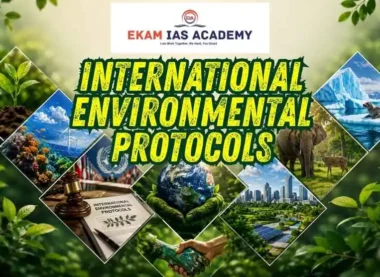
ToggleEcosystems do not obey national borders. Industrial emissions in one continent accelerate glacial melt in another, while ocean plastic pollution degrades marine biomes globally. This ecological connectivity highlights the critical need for comprehensive global sustainable development initiatives UPSC modules cover. Without coordinated multilateral frameworks, individual nations face the “Tragedy of the Commons,” where short-term resource exploitation overrides long-term global survival.
Evolution of Global Environmental Governance
The architecture of modern multilateral eco-governance has evolved through several milestone conventions, shifting from basic conservation to integrated sustainable development frameworks:
[1972] Stockholm Conference ──► Focus: Human Environment & creation of UNEP
                                     │
[1992] Rio Earth Summit      ──► Focus: Climate, Biodiversity, & Agenda 21
                                     │
[2015] Paris Agreement       ──► Focus: Enforceable legally-binding climate targets
Major International Efforts and Environmental Agreements
To operationalize global governance, the international community relies on specific, legally binding international environmental agreements UPSC aspirants must master:
A. Core Climate Mitigation Frameworks
- UNFCCC & The Paris Agreement: The United Nations Framework Convention on Climate Change (UNFCCC) serves as the primary vehicle for global climate action. Its landmark Paris Agreement mandates all nations to submit Nationally Determined Contributions (NDCs) to limit global warming to well below $2^\circ\text{C}$ above pre-industrial levels.
- The Kyoto Protocol: An earlier framework that introduced legally binding emission reduction targets for developed economies, establishing market-based mechanisms like the Clean Development Mechanism (CDM).
B. Biodiversity and Ecosystem Conservation
- Convention on Biological Diversity (CBD): Focuses on conserving biological diversity and ensuring the fair, equitable sharing of benefits arising from genetic resources. This includes the historic Kunming-Montreal Global Biodiversity Framework, which aims to protect 30% of the planet’s lands and oceans by 2030 (“30×30 target”).
- The Ramsar Convention: A dedicated global treaty focusing specifically on the conservation and sustainable use of ecologically vital wetlands.
- CITES: Regulates international trade in endangered species of wild fauna and flora to prevent overexploitation.
International Organizations and Climate Finance
Global sustainability efforts are managed and funded by specialized multilateral institutions:
- United Nations Environment Programme (UNEP): The leading global environmental authority that sets the global environmental agenda and promotes coherent implementation of sustainability within the UN system.
- Global Environment Facility (GEF): Functions as a major joint financial mechanism, providing grants to developing countries to meet the objectives of international environmental conventions.
- Green Climate Fund (GCF): Formed under the UNFCCC framework to redirect investment capital from developed nations down into developing economies, funding critical climate adaptation and clean energy transitions.
India's Strategic Role and Global Challenges
India has transitioned from a participant into a proactive leader within global environmental governance, balancing its domestic development needs with ambitious international climate pledges:
- International Solar Alliance (ISA): A joint initiative launched by India and France to mobilize institutional capital and scale up solar energy deployments across solar-rich countries.
- Coalition for Disaster Resilient Infrastructure (CDRI): A global partnership launched by India to promote the resilience of infrastructure systems against climate and disaster risks.
Structural Challenges
Despite extensive frameworks, global sustainability faces deep obstacles. The persistent North-South Divide continues to stall negotiations, as developed nations often fail to deliver on their promised $100 billion annual climate finance commitments. Additionally, the non-binding nature of many international treaties allows high-emitting nations to bypass strict environmental accountability without facing legal penalties.
Future Strategies
Moving forward, global governance must shift away from fragmented, sector-specific treaties toward integrated, legally enforceable ecosystem frameworks. This requires indexing climate finance directly to measurable conservation outcomes and accelerating technology transfers to developing countries.
Conclusion
In conclusion, analyzing international efforts to achieve sustainability demonstrates that planetary survival requires absolute multilateral solidarity. By aligning domestic policies with global mandates like the UN Sustainable Development Goals (SDGs) and scaling up initiatives like the International Solar Alliance, the global community can build a resilient, circular economy that preserves the biosphere for future generations.
UPSC Prelims: PYQs & Practice Questions
Previous Year Questions (Prelims)
UPSC CSE Prelims 2016
Q: With reference to Agenda 21, sometimes seen in the news, consider the following statements:
1. It is a global action plan for sustainable development.
2. It originated in the World Summit on Sustainable Development held in Johannesburg in 2002.
Which of the statements given above is/are correct?
(a) 1 only
(b) 2 only
(c) Both 1 and 2
(d) Neither 1 nor 2
Answer: (a) 1 only
Explanation:
Statement 1 is correct.
Agenda 21 is a comprehensive, non-binding global action plan designed to promote
sustainable development across local, national, and global levels.
Statement 2 is incorrect. Agenda 21 originated at the United Nations Conference on Environment and Development (UNCED), popularly known as the Earth Summit, held in Rio de Janeiro, Brazil, in 1992, not at the Johannesburg Summit of 2002.
UPSC CSE Prelims 2023
Q: Consider the following statements:
1. The Global Environment Facility (GEF) provides grants to developing countries for projects related to
biodiversity, climate change, and
international waters.
2. The GEF functions as a financial mechanism for both the
Convention on Biological Diversity (CBD) and the
United Nations Framework Convention on Climate Change (UNFCCC).
Which of the statements given above is/are correct?
(a) 1 only
(b) 2 only
(c) Both 1 and 2
(d) Neither 1 nor 2
Answer: (c) Both 1 and 2
Explanation:
Both statements are correct. The
Global Environment Facility (GEF) was established around the
1992 Rio Earth Summit framework to provide grants and concessional funding to developing countries.
It supports projects related to biodiversity conservation, climate change, international waters, land degradation, chemicals, and waste management.
The GEF acts as a financial mechanism for major global environmental conventions such as the CBD, UNFCCC, UNCCD, Stockholm Convention on Persistent Organic Pollutants, and the Minamata Convention on Mercury.
Practice Questions
Q: In the context of global biodiversity governance, consider the following statements regarding the Kunming-Montreal Global Biodiversity Framework (GBF):
1. It was adopted under the aegis of the
United Nations Framework Convention on Climate Change (UNFCCC) during COP27.
2. It mandates the “30x30 target”, which aims to ensure that at least
30 percent of the world’s degraded terrestrial, inland water, coastal, and marine ecosystems are under effective restoration and conservation by 2030.
Which of the statements given above is/are correct?
(a) 1 only
(b) 2 only
(c) Both 1 and 2
(d) Neither 1 nor 2
Answer: (b) 2 only
Explanation:
Statement 1 is incorrect. The
Kunming-Montreal Global Biodiversity Framework (GBF) was adopted under the
Convention on Biological Diversity (CBD) at its
15th Conference of the Parties (COP15), not under the UNFCCC.
Statement 2 is correct. Target 3 of the GBF is popularly known as the 30x30 target. It aims to place at least 30% of the world’s terrestrial, inland water, coastal, and marine areas under effective conservation and restoration by 2030.
This target is important for reversing catastrophic habitat loss, strengthening biodiversity protection, and improving ecosystem resilience.
Q: The international market-based mechanism known as the Clean Development Mechanism (CDM), which allows developed nations to invest in green infrastructure projects within developing nations to earn carbon credits, was officially established under which treaty?
(a) The Paris Agreement
(b) The Kyoto Protocol
(c) The Montreal Protocol
(d) The Vienna Convention
Answer: (b) The Kyoto Protocol
Explanation:
The Clean Development Mechanism (CDM) was officially defined under
Article 12 of the Kyoto Protocol, 1997.
It allowed industrialized nations with binding emission-reduction targets to invest in emission-reduction projects in developing countries and earn carbon credits.
CDM served as a market-based climate mechanism that linked climate finance, technology transfer, and sustainable development with global greenhouse gas reduction efforts.
UPSC Mains – Previous Year & Practice Questions
Mains Previous Year Questions
Mains 2022
Question: Clean energy is the order of the day.
Describe briefly India’s changing policy towards climate change in various international fora in the context of
COP-26.
(Directly tests India's strategic leadership in global climate negotiations.)
Mains 2021
Question: Explain the purpose of the
Green Grid Initiative —
One Sun One World One Grid (OSOWOG) launched at the World Leaders’ Summit of the
COP26 Climate Conference.
(Evaluates cross-border clean energy grid integration frameworks.)
Mains 2019
Question: Describe the major outcomes of the
24th Conference of the Parties (COP-24) of the
United Nations Framework Convention on Climate Change (UNFCCC).
(Tests details of the Paris Agreement Work Programme or Rulebook.)
Mains 2016
Question: Give an account of the current status and the targets to be achieved pertaining to
renewable energy sources in the country.
(Connects India's domestic energy goals directly to its international climate pledges.)
Mains 2015
Question: Discuss the
Namami Gange and
National Mission for Clean Ganga (NMCG) programmes and causes of mixed results from the previous schemes.
(Useful for linking river rejuvenation, sustainable development, pollution control, and institutional governance.)
Mains Practice Questions
[15 Marks | 250 Words]
Question: The persistent delay by developed nations in fulfilling their promised USD 100 billion annual climate finance commitment remains a central friction point in global environmental governance. Analyze the impacts of this funding deficit on the climate adaptation strategies of developing countries.
[15 Marks | 250 Words]
Question: Examine how the Kunming-Montreal Global Biodiversity Framework seeks to address the structural failures of the earlier Aichi Biodiversity Targets. Discuss India's readiness to achieve the “30x30” conservation target.
[10 Marks | 150 Words]
Question: Evaluate how India has transitioned from a defensive participant to a proactive rule-maker in global sustainable development initiatives, with special reference to the International Solar Alliance (ISA).



International Efforts to Achieve Sustainability-FAQs
What is North-South Divide?
It refers to disagreements between developed and developing countries in climate negotiations. Developing nations demand climate finance and technology transfer because developed nations caused most historical emissions.
Difference between Convention and Protocol?
A Convention is a broad framework treaty, like UNFCCC. A Protocol is a specific legal agreement under it with binding targets or rules, like the Kyoto Protocol.
What is Green Climate Fund?
The Green Climate Fund supports developing countries in climate mitigation and adaptation. It funds clean energy, green infrastructure, and climate-resilient agriculture.
What is CBDR principle?
CBDR means all countries share environmental responsibility, but not equally. Developed nations must take greater responsibility due to higher historical emissions and stronger capacity.
What is Tragedy of the Commons?
It means shared resources like oceans and atmosphere get overused when countries act in self-interest. International agreements solve this through common rules, quotas, and monitoring.