

Table of Contents
ToggleINDIA–FRANCE RELATIONS
TOPIC: (GS2) INTERNATIONAL RELATIONS: INDIAN EXPRESS
The Indian PM and French President held bilateral talks in Nice, their first meeting after elevating ties to a Special Global Strategic Partnership.
Economic and Trade Cooperation
- Doubling Trade: Target to raise bilateral trade from $16 billion to $32 billion by 2030 through a HighLevel Mechanism.
- India–EU FTA: Both sides stressed early conclusion to unlock investment and market access.
- Economic Security Dialogue: New platform to strengthen supply chains, secure critical minerals, and expand SME, aviation, and railway cooperation.
- Skill Development: Centre of Excellence for Aeronautics in Kanpur to support aerospace manufacturing.
Defence Partnership
- CoDevelopment: Focus on joint design and production of advanced defence platforms.
- Existing Cooperation:
- Rafale jets for Air Force & Navy.
- Scorpene submarines.
- Shakti helicopter engines.
- Joint helicopter manufacturing.
- Milestone: Inauguration of H125 Helicopter Final Assembly Line in Karnataka (2026) by Tata Advanced Systems & Airbus.
Space and Nuclear Collaboration
- Space Cooperation: ISRO–CNES partnership expanded to human spaceflight, SSA, and private sector participation.
- Civil Nuclear Energy: India’s SHANTI Act opens avenues for collaboration in Small Modular Reactors (SMRs) and advanced nuclear technologies.
Innovation and Technology
- Innovation Roadmap 2030: Provides a longterm framework for cooperation in technology, guiding joint projects till 2030.
- AI Working Group: A joint body focusing on AI governance, ethics, and responsible use of emerging technologies.
- Deep Tech Collaboration: Expanding partnerships in semiconductors, agritech, medtech, renewable energy, defence tech, and space technologies.
- 19 Agreements: Signed between institutions of both countries, strengthening innovation ecosystems.
Digital, Education, Mobility and Culture
- UPI Expansion: Airports in Nice and Paris to enable UPI payments, promoting India’s digital public infrastructure globally.
- Talent Mobility: Mutual recognition of qualifications, student exchanges, and French campuses in India under NEP 2020.
- VisaFree Transit: France operationalised visafree airport transit for Indian nationals, easing travel.
- Cultural Cooperation: Collaboration among museums and heritage institutions, including the National Maritime Heritage Complex.
Trade dynamics
- Bilateral trade target: $32 billion by 2030, up from $16 billion in 202526.
- Indian exports to France: $7.1 billion in 202526, making France India’s 3rd largest EU trading partner (after Netherlands & Germany).
- Defence cooperation: Includes Rafale jets, Scorpene submarines, and H125 helicopter assembly line in Karnataka (2026).
- Space partnership: Over 60 years of ISRO–CNES collaboration, now expanding to human spaceflight and SSA.
- Nuclear energy: India’s SHANTI Act opens scope for Small Modular Reactors (SMRs) and advanced nuclear technologies.
Historical Context
- Strategic Partnership: Established in 1998, first for India with a Western nation.
- Shared Values: Democracy, multilateralism, respect for international law.
- Horizon 2047: Roadmap for next 25 years of cooperation, marking 25 years of partnership in 2023.
- Defence Exercises: SHAKTI (Army), GARUDA (Air Force), VARUNA (Navy).
- Diaspora: 119,000 Indians live in mainland France, strengthening peopletopeople ties.
- Year of Innovation 2026 : Jointly inaugurated in Mumbai, celebrating bilateral innovation.
Conclusion
The India–France Special Global Strategic Partnership is evolving into a comprehensive framework of trade, defence, technology, and global governance, positioning both nations as key partners in addressing 21stcentury challenges.
SHIP RECYCLING IN INDIA
TOPIC: (GS3) ECONOMY: THE HINDU
India has issued its first ship recycling credit note to Bella Shipping under a new scheme announced in Budget 202526, aimed at promoting green ship recycling and linking it with domestic shipbuilding.
Ship Recycling in India
- Dismantling endoflife ships to recover steel, machinery, spare parts, and reusable equipment, while ensuring safe disposal of hazardous waste (asbestos, heavy metals, oils).
- Globally, ~16,000 ships (700 million DWT) are expected to be recycled in the next decade, highlighting the scale of the industry.
Economic Role
- Steel Recovery: India recycles 4.5 million LDT (Light Displacement Tonnage) annually, with plans to expand capacity to 9 million LDT by 2047 under the Maritime Amrit Kaal Vision 2047.
- Energy Savings: Recycled steel requires 60–70% less energy compared to primary steel production, reducing carbon emissions.
- Employment: Provides jobs to thousands in coastal Gujarat, Maharashtra, and Tamil Nadu, sustaining ancillary industries like rerolling mills, transport, and waste management.
- Import Substitution: Reduces dependence on imported scrap metal, strengthening India’s steel supply security.
Global Position
- India contributes 33% of global ship recycling tonnage and nearly onethird of vessels recycled worldwide (FY26).
- AlangSosiya Yard (ASSRY), Gujarat: Largest ship recycling hub globally, handling 97% of India’s recycling activity with 120 operational plots, many HKCcompliant.
- India is increasingly seeking EU whitelist compliance under the EU Ship Recycling Regulation, enabling recycling of EUflagged vessels.
Legal & Environmental Framework
- Governed by the Recycling of Ships Act, 2019, aligned with the Hong Kong International Convention (HKC).
- HKC entered into force globally in June 2025; India ratified it in 2019, strengthening its credibility.
- Focus areas:
- Safe handling of asbestos, heavy metals, toxic oils.
- Worker safety and emergency preparedness.
- Pollution control and coastal protection.
- India ratified the Hong Kong Convention in 2019, strengthening its global leadership in ship recycling.
Economic Importance
- Recovery of steel for domestic industries.
- Employment generation in coastal regions.
- Growth of ancillary maritime industries.
- Supports Maritime India Vision 2030 and the Blue Economy framework.
How the Scheme Works
- Credit Note Value: Ship owners receive 40% of the scrap value of a dismantled vessel as a credit note.
- Redemption: The credit can be used to cover up to 5% of the cost of a new ship built in an Indian shipyard.
- Eligibility: Only Hong Kong Convention (HKC) compliant yards qualify, ensuring environmental and safety standards.
- Objective: Strengthen the circular economy, link recycling with domestic shipbuilding, and enhance competitiveness of Indian shipyards.
Challenges
- India processed only ~13% of global recycled tonnage, showing reliance on dismantling smaller ships rather than large carriers.
- Limited Shipbuilding Capacity: India currently lacks infrastructure to build large commercial vessels, restricting full use of the scheme.
- Digital Systems: Need for faster rollout of digital credit note platforms and simplified approval processes.
- Skilled Labour: Expansion of trained maritime workforce is essential for scaling shipbuilding.
- Infrastructure Expansion: Greater investment in shipyards and ancillary industries required to match global standards.
Conclusion
India’s new green ship recycling initiative is a strategic step linking sustainability with industrial growth, positioning the country as a global hub for ecofriendly recycling and shipbuilding.
GLOBAL REFUGEES AND UNHCR REPORT 2025
TOPIC: (GS2) INTERNATIONAL RELATIONS: THE HINDU
The UNHCR report (2025) shows that the global refugee population will decline marginally by 3% to 46.1 million, but many are returning home due to adverse conditions rather than improved safety, raising humanitarian concerns.
Refugee Numbers and Origins
- Decline in Refugees: Estimated fall to 46.1 million in 2025.
- Key Source Countries: Syria, Venezuela, Afghanistan, Ukraine, South Sudan, Sudan remain major contributors.
- Palestinian Refugees: Account for nearly 15% of global refugee population.
- Return Trends: Many return not due to peace but because of lack of options in host countries (examples: Afghanistan, Sudan, Ukraine).
Countries of Asylum
- Top Hosts: Türkiye, Iran, Colombia, Pakistan, Uganda, Germany, Chad.
- Challenges: Pressure on host nations’ resources, healthcare, and employment.
- Regional Concentration: Türkiye and Iran together host millions, especially Syrians and Afghans.
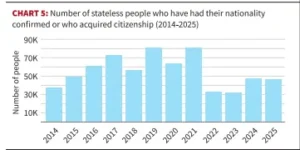
Asylum Applications 2025
- Ukraine: 7.5 lakh asylum seekers; U.S. received 9.1 lakh applications.
- Sudan: 6 lakh displaced; Egypt hosted ~2.95 lakh.
- Venezuela: 3.05 lakh asylum seekers; Germany received ~2.88 lakh.
- South Sudan: 2.32 lakh displaced; Spain hosted ~1.74 lakh.
- Other flows: From Burkina Faso, Mali, Myanmar, Cuba, DRC, with asylum destinations including Poland, Uganda, Mauritania, Italy, Bangladesh.
Legal and Humanitarian Dimensions
- International Law: Refugee protection governed by 1951 Refugee Convention and 1967 Protocol.
- UNHCR Role: Coordinates humanitarian aid, resettlement, and monitoring.
- Challenges: Lack of enforcement mechanisms, politicisation of asylum, and inadequate funding.
- India’s Position: Not a signatory to the 1951 Convention but hosts refugees from Tibet, Sri Lanka, Myanmar, Afghanistan, and supports UNHCR humanitarian efforts.
Broader Implications
- Security Concerns: Refugee flows linked to conflict zones, sanctions, and fragile states.
- Economic Impact: Strain on host countries’ infrastructure but also contribution to labour markets.
- Humanitarian Ethics: Returning refugees due to unsafe conditions highlights gaps in global protection frameworks.
- Global Governance: Need for stronger cooperation under UN, G7, and regional platforms to address displacement.
Conclusion
The refugee crisis underscores that forced returns without safety reflect systemic failures in global governance, demanding stronger international solidarity and sustainable solutions.
DRONE WARFARE AND CHANGING DYNAMICS
TOPIC: (GS3) SEQURITY: THE HINDU
Recent wars in Ukraine, Lebanon, and West Asia highlight how drones have become central to modern warfare, shifting military power from traditional arsenals to cheap, massproduced unmanned systems.
Transformation of Military Power
- Traditional Superiority: Earlier, battlefield dominance depended on advanced aircraft, tanks, artillery, warships, and large defence budgets.
- Shift in Paradigm: Drones now allow smaller militaries and nonstate actors to challenge stronger armies.
- Functions: Intelligence, surveillance, reconnaissance (ISR), precision strikes, artillery guidance, and electronic warfare.
- FPV Revolution: FirstPerson View drones converted into lowcost precision weapons, destroying assets worth millions at a fraction of cost.
Ukraine’s Drone Strategy
- Industrial Scale: Ukraine pioneered mass production and battlefield integration of FPV drones, loitering munitions, bomber drones, and fibreoptic systems.
- Civilian Adaptation: Commercial drones like DJI Mavic 3 and DJI Matrice 300 RTK repurposed for combat.
- Economic Impact: A drone worth a few hundred dollars can neutralise tanks or artillery worth millions, reshaping defence economics.
Hezbollah and Regional Drone Networks
- Iranian Platforms: Hezbollah relies on Iraniansupplied drones like Ababil, Mohajer, Shahed series.
- Operational Layers: Mohajer4 and Shahed129 for ISR; Shahed136 for oneway strike missions.
- Technological Adaptation: Fibreoptic FPV drones resist jamming, effective in contested electromagnetic environments.
Israel’s CounterDrone Measures
- Defence Architecture: Integration of electronic warfare (EW), radar arrays, and interception systems.
- Iron Drone Raider: Experimental platform using net capture or collision to neutralise UAVs.
- Swarm Defence: Designed to detect and disable drone swarms before they reach Israeli territory.
Broader Implications
- Military Economics: Lowcost drones challenge expensive conventional platforms.
- Continuous Battlespace: Detection often followed by immediate engagement, reducing reaction time.
- Global Spread: Civilian technology adapted for military use across regions.
- India’s Context: India is investing in indigenous drone production under Make in India and Defence Production Policy, with focus on surveillance and border security.
Conclusion
Drone warfare has reshaped modern conflicts, proving that inexpensive unmanned systems can redefine military power, economics, and strategy in the 21st century.
INDIAN SEAFARERS AT GULF AND CRISIS
TOPIC: (GS3) SEQURITY: THE HINDU
India lodged a strong protest with the U.S. after American naval strikes hit merchant ships carrying Indian crew in the Gulf, killing three seafarers aboard the tanker Settebello.
Indian Seafarers
- Global Workforce: India has ~3.5 lakh seafarers, accounting for 1 in 6 globally.
- Active Service: Over half are deployed at any time, mostly on foreignflagged ships.
- Gulf Region: 23,000 Indian seafarers currently work in the Gulf, with majority based in the UAE.
- IMO Estimate: 20,000 seafarers of all nationalities stranded in the Persian Gulf due to tensions.
Sanctions and Targeting of Ships
- Sanctions Impact: U.S. sanctions cripple ships by cutting access to finance and insurance.
- Case Examples:
- Marivex sanctioned in Dec 2025 for Iranian links.
- Settebello flagged by advocacy group United Against Nuclear Iran.
- Legal Scope: U.S. sanctions apply only within the U.S., but indirectly affect global shipping through insurance and port restrictions.
Flags of Convenience (FOC)
- Registration Practice: Ships are registered in countries like Panama, Liberia, Marshall Islands, Palau, even when ownership and crew are Indian.
- Purpose: Used to bypass stricter regulations, labour laws, and sanctions enforcement.
- Impact on India: Limits India’s ability to intervene, since vessels are not Indianflagged and fall outside direct naval protection.
- Historical Example: During the IranIraq war, the U.S. reflagged ships as American to legally escort them through Hormuz.
India’s Options and Past Actions
- Operation Sankalp: In 2024, Indian Navy safeguarded merchant ships from Houthi attacks in the Gulf of Aden.
- AntiPiracy Missions: Successful interventions against Somali pirates in the Arabian Sea.
- Current Crisis: More complex as it involves state actors (U.S. & Iran), limiting India’s military response.
- Diplomatic Tools: Strong protests and negotiations remain India’s primary option to protect seafarers.
International Law and Protection Gaps
- IMO Role: Sets global safety and environmental standards but lacks enforcement power against military attacks.
- UNCLOS Framework: Governs maritime rights and strait passage, but enforcement is weak.
- Treaty Status: U.S. has not signed UNCLOS; Iran has signed but not ratified, reducing its effectiveness.
- Global Authority Gap: No overarching body exists to enforce protection of seafarers in conflict zones, leaving outcomes dependent on state goodwill.
Conclusion
The Gulf crisis highlights how ordinary Indian seafarers bear the brunt of geopolitical conflicts, exposing gaps in global maritime law and India’s limited ability to protect citizens sailing under foreign flags.
ARBUSCULAR MYCORRHIZAL FUNGI
TOPIC: (GS3) SCIENCE AND TECHNOLOGY: THE HINDU
A new study in Science journal has produced the first global map of Arbuscular Mycorrhizal (AM) fungi, highlighting their underground networks and ecological importance.
Arbuscular Mycorrhizal Fungi (AMF)
- Arbuscular Mycorrhizal Fungi are rootdependent obligate biotrophs belonging to the Glomeromycota phylum.
- They penetrate plant root cortical cells and form arbuscules (treelike structures) that facilitate nutrient exchange.
- This is a type of endomycorrhiza, distinct from ectomycorrhiza where fungi remain outside root cells.
- Found in ~80% of terrestrial vascular plants, including crops, grasses, and forests. Present across ecosystems ranging from tropical forests to semiarid grasslands.
- Example: India’s Banni grasslands are part of the largest AM fungal networks globally.

Structure
- Composed of hyphae (microscopic branching threads).
- Hyphae act as twoway pipelines, transporting nutrients (phosphorus, nitrogen, sulfur, micronutrients) to plants and receiving carbon compounds.
- Ecosystem Presence: Grasslands in South Sudan, Tibetan Plateau, and India’s Banni region contain ~40% of global AM fungal networks.
- Carbon Storage: Networks hold ~300 million tonnes of carbon, four to six times the human population’s weight.
Ecological Role
- Natural Bio fertilizers: Provide water, nutrients, and pathogen resistance to plants in return for carbon.
- Climate Regulation: Draw carbon into soils, reducing atmospheric CO₂.
- Symbiotic Reach: Associated with ~70% of plant species, enhancing soil fertility.
- Carbon Sequestration: Estimated to capture 4 billion tonnes of CO₂equivalent annually.
Significance for India and the World
- Soil Health: Crucial for sustainable farming and restoring degraded lands.
- Biodiversity Link: Support plant diversity and resilience against stress.
- Policy Implications: Mapping aids climatesmart agriculture and conservation planning.
- Indian Context: Presence in Banni grasslands highlights India’s role in global carbon storage.
Conclusion
Arbuscular Mycorrhizal fungi form the invisible backbone of ecosystems, ensuring nutrient cycles, carbon storage, and climate stability—making them vital allies in sustainable development.

ARBITRAGE FUNDS
TOPIC: (GS3) ECONOMY: THE HINDU
Arbitrage funds are in focus as they are being used to capitalize on mispricing in futures contracts, offering investors hedged equitylike returns with lower risk.
What Are Arbitrage Funds?
- Arbitrage Funds are a type of hybrid mutual fund.
- They mainly invest in equities, but when no opportunities exist, they shift to debt or money market instruments for stability.
- Their special feature is that they earn profits by exploiting temporary price differences in the market, instead of waiting for longterm growth.
- Fund Manager Role: Executes multiple trades daily to capture small spreads; invests in debt or money market instruments when no arbitrage opportunities exist.
- SEBI Classification: Must hold at least 65% in equities/equityrelated securities, making them taxefficient like equity funds.
How Do They Work?
- Principle: Buy and sell the same share at the same time in different markets (spot vs. futures, or across exchanges).
- Example: If a stock is priced at ₹100 in the cash market and ₹102 in the futures market, the fund manager buys at ₹100 and sells at ₹102, earning ₹2 profit.
- Fund Manager Role: Executes multiple trades daily to capture small spreads.
- If no arbitrage opportunities exist, the fund invests in shortterm debt instruments to ensure stable returns.
Benefits of Arbitrage Funds
- Low Risk: Hedged positions minimize market risk, suitable for conservative investors.
- Tax Advantage: Gains held over one year qualify as longterm capital gains (LTCG).
- Liquidity: Easy redemption, making them flexible for shortterm needs.
- Diversification: Spread across sectors and instruments, reducing concentration risk.
Limitations
- Market Dependency: Returns rely on volatility; fewer opportunities in stable markets.
- ShortTerm Focus: Not ideal for longterm wealth creation compared to equity growth funds.
- Operational Intensity: Requires multiple trades daily, making fund management complex.
Broader Significance
- Investor Perspective: Useful for riskaverse investors seeking equitylike taxation with debtlike safety.
- Policy Context: SEBI’s hybrid classification ensures transparency and investor protection.
- Economic Role: Helps maintain market efficiency by reducing pricing mismatches.
- Example: During high volatility phases (e.g., elections, global crises), arbitrage funds tend to perform better due to wider spreads.
Conclusion
Arbitrage funds act as lowrisk equity hybrids, balancing safety with tax efficiency, and serve as stabilizers in volatile markets.
ATAL INNOVATION MISSION
TOPIC: (GS3) SCIENCE AND TECHNOLOGY: THE HINDU
Recently, Atal Innovation Mission (AIM), NITI Aayog, and La Fondation Dassault Systèmes launched the India–France ATL Bridge to strengthen innovationled cooperation between the two nations.
Atal Innovation Mission
- Establishment: Initiated in 2016 under NITI Aayog to promote entrepreneurship and innovation.
- Objective: Build a culture of creativity, provide platforms for collaboration, and act as a central body for integrating India’s innovation ecosystem.
Key Objectives
- Encourage creativity and problemsolving across sectors.
- Facilitate collaboration among diverse stakeholders – government, industry, academia, and civil society.
- Strengthen technological infrastructure and innovation capacity nationwide.
Major Initiatives under AIM
Atal Tinkering Laboratories (ATL)
- Labs set up in schools to nurture innovation among students aged 12+.
- Provide access to STEM tools and modern equipment.
- Aim to spark handson creativity and design thinking.
Atal Incubation Centres (AIC)
- Support entrepreneurs with infrastructure, mentorship, and funding access.
- Target creation of worldclass startups in smart cities and leading institutions.
- Promote scalability and sustainability of new ventures.
Atal Research and Innovation for Small Businesses (ARISE)
- Designed to boost MSMEs and startups through researchdriven projects.
- Initial clients include Central Government ministries and departments.
- Builds a pipeline of innovative products and solutions.
Broader Significance
- Education: ATL labs align with National Education Policy 2020 focus on experiential learning.
- Entrepreneurship: AICs complement Startup India Mission by nurturing earlystage ventures.
- MSME Growth: ARISE supports small businesses, crucial for India’s employment and GDP contribution.
- Global Cooperation: India–France ATL Bridge reflects India’s push for international innovation partnerships.
Conclusion
The Atal Innovation Mission is a cornerstone of India’s innovation ecosystem, driving creativity, entrepreneurship, and global collaboration for sustainable growth.