
Table of Contents
ToggleIndia’s Ballistic Missile Defence System
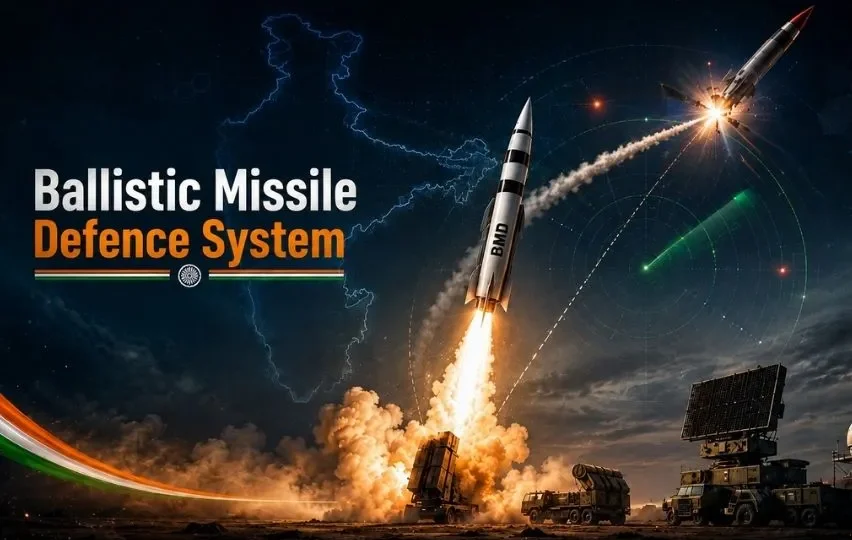
India has demonstrated its growing strength in multi-layered Ballistic Missile Defence (BMD) capability, marking a major milestone in the country’s defence preparedness. The development reflects India’s focus on building an Atmanirbhar Bharat and a Surakshit Bharat through advanced indigenous missile defence technologies.
Ballistic Missile Defence is designed to detect, track, intercept and destroy incoming ballistic missiles before they hit their target. For a country like India, located in a complex security environment, BMD strengthens strategic deterrence and improves air defence readiness.
Recent Defence Milestone
India’s successful demonstration of missile defence system places it among a select group of countries with advanced missile defence systems. Countries such as the United States, Russia, China and Israel have developed similar missile defence capabilities.
The system is significant because it provides protection against different categories of missile threats, including short-range, medium-range, intermediate-range and long-range ballistic missiles. It also shows India’s growing technological capacity in radar systems, interceptor missiles, command-control networks and real-time tracking mechanisms.
What is Ballistic Missile Defence?
Ballistic Missile Defence refers to a defensive system that intercepts ballistic missiles during different stages of their flight path. A ballistic missile is initially powered by rockets and then follows an unpowered, free-falling trajectory toward its target.
Examples of ballistic missiles include systems like Agni-V, which is part of India’s strategic missile programme.
A BMD system generally includes:
Detection and Tracking
Advanced radar systems detect an incoming missile and track its trajectory.
Command and Control
A central command system analyses the missile path and selects the most suitable interceptor.
Interception
Interceptor missiles destroy the incoming threat either inside or outside the Earth’s atmosphere.
Types of Ballistic Missile Intercepts
India’s BMD capability is described as multi-layered because it includes different interception layers.
Exo-Atmospheric Intercept
This takes place outside the Earth’s atmosphere. It is useful for destroying incoming missiles at a higher altitude before they re-enter the atmosphere.
Endo-Atmospheric Intercept
This takes place within the Earth’s atmosphere. It is used to destroy missiles in the lower phase of their flight.
Terminal Intercept
This is the final layer of defence, where the incoming missile is intercepted close to its target area. It acts as the last protective shield.
Three Phases of India’s BMD Programme
India’s BMD programme has evolved in phases to counter different missile ranges and emerging threats.
Phase I
Phase I involves PDV and AAD interceptors. These are mainly designed to counter short-range and medium-range ballistic missiles up to around 2,000 km.
Phase II
Phase II includes advanced AD-1 and AD-2 interceptors. These are designed to counter missiles with ranges up to around 5,000 km.
The AD-1 interceptor is a long-range interceptor capable of both exo-atmospheric and endo-atmospheric interception. The AD-2 interceptor is designed to intercept intermediate-range ballistic missile threats.
Phase III
Phase III is under development and focuses on future threats such as hypersonic glide vehicles and missiles with Multiple Independently Targetable Re-entry Vehicles.
This phase includes systems such as:
AD-AH: Anti-hypersonic interceptor for manoeuvring hypersonic glide vehicles.
AD-AM: Anti-missile interceptor for threats involving MIRVs.
Classification of Ballistic Missiles by Range
Ballistic missiles are classified based on their range.
SRBM
Short-Range Ballistic Missiles have a range below 1,000 km.
MRBM
Medium-Range Ballistic Missiles have a range between 1,000 km and 3,000 km.
IRBM
Intermediate-Range Ballistic Missiles have a range between 3,000 km and 5,500 km.
ICBM
Intercontinental Ballistic Missiles have a range above 5,500 km.
This classification is important for understanding why a layered defence system is necessary. Different missile ranges require different interceptors, radar coverage and response mechanisms.
Strategic Importance for India
India’s BMD capability strengthens national security in several ways. First, it provides a protective shield against missile threats targeting major cities, military bases and strategic assets. Second, it improves India’s deterrence posture by reducing vulnerability to surprise missile attacks.
Third, BMD enhances India’s technological self-reliance. Indigenous development of interceptors, radars and defence systems supports the larger vision of Atmanirbhar Bharat in defence manufacturing.
Link with India’s Defence Modernisation
India’s progress in BMD also reflects the broader modernisation of the defence sector. Along with missile defence, India has also tested systems such as the Naval Anti-Ship Missile-Medium Range (NASM-MR), showing progress in both land-based and naval defence capabilities.
Such developments are important because modern warfare is increasingly technology-driven. Air defence, missile defence, cyber systems, space-based surveillance and precision strike capabilities are becoming central to national security.
UPSC Relevance
India’s Ballistic Missile Defence capability is important for UPSC GS Paper 3, especially under defence technology, internal security, science and technology, and indigenisation of defence production.
For UPSC aspirants, this topic should be studied through the following dimensions:
Defence technology: interceptor missiles, radar systems and missile classification.
Internal security: protection of strategic assets and cities.
Strategic deterrence: India’s role in regional security.
Atmanirbhar Bharat: indigenous defence manufacturing and DRDO-led development.
Geopolitics: comparison with advanced missile defence powers.
Conclusion
India’s demonstration of multi-layered Ballistic Missile Defence capability is a major step in strengthening national security. It shows India’s progress in advanced defence technology, indigenous missile systems and strategic preparedness.
A strong BMD system does not merely protect against missile attacks; it also strengthens India’s deterrence, improves military confidence and supports the vision of a secure and self-reliant India. For UPSC preparation, this topic is highly relevant as it connects defence technology, national security, strategic autonomy and India’s growing defence capabilities.



Frequently Asked Questions on India’s Ballistic Missile Defence System
What is Ballistic Missile Defence System?
A Ballistic Missile Defence System is a security shield designed to detect, track, intercept and destroy incoming ballistic missiles before they hit their target.
What is India’s Ballistic Missile Defence capability?
India’s Ballistic Missile Defence capability is a multi-layered defence system that can intercept incoming missile threats at different stages, including exo-atmospheric, endo-atmospheric and terminal phases.
What are the phases of India’s BMD programme?
India’s BMD programme includes Phase I with PDV and AAD interceptors, Phase II with AD-1 and AD-2 interceptors, and Phase III under development for hypersonic and MIRV-based missile threats.
What is the difference between exo-atmospheric and endo-atmospheric intercept?
Exo-atmospheric intercept happens outside the Earth’s atmosphere, while endo-atmospheric intercept happens within the atmosphere. Both layers help strengthen missile defence.
Why is Ballistic Missile Defence important for UPSC?
Ballistic Missile Defence is important for UPSC because it connects with defence technology, DRDO, national security, strategic deterrence, missile systems, Atmanirbhar Bharat and India’s defence modernisation.