Table of Contents
ToggleNational Mission for Clean Ganga: Objectives, Achievements and Challenges
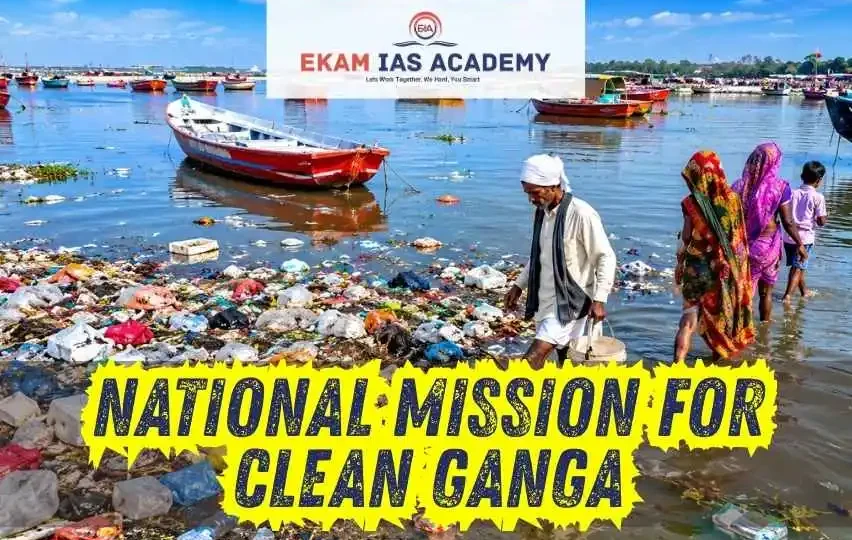
The National Mission for Clean Ganga (NMCG) serves as the primary implementation engine driving river rejuvenation in India, combining engineering interventions with community-led conservation.
Background and Institutional Framework
The history of Ganga Pollution Control began with the Ganga Action Plan (GAP) Phase-I in 1985. Recognizing the need for a holistic basin-wide strategy rather than a piecemeal state-centric approach, the National Mission for Clean Ganga (NMCG) was registered as a society in August 2011 under the Societies Registration Act, 1860.
The Organizational Structure:
National Ganga Council (NGC) – Chaired by Prime Minister
│
▼
NMCG Governing Council – Formulates Strategic Direction
│
▼
NMCG Executive Committee – Financial Approvals up to ₹1,000 Cr
│
▼
State Programme Management Groups (SPMGs) & District Ganga Committees
NMCG acts as the statutory executive arm of the National Ganga Council (NGC), which replaced the older National Ganga River Basin Authority (NGRBA) in 2016. Functioning under the Ministry of Jal Shakti, NMCG coordinates field-level operations across the five core main-stem states: Uttarakhand, Uttar Pradesh, Bihar, Jharkhand, and West Bengal.
The Namami Gange Programme: Objectives & Core Components
Launched as a flagship initiative in June 2014, the Namami Gange Programme was structured with an initial budget outlay of ₹20,000 crore, which was subsequently expanded to over ₹42,500 crore. The program addresses Ganga River Conservation through eight fundamental pillars:
| S.No. | Namami Gange Pillar |
|---|---|
| 1 | Sewerage Infrastructure |
| 2 | River-Front Development |
| 3 | Surface Cleaning |
| 4 | Bio-Diversity |
| 5 | Afforestation |
| 6 | Public Awareness |
| 7 | Industrial Effluents |
| 8 | Ganga Gram (Rural ODF) |
Key Achievements and Recent Developments
The transition into Namami Gange Mission 2.0 (extended through March 2026) has yielded measurable improvements in water quality and ecological health:
- Sewage Treatment Milestones: Over 524 projects have been sanctioned, establishing major state-of-the-art Sewage Treatment Plants (STPs) using the Hybrid Annuity Model (HAM) and DBOT frameworks to share financial risks with private developers.
- Ecological Revival: Focused interventions have resulted in a significant resurgence of the endangered Gangetic Dolphin (with a record nationwide count of 6,324 dolphins). To boost the aquatic food chain, over 203 lakh native fish fingerlings have been ranched into the river system.
- Scientific Monitoring: Water quality data collected across 112 dedicated monitoring stations shows that Dissolved Oxygen (DO) and pH levels consistently meet prescribed bathing standards across the vast majority of the river’s main stem.
- The “Arth Ganga” Paradigm: This model focuses on building a sustainable circular water economy by promoting zero-budget natural farming along the basin, advancing the reuse of treated wastewater, and supporting eco-tourism trails.
Challenges and Way Forward
Despite these milestones, several persistent issues challenge river conservation schemes in India:
- The Point-Source Pollution Gap: While municipal wastewater treatment has scaled up significantly, toxic industrial effluents from chemical and textile clusters occasionally bypass treatment frameworks.
- Fecal Coliform Violations: Despite lower Biological Oxygen Demand (BOD) across several segments, localized patches around industrial and high-density urban areas (such as Kanpur and Mirzapur-Ghazipur) continue to show elevated fecal coliform levels.
- Urban-River Friction: Rapidly growing urban centers often lack localized stormwater infrastructure, causing raw sewage to overflow into the basin during monsoon periods.
The Strategy Moving Forward:
To sustain these gains, the governance framework is integrating Urban River Management Plans (URMPs) through the River Cities Alliance (RCA) to weave river health into urban master planning. Expanding decentralized wastewater recycling, leveraging the Global River Cities Alliance (GRCA) for international knowledge transfer, and strengthening District Ganga Committees will solidify the gains of this vital mission.
Conclusion
Evaluating the National Mission for Clean Ganga UPSC metrics reveals that reviving a massive river basin requires shifting from simple infrastructure building to a comprehensive socio-ecological model. By combining scientific tracking, public participation, and a circular water economy under the Arth Ganga framework, the NMCG provides a valuable blueprint for river rejuvenation across India.
UPSC Prelims: PYQs & Practice Questions
Previous Year Questions (Prelims)
UPSC CSE Prelims 2016
Q: Which of the following are the key objectives of the 'Namami Gange Programme' launched by the Central Government?
1. Effective abatement of pollution, conservation, and rejuvenation of the National River Ganga.
2. Creating a 100-kilometer industrial corridor along the river banks to generate employment.
3. Development of 'Ganga Gram' in villages situated along the river to ensure Open Defecation Free (ODF) status.
Select the correct answer using the code given below:
(a) 1 and 2 only
(b) 1 and 3 only
(c) 2 and 3 only
(d) 1, 2 and 3
Answer: (b) 1 and 3 only
Explanation:
Statements 1 and 3 are correct. The core focus of Namami Gange is pollution abatement, river rejuvenation, and creating a sanitation buffer through Ganga Grams to eliminate open defecation. Statement 2 is incorrect because the programme aims to restrict and regulate heavy industrial encroachment along river banks rather than promoting a massive industrial corridor.
UPSC CSE Prelims 2015
Q: With reference to the National Ganga River Basin Authority (NGRBA), consider the following statements:
1. The River Basin is the unit of planning and management.
2. It spearheads the river conservation efforts at the national level.
3. One of the Chief Ministers of the states through which the Ganga flows becomes the Chairman of NGRBA on a rotation basis.
Which of the statements given above is/are correct?
(a) 1 and 2 only
(b) 2 and 3 only
(c) 1 and 3 only
(d) 1, 2 and 3
Answer: (a) 1 and 2 only
Explanation:
Statements 1 and 2 are correct. The NGRBA pioneered the structural shift toward viewing the entire river basin as an interconnected planning unit. Statement 3 is incorrect because the NGRBA was chaired by the Prime Minister of India, not by state Chief Ministers. In 2016, the NGRBA was replaced by the National Ganga Council (NGC), which is also chaired by the Prime Minister.
Practice Questions
Q: In the context of the newly introduced "Arth Ganga" concept under the National Mission for Clean Ganga (NMCG), consider the following statements:
1. It aims to bridge the gap between environmental conservation and economic development by creating a sustainable livelihood model along the Ganga basin.
2. It completely bans agricultural practices within a 5 km radius of the river to prevent fertilizer runoff.
3. It promotes the monetization and reuse of treated wastewater and sludge from STPs for industrial and agricultural applications.
Which of the statements given above is/are correct?
(a) 1 only
(b) 1 and 3 only
(c) 2 and 3 only
(d) 1, 2 and 3
Answer: (b) 1 and 3 only
Explanation:
Statements 1 and 3 are correct. Arth Ganga is a sustainable economic model focused on natural farming, livelihood generation, and wastewater monetization. Statement 2 is incorrect because it does not ban agriculture; instead, it encourages farmers to shift toward Zero-Budget Natural Farming (ZBNF) and organic cultivation along river corridors to reduce chemical runoff.
Q: The Executive Committee of the National Mission for Clean Ganga (NMCG) holds the statutory authority to independently accord financial approvals for river rejuvenation projects up to which monetary threshold?
(a) ₹100 crore
(b) ₹500 crore
(c) ₹1,000 crore
(d) ₹5,000 crore
Answer: (c) ₹1,000 crore
Explanation:
Under the revamped administrative structure of 2016 designed to fast-track decisions and reduce bureaucratic delays, the NMCG Executive Committee was empowered to grant final financial approvals for infrastructure and sewerage projects costing up to ₹1,000 crore without requiring separate ministerial clearance.
UPSC Mains – Previous Year & Practice Questions
Mains Previous Year Questions
Mains 2024
Question: Analyze the factors responsible for the high level of pollution in Indian rivers despite decades of centralized river cleanup initiatives.
Requires a deep case study of the bottlenecks faced by NMCG in sectors like Kanpur's tanneries.
Mains 2021
Question: Explain the concept of Environmental Flows (E-Flows) in the context of river ecosystem restoration. Assess its implementation challenges in India's major perennial rivers.
Directly maps to NMCG's mandatory E-flow notifications for the Ganga.
Mains 2019
Question: What are the socio-economic implications of the severe degradation of major freshwater river basins in India?
Links directly to why the Arth Ganga economic framework was introduced.
Mains 2016
Question: Environmental degradation cannot be tackled by state regulations alone; it requires active corporate accountability and community-led green initiatives. Elaborate.
Allows discussion on the role of Ganga Praharis and public participation under Namami Gange.
Mains 2015
Question: Cleanliness of rivers is not possible without an effective urban solid waste management system. Critically analyze with reference to towns situated along the river Ganga.
Mains Practice Questions
[15 Marks | 250 Words]
Question: Examine how the Arth Ganga paradigm transforms the Namami Gange Programme from a pure engineering-centric pollution cleanup initiative into a sustainable socio-economic movement.
[10 Marks | 150 Words]
Question: The deployment of the Hybrid Annuity Model (HAM) for building Sewage Treatment Plants (STPs) has significantly improved private sector accountability under the NMCG. Explain the economic logic behind this model and its impact on infrastructure sustainability.
[15 Marks | 250 Words]
Question: Balancing Nirmal Dhara — unpolluted water — with Aviral Dhara — continuous ecological flow — presents a complex regulatory challenge due to upstream hydroelectric and irrigation demands. Critically analyze how the NMCG balances these competing interests.



National Mission for Clean Ganga-FAQs
What is the National Mission for Clean Ganga?
The National Mission for Clean Ganga is the executive body responsible for implementing the Namami Gange Programme and coordinating Ganga river conservation, pollution control and basin-level rejuvenation.
What is the Namami Gange Programme?
Namami Gange is a flagship government programme launched in 2014 to clean and rejuvenate the River Ganga through sewage treatment, riverfront development, biodiversity conservation, afforestation, public awareness and industrial pollution control.
Which ministry implements the National Mission for Clean Ganga?
The National Mission for Clean Ganga functions under the Ministry of Jal Shakti. It works with State Programme Management Groups and District Ganga Committees across major Ganga basin states.
What are Aviral Dhara and Nirmal Dhara?
Aviral Dhara means maintaining continuous ecological flow in the river, while Nirmal Dhara means ensuring clean and pollution-free river water. Both are core objectives of Ganga rejuvenation.
Why is National Mission for Clean Ganga important for UPSC?
National Mission for Clean Ganga is important for UPSC because it connects with river conservation, Namami Gange, water pollution, sewage treatment, biodiversity, Gangetic Dolphin, Arth Ganga, urban governance and sustainable development.